Results by title
7 books match the query 'Race awareness in literature'
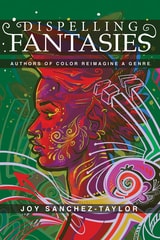
Dispelling Fantasies
Authors of Color Reimagine a GenreJoy Sanchez-Taylor
The Ohio State University Press, 2025
In Dispelling Fantasies, Joy Sanchez-Taylor examines how authors of color, such as R. F. Kuang, N. K. Jemisin, Nnedi Okorafor, Tomi Adeyemi, Tasha Suri, Aiden Thomas, Nghi Vo, and Marlon James, among others, offer critical counterpoints to the history of white-dominated, Eurocentric fantasy. The traditional fantasy that these authors are writing against reinforces Christian virtues and colonial, white supremacist structures; Sanchez-Taylor argues that its racial tropes are tied to a history of colonization and Christian missionary practices, with popular fantasy narratives often depicting Indigenous groups as primitive, deviant peoples in need of salvation. Such representations are based on a Western binary of rational versus magical and are influenced by tenets of Christianity, ultimately contributing to depictions of “the dark fantastic” or fantasy worlds where dark and othered characters are implicitly portrayed as evil and irredeemable. Organized around four Christian ideals that appear frequently in Western fantasy texts—virtue, envy, patriarchy, and salvation—Dispelling Fantasies demonstrates how non-Eurocentric fantasy worlds offer alternative versions of morality, race, gender, and sexuality and make space for authors to move away from hierarchical, binary systems of good and evil.
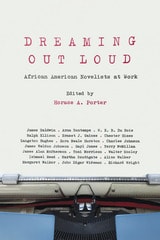
Dreaming Out Loud
African American Novelists at WorkHorace Porter
University of Iowa Press, 2015
Some essays explore the challenges of being an African American writer in the United States, broadly addressing aesthetic and racial prejudice in American publishing and literature and its changing face over the decades. Others are more specific and personal, recounting how the authors came to be a reader and writer in a culture that did not always encourage them to do so. Some are more general and focus on practice and craft, while still other essays offer detailed behind-the-scenes accounts of how famous novels, such as Native Son, Invisible Man, The Autobiography of Miss Jane Pittman, and The Color Purple, came to life. Ranging from the Harlem Renaissance, through the Civil Rights movement, and into the twenty-first century, this anthology explores what it has meant to be an African American novelist over the past hundred years.
Found within are essays by twenty-one African American novelists, including Nobel Prize-winner Toni Morrison, National Book Award-winners Ralph Ellison and Charles Johnson, Pulitzer Prize-winners Alice Walker and James Alan McPherson, and well-known canonical writers such as W. E. B. Du Bois, James Weldon Johnson, Langston Hughes, Richard Wright, Zora Neale Hurston, and Margaret Walker. Dreaming Out Loud seeks to inspire writers and readers alike, while offering a fascinating and important portrait of novelists at work in their own words.
CONTRIBUTORS
James Baldwin, Arna Bontemps, W. E. B. Du Bois, Ralph Ellison, Ernest Gaines, Chester Himes, Langston Hughes, Zora Neale Hurston, Charles Johnson, James Weldon Johnson, Gayl Jones, Terry McMillan, James Alan McPherson, Toni Morrison, Walter Mosley, Ishmael Reed, Martha Southgate, Alice Walker, Margaret Walker, John Edgar Wideman, Richard Wright
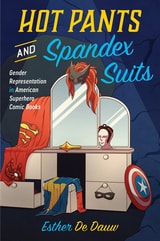
Hot Pants and Spandex Suits
Gender Representation in American Superhero Comic BooksEsther De Dauw
Rutgers University Press, 2021
Hot Pants and Spandex Suits offers a far-reaching look at how masculinity and femininity have been represented in American superhero comics, from the Golden and Silver Ages to the Modern Age. Scholar Esther De Dauw contrasts the bulletproof and musclebound phallic bodies of classic male heroes like Superman, Captain America, and Iron Man with the figures of female counterparts like Wonder Woman and Supergirl, who are drawn as superhumanly flexible and plastic. It also examines the genre’s ambivalent treatment of LGBTQ representation, from the presentation of gay male heroes Wiccan and Hulkling as a model minority couple to the troubling association of Batwoman’s lesbianism with monstrosity. Finally, it explores the intersection between gender and race through case studies of heroes like Luke Cage, Storm, and Ms. Marvel.
Hot Pants and Spandex Suits is a fascinating and thought-provoking consideration of what superhero comics teach us about identity, embodiment, and sexuality.
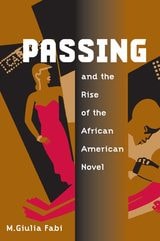
Passing and the Rise of the African American Novel
M. Giulia Fabi
University of Illinois Press, 2001
Focusing on the trope of passing--black characters lightskinned enough to pass for white--M. Giulia Fabi shows how early African American authors such as William Wells Brown, Frank J. Webb, Charles W. Chesnutt, Sutton E. Griggs, Frances E. W. Harper, Edward A. Johnson, and James Weldon Johnson transformed traditional representations of blackness and moved beyond the tragic mulatto motif. Challenging the myths of racial purity and the color line, these authors used passing to celebrate a distinctive, African American history, culture, and worldview.
Fabi examines how early black writers adapted existing literary forms, including the sentimental romance, the domestic novel, and the utopian novel, to express their convictions and concerns about slavery, segregation, and racism. Chesnutt used passing as both a structural and a thematic element, while James Weldon Johnson innovated by parodying the earlier novels of passing and presenting the decision to pass as the result, rather than the cause, of cultural alienation. Fabi also gives a historical overview of the canon-making enterprises of African American critics from the 1850s to the 1990s and considers how their concerns about promoting the canonization of African American literature affected their perceptions of nineteenth-century black fiction.
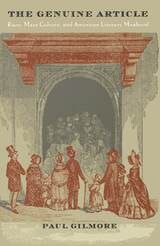
The Genuine Article
Race, Mass Culture, and American Literary ManhoodPaul Gilmore
Duke University Press, 2001
From characters in Indian melodramas and minstrel shows to exhibits in popular museums and daguerrotype galleries, primitive racialized figures circulated as “the genuine article” of manliness in the antebellum United States. Gilmore argues that these figures were manipulated, translated, and adopted not only by canonical authors such as Hawthorne, Thoreau, Cooper, and Melville but also by African American and Native American writers like William Wells Brown and Okah Tubbee. By examining how these cultural notions of race played out in literary texts and helped to construct authorship as a masculine profession, Gilmore makes a unique contribution to theories of class formation in nineteenth-century America.
The Genuine Article will enrich students and scholars of American studies, gender studies, literature, history, sociology, anthropology, popular culture, and race.
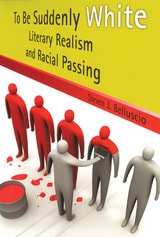
To Be Suddenly White
Literary Realism and Racial PassingSteven J. Belluscio
University of Missouri Press, 2006
To Be Suddenly White offers new readings of traditional passing narratives from the African American literary tradition, such as James Weldon Johnson’s The Autobiography of an Ex-Coloured Man, Nella Larsen’s Passing, and George Schuyler’s Black No More. It is also the first full-length work to consider a number of Jewish American and Italian American prose texts, such as Mary Antin’s The Promised Land, Anzia Yezierska’s Bread Givers, and Guido d’Agostino’s Olives on the Apple Tree, as racial passing narratives in their own right. Belluscio also demonstrates the contradictions that result from the passing narrative’s exploration of racial subjectivity, racial difference, and race itself.
When they are seen in comparison, ideological differences begin to emerge between African American passing narratives and “white ethnic” (Jewish American and Italian American) passing narratives. According to Belluscio, the former are more likely to engage in a direct critique of ideas of race, while the latter have a tendency to become more simplistic acculturation narratives in which a character moves from a position of ethnic difference to one of full American identity.
The desire “to be suddenly white” serves as a continual point of reference for Belluscio, enabling him to analyze how writers, even when overtly aware of the problematic nature of race (especially African American writers), are also aware of the conditions it creates, the transformations it provokes, and the consequences of both. Byexamining the content and context of these works, Belluscio elucidates their engagement with discourses of racial and ethnic differences, assimilation, passing, and identity, an approach that has profound implications for the understanding of American literary history.

Under the Sky of My Africa
Alexander Pushkin and BlacknessCatherine Nepomnyashchy
Northwestern University Press, 2006
Roughly in the year 1705, a young African boy, acquired from the seraglio of the Turkish sultan, was transported to Russia as a gift to Peter the Great. This child, later known as Abram Petrovich Gannibal, was to become Peter's godson and to live to a ripe old age, having attained the rank of general and the status of Russian nobility. More important, he was to become the great-grandfather of Russia's greatest national poet, Alexander Pushkin. It is the contention of the editors of this book, borne out by the essays in the collection, that Pushkin's African ancestry has played the role of a "wild card" of sorts as a formative element in Russian cultural mythology; and that the ways in which Gannibal's legacy has been included in or excluded from Pushkin's biography over the last two hundred years can serve as a shifting marker of Russia's self-definition.
The first single volume in English on this rich topic, Under the Sky of My Africa addresses the wide variety of interests implicated in the question of Pushkin's blackness-race studies, politics, American studies, music, mythopoetic criticism, mainstream Pushkin studies. In essays that are by turns biographical, iconographical, cultural, and sociological in focus, the authors-representing a broad range of disciplines and perspectives-take us from the complex attitudes toward race in Russia during Pushkin's era to the surge of racism in late Soviet and post-Soviet contemporary Russia. In sum, Under the Sky of My Africa provides a wealth of basic material on the subject as well as a series of provocative readings and interpretations that will influence future considerations of Pushkin and race in Russian culture.