Results by title
119 books match the query 'Race in literature' and 7 start with a
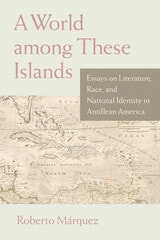
A World among These Islands
Essays on Literature, Race, and National Identity in Antillean AmericaRoberto Marquez
University of Massachusetts Press, 2010
Caribbean literature and culture have all too often been viewed in fragmented terms, without attention to the broader commonalities of the region. In this collection of essays written over many years, Roberto Márquez offers a more encompassing vision, one that respects the individual traditions of particular locales, languages, and cultures but also sees the larger themes that bind the area's literary heritage and history. Márquez begins by making the case for a genuinely Caribbean literary criticism, one that moves beyond the colonial history of fragmentation and isolation and the critical insularity of more conventional approaches. His pan-Caribbean perspective provides a point of departure for the scrutiny of the evolving dramas of race, nationality, nation-building, and cultural articulation in the region. Márquez then focuses specifically on Puerto Rico—its literary and socio—historical experience, the particularities of its “New Creole” incarnations, and the effects of waves of migration to the United States. In the final section of the book, he discusses writers and cultural figures from the other Spanish, Anglophone, and Francophone territories and the ways in which they engage or reflect the defining themes of literature, race, and national identity in Antillean America.
Abandoning the Black Hero
Sympathy and Privacy in the Postwar African American White-Life NovelCharles, John C
Rutgers University Press, 2012
Abandoning the Black Hero is the first book to examine the postwar African American white-life novel—novels with white protagonists written by African Americans. These fascinating works have been understudied despite having been written by such defining figures in the tradition as Richard Wright, Zora Neale Hurston, James Baldwin, Ann Petry, and Chester Himes, as well as lesser known but formerly best-selling authors Willard Motley and Frank Yerby.
John C. Charles argues that these fictions have been overlooked because they deviate from two critical suppositions: that black literature is always about black life and that when it represents whiteness, it must attack white supremacy. The authors are, however, quite sympathetic in the treatment of their white protagonists, which Charles contends should be read not as a failure of racial pride but instead as a strategy for claiming creative freedom, expansive moral authority, and critical agency.
In an era when “Negro writers” were expected to protest, their sympathetic treatment of white suffering grants these authors a degree of racial privacy previously unavailable to them. White writers, after all, have the privilege of racial privacy because they are never pressured to write only about white life. Charles reveals that the freedom to abandon the “Negro problem” encouraged these authors to explore a range of new genres and themes, generating a strikingly diverse body of novels that significantly revise our understanding of mid-twentieth-century black writing.
Africa in the Indian Imagination
Race and the Politics of Postcolonial CitationAntoinette Burton
Duke University Press, 2016
All New, All Different?
A History of Race and the American SuperheroBy Allan W. Austin and Patrick L. Hamilton
University of Texas Press, 2019
Winner, John G. Cawelti Award for the Best Textbook/Primer, Popular Culture Association/American Culture Association, 2019
MPCA/ACA Book Award, Midwest Popular Culture Association / Midwest American Culture Association, 2020
Taking a multifaceted approach to attitudes toward race through popular culture and the American superhero, All New, All Different? explores a topic that until now has only received more discrete examination. Considering Marvel, DC, and lesser-known texts and heroes, this illuminating work charts eighty years of evolution in the portrayal of race in comics as well as in film and on television.
Beginning with World War II, the authors trace the vexed depictions in early superhero stories, considering both Asian villains and nonwhite sidekicks. While the emergence of Black Panther, Black Lightning, Luke Cage, Storm, and other heroes in the 1960s and 1970s reflected a cultural revolution, the book reveals how nonwhite superheroes nonetheless remained grounded in outdated assumptions. Multiculturalism encouraged further diversity, with 1980s superteams, the minority-run company Milestone’s new characters in the 1990s, and the arrival of Ms. Marvel, a Pakistani-American heroine, and a new Latinx Spider-Man in the 2000s. Concluding with a discussion of contemporary efforts to make both a profit and a positive impact on society, All New, All Different? enriches our understanding of the complex issues of racial representation in American popular culture.
Archives of Labor
Working-Class Women and Literary Culture in the Antebellum United StatesLori Merish
Duke University Press, 2017
Asian Ameritopias
Asian American Speculative FictionsStephen Hong Sohn
Temple University Press, 2026
Asian American writers have long produced literary works of speculative fiction, the supergenre that employs science fictional, fantastical, or supernatural elements. Stephen Hong Sohn’s Asian Ameritopias is the first book-length study to consider how these aesthetically complex and wildly imaginative representations offer writers a way to explore themes of race and identity, as well as alternate futures and other planets.
Sohn examines how various novels and stories enable Asian American writers to engage with and reimagine issues of social justice, revisualize the bounds of social collectives, and create new pathways for precarious subjects. Asian Ameritopias assesses speculative fictions that spotlight supernatural horror and fantasy, such as ghosts and magical objects, to excavate racialized histories of oppression. Moving to science fiction, Sohn shows how Asian American cyborgs employ their technological powers to offer protection for socially marginalized groups, including sex workers, the undocumented, the poor, and the injured. He ends by analyzing three novels featuring extraterrestrials who look like Asian Americans in order to address issues of xenophobia and ostracization.
The speculative fictions Sohn unpacks in Asian Ameritopias provide a ripe opportunity to reflect on and confront our current, turbulent reality.
Authentic Blackness
The Folk in the New Negro RenaissanceJ. Martin Favor
Duke University Press, 1999
Authentic Blackness looks at the place of the “folk”—those African Americans “furthest down,” in the words of Alain Locke—and how the representation of the folk and the black middle class both spurred the New Negro Movement and became one of its most serious points of contention. Drawing on vernacular theories of African American literature from such figures as Henry Louis Gates Jr. and Houston Baker as well as theorists Judith Butler and Stuart Hall, Favor looks closely at the work of four Harlem Renaissance fiction writers: James Weldon Johnson, Nella Larsen, George Schuyler, and Jean Toomer. Arguing that each of these writers had, at best, an ambiguous relationship to African American folk culture, Favor demonstrates how they each sought to redress the notion of a fixed black identity. Authentic Blackness illustrates how “race” has functioned as a type of performative discourse, a subjectivity that simultaneously builds and conceals its connections with such factors as class, gender, sexuality, and geography.