Results by title
6 books match the query 'Racine'

Blue Jenkins
Working for WorkersJulia Pferdehirt
Wisconsin Historical Society Press, 2011
More Plays by Rivals of Corneille and Racine
Lacy Lockert
Vanderbilt University Press, 0
Racine and English Classicism
By Katherine E. Wheatley
University of Texas Press, 1956
Literary historians and critics who have written on the influence of Racine in England during the neoclassical period apparently have assumed that the English translators and adapters of Racine’s plays in general succeeded in presenting the real Racine to the English public.
Katherine Wheatley here reveals the wide discrepancy between avowed intentions and actual results. Among the English plays she compares with their French originals are Otway’s Titus and Berenice, Congreve’s The Mourning Bride, and Philips’s The Distrest Mother. These comparisons, fully supported by quoted passages, reveal that those among the English public and contemporary critics who could not themselves read French had no chance whatever to know the real Racine: “The adapters and translators, so-called, had eliminated Racine from his tragedies before presenting them to the public.” Unacknowledged excisions and additions, shifts in plot, changes in dénouement, and frequent mistranslation turned Racine’s plays into “wretched travesties.” Two translations of Britannicus, intended for reading rather than for acting, are especially revealing in that they show which Racinian qualities eluded the British translators even when they were not trying to please an English theatergoing audience.
Why it is, asks the author, that no English dramatist could or would present Racine as he is to the English public of the neoclassical period? To answer this question she traces the development of Aristotelian formalism in England, showing the relation of the English theory of tragedy to French classical doctrine and the relation of the English adaptations of Racine to the English neoclassical theory of tragedy. She concludes that “deliberate alterations made by the English, far from violating classical tenets, bring Racine’s tragedies closer to the English neoclassical ideal than they were to begin with, and this despite the fact that some tenets of English doctrine came from parallel tenets widely accepted in France.” She finds that “in the last analysis, French classical doctrine was itself a barrier to the understanding of Racinian tragedy in England and an incentive to the sort of change English translators and adapters made in Racine.” This paradox she explains by the fact that Racine himself had broken with the classical tradition as represented by Corneille.

Racine
From Ancient Myth to Tragic ModernityMitchell Greenberg
University of Minnesota Press, 2009
A study of all of the major tragedies of Jean Racine, France's preeminent dramatist-and, according to many, its greatest and most representative author-Mitchell Greenberg's work offers an exploration of Racinian tragedy to explain the enigma of the plays' continued fascination.
Greenberg shows how Racine uses myth, in particular the legend of Oedipus, to achieve his emotional power. In the seventeenth-century tragedies of Racine, almost all references to physical activity were banned from the stage. Yet contemporary accounts of the performances describe vivid emotional reactions of the audiences, who were often reduced to tears. Greenberg demonstrates how Racinian tragedy is ideologically linked to Absolutist France's attempt to impose the "order of the One" on its subjects. Racine's tragedies are spaces where the family and the state are one and the same, with the result that sexual desire becomes trapped in a closed, incestuous, and highly formalized universe.
Greenberg ultimately suggests that the politics and sexuality associated with the legend of Oedipus account for our attraction to charismatic leaders and that this confusion of the state with desire explains our continued fascination with these timeless tragedies.
The Chief Rivals of Corneille and Racine
Lacy Lockert
Vanderbilt University Press, 0
No play by any of these dramatists, except Voltaire, has ever before been translated into English. The faithfulness and literary qualities of Dr. Lockert's translations are avouched by his two previous volumes in this field, The Chief Plays of Corneille and The Best Plays of Racine.
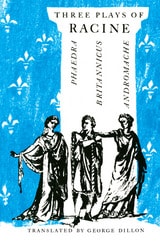
Three Plays of Racine
Phaedra, Andromache, and BritannicusJean Baptiste Racine
University of Chicago Press, 1961
"His literal and flexible blank verse actually forms the nearest thing in English to the longer-measured rhymed couplets of Racine; even an ordinary reading aloud of so faithful a rendering provides something of the experience that Proust described."—Elliott Coleman, Poetry
"A superb introduction . . . flawless translations, infused with poetic fire and charm."—Margaret Carpenter, Norfolk Virginian-Pilot