Results by title

19 books match the query 'Racism against Black people'

cover of A Wide Net of Solidarity: Antiracism and Anti-Imperialism from the Americas to the Globe

A Wide Net of Solidarity

Antiracism and Anti-Imperialism from the Americas to the Globe

Anne Garland Mahler

Duke University Press, 2025
In A Wide Net of Solidarity, Anne Garland Mahler traces the impact of the Anti-Imperialist League of the Americas (LADLA, Liga Antimperialista de las Américas) on racial justice and anti-extractive struggles from the early twentieth century to the present. Founded in 1925 in Mexico City by a group of multinational activists, LADLA brought together trade unions, agrarian organizations, and artist groups across fourteen chapters in the Americas, with highest activity in the Greater Caribbean and United States. Within two years, LADLA activists joined the League Against Imperialism, formed at the 1927 Brussels Congress, where they met with US Black activists and anticolonial leaders from Africa and Asia. Drawing on extensive archival research, Mahler uncovers LADLA’s role in fostering Black, Indigenous, and immigrant-led resistance movements while positioning these struggles within a broader hemispheric and global struggle against the racialized accumulation of capital. By unearthing LADLA’s multiracial analysis of capitalist exploitation as well as its emphasis on mutual solidarity across difference, Mahler shows us how the organization provides vital insight for social movements fighting racial and economic injustice today.
[more]
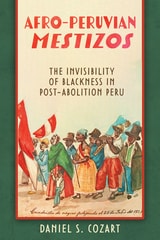
cover of Afro-Peruvian Mestizos: The Invisibility of Blackness in Post-Abolition Peru

Afro-Peruvian Mestizos

The Invisibility of Blackness in Post-Abolition Peru

Daniel S. Cozart

University of Alabama Press, 2025

A transformative study by Daniel S. Cozart, Afro-Peruvian Mestizos redefines the narrative of mestizaje in post-abolition Peru, uncovering the hidden histories and enduring strength of Afro-Peruvian communities.

Afro-Peruvian Mestizos: The Invisibility of Blackness in Post-Abolition Peru by Daniel S. Cozart investigates the ideologies of mestizaje, or racial mixing, that Latin American elites used to construct modern national identities during the nineteenth and twentieth centuries. Through close reading of archival records, legal documents, and literary works, Cozart uncovers the systematic exclusion of Afro-Peruvians from the nation's narrative of progress, revealing how their presence was deliberately omitted from official histories and censuses. The abolition of slavery in 1855 marked the beginning of a process where Afro-Peruvians were marginalized, their identities overshadowed by a national narrative that prioritized Indigenous heritage and whiteness.

Drawing on Michel-Rolph Trouillot's framework of historical production, the book traces the contradictions inherent in liberal and positivist ideologies that sought to forge a "raceless" society, all while silencing Afro-Peruvian voices and erasing their history. The conclusion reflects on the significance of erasure for Afro-Peruvians in the twentieth and twenty-first centuries, as they now demand to be seen. This book is a powerful examination of historical silences and the ongoing struggle for recognition in the face of systemic racism.
[more]
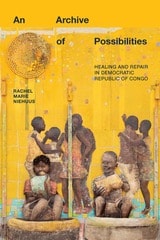
cover of An Archive of Possibilities: Healing and Repair in Democratic Republic of Congo

An Archive of Possibilities

Healing and Repair in Democratic Republic of Congo

Rachel Marie Niehuus

Duke University Press, 2024

In An Archive of Possibilities, anthropologist and surgeon Rachel Marie Niehuus explores possibilities of healing and repair in the eastern Democratic Republic of Congo against a backdrop of 250 years of Black displacement, enslavement, death, and chronic war. Niehuus argues that in a context in which violence characterizes everyday life, Congolese have developed innovative and imaginative ways to live amid and mend from repetitive harm. Drawing on ethnographic fieldwork and the Black critical theory of Achille Mbembe, Christina Sharpe, Alexis Pauline Gumbs and others, Niehuus explores the renegotiation of relationships with land as a form of public healing, the affective experience of living in insecurity, the hospital as a site for the socialization of pain, the possibility of necropolitical healing, and the uses of prophesy to create collective futures. By considering the radical nature of cohabitating with violence, Niehuus demonstrates that Congolese practices of healing imagine and articulate alternative ways of living in a global regime of antiblackness.
[more]
cover of Anti-Blackness and Human Monstrosity in Black American Horror Fiction

Anti-Blackness and Human Monstrosity in Black American Horror Fiction

Jerry Rafiki Jenkins

The Ohio State University Press, 2024

In Anti-Blackness and Human Monstrosity in Black American Horror Fiction, Jerry Rafiki Jenkins examines four types of human monsters that frequently appear in Black American horror fiction—the monsters of White rage, respectability, not-ness, and serial killing. Arguing that such monsters represent specific ideologies of American anti-Blackness, Jenkins shows that despite their various motivations for harming and killing Black people, these monsters embody the horrors that emerge when Black American is disassociated from American. Although these monsters of anti-Blackness are dangerous because they can terrorize Black people with virtual impunity, their anti-Black sadism, as Jenkins calls it, is what makes them repulsive. Jenkins examines a variety of these monstrous forms in Tananarive Due's The Between, Victor LaValle's The Changeling, Octavia Butler's Kindred, Nnedi Okorafor's Who Fears Death, and many other works. While these monsters and the texts that they populate ask us to think about the role that anti-Blackness plays in being or becoming American, they also offer intellectual resources that Black and non-Black people might use to combat the everyday versions of human monstrosity.
[more]
cover of Black Life Matter: Blackness, Religion, and the Subject

Black Life Matter

Blackness, Religion, and the Subject

Biko Mandela Gray

Duke University Press, 2022
In Black Life Matter, Biko Mandela Gray offers a philosophical eulogy for Aiyana Stanley-Jones, Tamir Rice, Alton Sterling, and Sandra Bland that attests to their irreducible significance in the face of unremitting police brutality. Gray employs a theoretical method he calls “sitting-with”—a philosophical practice of care that seeks to defend the dead and the living. He shows that the police who killed Stanley-Jones and Rice reduced them to their bodies in ways that turn black lives into tools that the state uses to justify its violence and existence. He outlines how Bland’s arrest and death reveal the affective resonances of blackness, and he contends that Sterling’s physical movement and speech before he was killed point to black flesh as unruly living matter that exceeds the constraints of the black body. These four black lives, Gray demonstrates, were more than the brutal violence enacted against them; they speak to a mode of life that cannot be fully captured by the brutal logics of antiblackness.
[more]
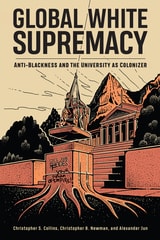
cover of Global White Supremacy: Anti-Blackness and the University as Colonizer

Global White Supremacy

Anti-Blackness and the University as Colonizer

Christopher S. Collins

Rutgers University Press, 2023
Knowledge is more expansive than the boundaries of the Western university model and its claim to be the dominant—or only—rigorous house of knowledge. In the former colonies of Europe (e.g., South Africa, Brazil, and Oceania), the curriculum, statues, architectures, and other aspects of the university demonstrate the way in which it is a fixture in empire maintenance. The trajectory of global White supremacy is deeply historical and contemporary—it is a global, transnational, and imperial phenomenon. White supremacy is sustained through the construction of inferiority and anti-Blackness. The context, history, and perspective offered by Collins, Newman, and Jun should serve as an introduction to the disruption of the ways in which university and academic dispositions have and continue to serve as sites of colonial and White supremacist preservation—as well as sites of resistance. 
 
[more]
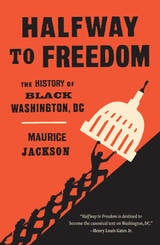
cover of Halfway to Freedom: The History of Black Washington, DC

Halfway to Freedom

The History of Black Washington, DC

Maurice Jackson. Foreword by Lonnie G. Bunch III.

Duke University Press, 2026

Halfway to Freedom is a social, political, intellectual, and cultural history of African Americans in Washington, DC, looking at the role that race, gender, color, culture, class, and power have played in the city and its relationship with the federal government, the nation, and the world.

For more than two hundred years, the history and culture of the District of Columbia have been in great part shaped by its Black residents. Several Black men were elected to political positions citywide only a handful of years after the end of the Civil War, and while the years after Reconstruction saw the region plagued with segregation and racial violence, the capital’s Black population continued to grow at all economic levels. Washington became the first major US city with a majority Black population in 1957, a status it held for almost seventy years as gentrification has led to the decline of Black political and economic power in DC in the twenty-first century. 
 
Halfway to Freedom is a social, political, intellectual, and cultural history of African Americans in Washington, DC; it explores the role that race, gender, color, class, and power have played in the city and its relationship with the federal government. Maurice Jackson explores the material conditions that shaped life for African Americans, free and enslaved, from the earliest moments of the District’s history to more contemporary times of organization and activism. Through an array of archival materials, especially firsthand accounts of Black residents in the area, Jackson critiques how and why DC exists as a haven within the Black American imaginary given the realities of conflict its Black residents have faced and continue to face today. In doing so, he highlights and honors the gains they have earned through the concerted struggles of labor organizations, women’s movements, sports, music, art, legal activism, and more.
[more]
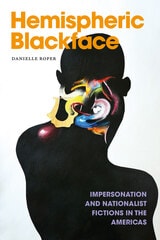
cover of Hemispheric Blackface: Impersonation and Nationalist Fictions in the Americas

Hemispheric Blackface

Impersonation and Nationalist Fictions in the Americas

Danielle Roper

Duke University Press, 2025
In Hemispheric Blackface, Danielle Roper examines blackface performance and its relationship to twentieth- and twenty-first-century nationalist fictions of mestizaje, creole nationalism, and other versions of postracialism in the Americas. Challenging both the dominance of the US minstrel tradition and the focus on the nation in blackface studies, Roper maps a hemispheric network of racial impersonation in Peru, Bolivia, Colombia, Jamaica, Cuba, and Miami. She analyzes blackface performance in the aftermath of the turn to multiculturalism in Latin America, the emergence of modern blackness in Jamaica, and the rise of Barack Obama in the United States, showing how blackface remains embedded in cultural entertainment. Contending that the Americas are linked by repeating nationalist fictions of postracialism, colorblindness, and myths of racial democracy, Roper assesses how acts of impersonation mediate the ongoing power of these narratives and enable people to comprehend advancements and reversals in racial equality. Rather than simply framing blackface as liberatory or oppressive, Roper traces its emergence from a shared history of slavery and the varied politics of racial enjoyment throughout the hemisphere.
[more]
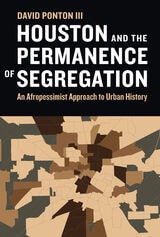
cover of Houston and the Permanence of Segregation: An Afropessimist Approach to Urban History

Houston and the Permanence of Segregation

An Afropessimist Approach to Urban History

David Ponton

University of Texas Press, 2024

2025 Most Significant Scholarly Book, Texas Institute of Letters

A history of racism and segregation in twentieth-century Houston and beyond.

Through the 1950s and beyond, the Supreme Court issued decisions that appeared to provide immediate civil rights protections to racial minorities as it relegated Jim Crow to the past. For black Houstonians who had been hoping and actively fighting for what they called a “raceless democracy,” these postwar decades were often seen as decades of promise. In Houston and the Permanence of Segregation, David Ponton argues that these were instead “decades of capture”: times in which people were captured and constrained by gender and race, by faith in the law, by antiblack violence, and even by the narrative structures of conventional histories. Bringing the insights of Black studies and Afropessimism to the field of urban history, Ponton explores how gender roles constrained thought in black freedom movements, how the “rule of law” compelled black Houstonians to view injustice as a sign of progress, and how antiblack terror undermined Houston’s narrative of itself as a “heavenly” place.

Today, Houston is one of the most racially diverse cities in the United States, and at the same time it remains one of the most starkly segregated. Ponton’s study demonstrates how and why segregation has become a permanent feature in our cities and offers powerful tools for imagining the world otherwise.

[more]
cover of I Saw Her in My Dreams

I Saw Her in My Dreams

Huda Hamed, translated by Nadine Sinno & William Taggart

University of Texas Press, 2022

I Saw Her in My Dreams is a powerful novel about interpersonal and systemic violence, examined through the lens of a relationship between Zahiyya, an anxious middle-class Omani artist, and Faneesh, the Ethiopian domestic worker she hires. When Zahiyya’s husband Amer, a novelist, leaves for Zanzibar in search of his biological mother, Zahiyya is left to confront her anxieties and prejudices. Both Zahiyya and Faneesh begin to suffer a recurring nightmare, prompting Zahiyya to read Fanheesh’s diaries in search of answers. Alone and afraid, Zahiyya reads excerpts from Amer’s novel, written from his father’s diaries about living in Zanzibar, where he fell in love with Amer’s mother, a Zanzibari woman whose absence still haunts him. Weaving between multiple perspectives and stories within stories, the novel explores honestly—but without sensationalizing or self-Orientalizing—the anti-Blackness that has endured in the Arab world and elsewhere.

[more]
cover of Malicious Intent: Murder and the Perpetuation of Jim Crow Health Care

Malicious Intent

Murder and the Perpetuation of Jim Crow Health Care

David Barton Smith

Vanderbilt University Press, 2023

“Do we want to perpetuate a Jim Crow health system?” A brilliant, idealistic physician named Jean Cowsert asked that question in Alabama in 1966. Her answer was no—and soon after, she died under suspicious circumstances. Unearthing the truth of Cowsert’s life and death is a central concern of David Barton Smith’s Malicious Intent. Unearthing the grim history of our health care system is another.

Race-related disparities in American death rates, exacerbated once again by the COVID-19 pandemic, have persisted since the birth of the modern US medical system a century ago. A unique but perpetually unequal history has prevented the United States from providing the kind of health care assurances that are taken for granted in other industrialized nations. The underlying story is one of political, medical, and bureaucratic machinations, all motivated by a deliberate Jim Crow systemic design. In Malicious Intent, David Barton Smith traces the Jean Cowsert story and the cold case of her death as a through line to explain the construction and fulfillment of an unequal health care system that would rather sacrifice many than provide for Black Americans.

Cowsert’s suspicious death came at a key moment in the struggle for universal health care in the wealthiest country on earth. Malicious Intent is a history of those failed efforts and a story of selective amnesia about one doctor’s death and the movement she fought for.

[more]
cover of Metaracial: Hegel, Antiblackness, and Political Identity

Metaracial

Hegel, Antiblackness, and Political Identity

Rei Terada

University of Chicago Press, 2023

A formidable critical project on the limits of antiracist philosophy.

Exploring anxieties raised by Atlantic slavery in radical enlightenment literature concerned about political unfreedom in Europe, Metaracial argues that Hegel's philosophy assuages these anxieties for the left. Interpreting Hegel beside Rousseau, Kant, Mary Shelley, and Marx, Terada traces Hegel's transposition of racial hierarchy into a hierarchy of stances toward reality. By doing so, she argues, Hegel is simultaneously antiracist and antiblack. In dialogue with Black Studies, psychoanalysis, and critical theory, Metaracial offers a genealogy of the limits of antiracism.
[more]
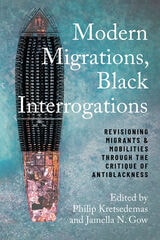
cover of Modern Migrations, Black Interrogations: Revisioning Migrants and Mobilities through the Critique of Antiblackness

Modern Migrations, Black Interrogations

Revisioning Migrants and Mobilities through the Critique of Antiblackness

Edited by Philip Kretsedemas and Jamella N. Gow

Temple University Press, 2024

Modern Migrations, Black Interrogations uses reflections on the Black experience to consider the “unasked question of blackness” in modern migration and movement. The editors and contributors use the lens of Black Studies to show how migration—compelled by force or suggestion, from the transatlantic African slave trade to the Great Migration and the current refugee crisis—has been structured to reinforce white supremacy.

Focusing on antiblackness in immigration and examining restrictions on freedom of movement and on settling alike, chapters address how Black im/mobility operates and how it can be distinguished from that of the migrant and the colonial settler, as well as from the transgressive mobilities of Indigenous populations. Looking at blackness, borders and border practices, and displacement, Modern Migrations, Black Interrogations investigates racialized boundaries that determine immigration policy, citizenship, legality, and inclusion. Additional chapters analyze communities, such as the Haitian diaspora in Miami, antiblackness in the context of Australian migration, and explore literary representations of justice, slavery and Black feminist consciousness.

Modern Migrations, Black Interrogations uses (anti)blackness to rethink the way we understand borders, immigrant identity, barriers to integration, and the dynamics of migrant exclusion, while also providing an understanding of “otherness” for Black populations across nationalities.  

Contributors: Maya Hislop, P. Khalil Saucier, Hyacinth Udah, Paula von Gleich, Tryon P. Woods, and the editors

[more]
cover of Physicians for the People: Black Doctors and the Struggle for Health-Care Equality in Alabama, 1870–1970

Physicians for the People

Black Doctors and the Struggle for Health-Care Equality in Alabama, 1870–1970

Jack D. Ellis with a foreword by Alan I Marcus

University of Alabama Press, 2025

WINNER OF THE JAMES F. SULZBY AWARD

Healing against the odds—Black doctors, bold resistance, and the fight for medical justice in Alabama.

Physicians for the People chronicles the remarkable stories of 241 Black doctors who practiced medicine in Alabama during the Jim Crow era. Historian Jack D. Ellis reveals the ingenuity and resilience of these trailblazing doctors who defied segregation by establishing hospitals and clinics and providing vital healthcare to underserved Black communities.

This meticulously researched work draws on archival sources, oral histories, and an unparalleled database to dismantle the myth of a monolithic medical system in the Jim Crow South. Jack D. Ellis argues that the post–Civil War lives of Black physicians, dentists, pharmacists, nurses, and midwives hold special significance, illuminating both the causes of health care disparities among African Americans and the reasons for their continued underrepresentation in the medical professions.

Offering much of interest to students and scholars of Black history, medical history, and the civil rights movement, Physicians for the People exposes the deliberate exclusion faced by Black doctors within the white medical establishment and their ongoing fight for racial equality in medicine.

[more]
cover of Sounds of Black Switzerland: Blackness, Music, and Unthought Voices

Sounds of Black Switzerland

Blackness, Music, and Unthought Voices

Jessie Cox

Duke University Press, 2025

Writing as a scholar, composer, and musician, Jessie Cox foregrounds the experience of Black Swiss through sound and music in his first book, Sounds of Black Switzerland. Cox, himself Black Swiss, affirms the value of Black life through sound while critiquing anti-Blackness as a cause of erasure, silence, and limitation. He examines Swiss Nigerian composer Charles Uzor’s pieces for George Floyd, work by Black Swiss musicians such as DJ Maïté Chénière, clarinetist Jérémie Jolo, and rapper Nativ, as well as his own musical collaborations with the Lucerne Festival. In these analyses, Cox tackles the particularities of anti-Blackness in Switzerland, creating a practice of listening beyond what can be directly heard to explore the radical potential of Black thought and experience in a nation often claimed to be race-free. In so doing, he ultimately shifts thinking about Blackness in relation to citizenship, immigration laws, gender, kinship, and belonging. By listening to Black Swiss and other voices inaudible to the current world, Cox theorizes new ways of practicing scholarly study and general ways of relating to others and the world.
[more]
cover of The Anarchy of Black Religion: A Mystic Song

The Anarchy of Black Religion

A Mystic Song

J. Kameron Carter

Duke University Press, 2023

In The Anarchy of Black Religion, J. Kameron Carter examines the deeper philosophical, theological, and religious history that animates our times to advance a new approach to understanding religion. Drawing on the black radical tradition and black feminism, Carter explores the modern invention of religion as central to settler colonial racial technologies wherein antiblackness is a founding and guiding religious principle of the modern world. He therefore sets black religion apart from modern religion, even as it tries to include and enclose it. Carter calls this approach the black study of religion. Black religion emerges not as doctrinal, confessional, or denominational but as a set of poetic and artistic strategies for improvisatory living and gathering. Potentiating non-exclusionary belonging, black religion is anarchic, mystical, and experimental: it reveals alternative relationalities and visions of matter that can counter capitalism’s extractive, individualistic, and imperialist ideology. By enacting a black study of religion, Carter elucidates the violence of religion as the violence of modern life while also opening an alternate praxis of the sacred.
[more]
cover of The Black Model Minority Student: African Immigrants and the Contradictions of Race in America

The Black Model Minority Student

African Immigrants and the Contradictions of Race in America

Mercy Agyepong

University of Chicago Press, 2027

Explores the contradictory perceptions of African immigrant students in New York City and reveals how anti-Blackness persists even within predominantly Black and Brown schools.

African immigrant students are often celebrated in the United States as academically successful and culturally disciplined. But what happens when praise itself becomes part of a racial hierarchy? In The Black Model Minority Student, sociologist of education Mercy Agyepong traces the complex experiences of West African immigrant students attending public high schools in New York City. 

Using ethnographic and interview data from predominantly Black and Brown schools in the Bronx, Agyepong shows that African immigrant students are often viewed through two competing yet coexisting narratives: as intellectually capable and hardworking, yet also as uncivilized or socially inferior. These perceptions are not incidental, but central to how anti-Blackness operates and how racial hierarchies are sustained in the United States. While the model minority stereotype shaped their experiences in Black and Brown high schools, West African immigrant students found that this seemingly favorable stereotype mattered less once they graduated and entered the white spaces of higher education and other social settings. At every step, African students—regardless of their national origins—were disadvantaged by racial stereotypes.

Theoretically grounded yet deeply human, The Black Model Minority Student offers an important new perspective on race, immigration, and education in contemporary America.

[more]
cover of The Color Black: Enslavement and Erasure in Iran

The Color Black

Enslavement and Erasure in Iran

Beeta Baghoolizadeh

Duke University Press, 2024
In The Color Black, Beeta Baghoolizadeh traces the twin processes of enslavement and erasure of Black people in Iran during the nineteenth and twentieth centuries. She illustrates how geopolitical changes and technological advancements in the nineteenth century made enslaved East Africans uniquely visible in their servitude in wealthy and elite Iranian households. During this time, Blackness, Africanness, and enslavement became intertwined—and interchangeable—in Iranian imaginations. After the end of slavery in 1929, the implementation of abolition involved an active process of erasure on a national scale, such that a collective amnesia regarding slavery and racism persists today. The erasure of enslavement resulted in the erasure of Black Iranians as well. Baghoolizadeh draws on photographs, architecture, theater, circus acts, newspapers, films, and more to document how the politics of visibility framed discussions around enslavement and abolition during the nineteenth and twentieth centuries. In this way, Baghoolizadeh makes visible the people and histories that were erased from Iran and its diaspora.
[more]
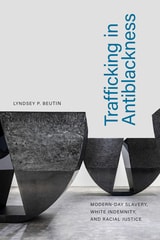
cover of Trafficking in Antiblackness: Modern-Day Slavery, White Indemnity, and Racial Justice

Trafficking in Antiblackness

Modern-Day Slavery, White Indemnity, and Racial Justice

Lyndsey P. Beutin

Duke University Press, 2023

In Trafficking in Antiblackness Lyndsey P. Beutin analyzes how campaigns to end human trafficking—often described as “modern-day slavery”—invoke the memory of transatlantic slavery to support positions ultimately grounded in antiblackness. Drawing on contemporary antitrafficking visual culture and media discourse, she shows how a constellation of media, philanthropic, NGO, and government actors invested in ending human trafficking repurpose the history of transatlantic slavery and abolition in ways that undermine contemporary struggles for racial justice and slavery reparations. The recurring narratives, images, and figures such as “slavery in Africa,” “Arab slave traders,” and “Black incapacity for self-governance” discursively turn Black people across the diaspora into the enslavers of the past and present in place of white Americans and Europeans. Doing so, Beutin contends, creates a rhetorical defense against being held liable for slavery’s dispossessions and violence. Despite these implications, Beutin demonstrates that antitrafficking discourse remains popular and politically useful for former slaving nations and their racial beneficiaries because it refashions historic justifications for white supremacy into today’s abolition of slavery.
[more]