Results by title
5 books match the query 'Raj Quartet'
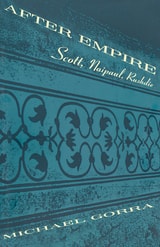
After Empire
Scott, Naipaul, RushdieMichael Gorra
University of Chicago Press, 1997
In After Empire Michael Gorra explores how three novelists of empire—Paul Scott, V. S. Naipaul, and Salman Rushdie—have charted the perpetually drawn and perpetually blurred boundaries of identity left in the wake of British imperialism.
Arguing against a model of cultural identity based on race, Gorra begins with Scott's portrait, in The Raj Quartet, of the character Hari Kumar—a seeming oxymoron, an "English boy with a dark brown skin," whose very existence undercuts the belief in an absolute distinction between England and India. He then turns to the opposed figures of Naipaul and Rushdie, the two great novelists of the Indian diaspora. Whereas Naipaul's long and controversial career maps the "deep disorder" spread by both imperialism and its passing, Rushdie demonstrates that certain consequences of that disorder, such as migrancy and mimicry, have themselves become creative forces.
After Empire provides engaging and enlightening readings of postcolonial fiction, showing how imperialism helped shape British national identity—and how, after the end of empire, that identity must now be reconfigured.
[more]
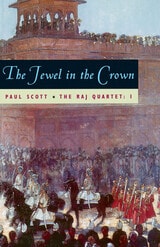
The Raj Quartet, Volume 1
The Jewel in the CrownPaul Scott
University of Chicago Press, 1976
The first volume of Paul Scott's classic account of the last days of British rule in India
No set of novels so richly recreates the last days of India under British rule—"two nations locked in an imperial embrace"—as Paul Scott's historical tour de force, The Raj Quartet. The Jewel in the Crown opens in 1942 as the British fear both Japanese invasion and Indian demands for independence. On the night after the Indian Congress Party votes to support Ghandi, riots break out and an ambitious police sergeant arrests a young Indian for the alleged rape of the woman they both love.
No set of novels so richly recreates the last days of India under British rule—"two nations locked in an imperial embrace"—as Paul Scott's historical tour de force, The Raj Quartet. The Jewel in the Crown opens in 1942 as the British fear both Japanese invasion and Indian demands for independence. On the night after the Indian Congress Party votes to support Ghandi, riots break out and an ambitious police sergeant arrests a young Indian for the alleged rape of the woman they both love.
[more]
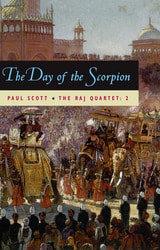
The Raj Quartet, Volume 2
The Day of the ScorpionPaul Scott
University of Chicago Press, 1998
The powerful, moving second volume of Paul Scott's classic account of the last days of British rule in India
In The Day of the Scorpion, Scott draws us deeper in to his epic of India at the close of World War II. With force and subtlety, he recreates both private ambition and perversity, and the politics of an entire subcontinent at a turning point in history.
As the scorpion, encircled by a ring of fire, will sting itself to death, so does the British raj hasten its own destruction when threatened by the flames of Indian independence. Brutal repression and imprisonment of India's leaders cannot still the cry for home rule. And in the midst of chaos, the English Laytons withdraw from a world they no longer know to seek solace in denial, drink, and madness.
[more]
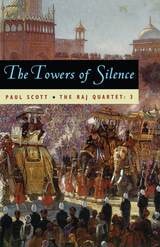
The Raj Quartet, Volume 3
The Towers of SilencePaul Scott
University of Chicago Press, 1998
The powerful third volume of Paul Scott's classic account of the final days of British rule in India
India, 1943: In a regimental hill station, the ladies of Pankot struggle to preserve the genteel façade of British society amid the debris of a vanishing empire and World War II. A retired missionary, Barbara Batchelor, bears witness to the connections between many human dramas; the love between Daphne Manner and Hari Kumar; the desperate grief an old teacher feels for an India she cannot rescue; and the cruelty of Captain Ronald Merrick, Susan Layton's future husband.
India, 1943: In a regimental hill station, the ladies of Pankot struggle to preserve the genteel façade of British society amid the debris of a vanishing empire and World War II. A retired missionary, Barbara Batchelor, bears witness to the connections between many human dramas; the love between Daphne Manner and Hari Kumar; the desperate grief an old teacher feels for an India she cannot rescue; and the cruelty of Captain Ronald Merrick, Susan Layton's future husband.
[more]
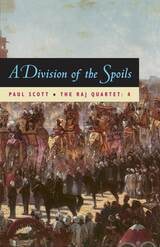
The Raj Quartet, Volume 4
A Division of SpoilsPaul Scott
University of Chicago Press, 1998
The powerful, dramatic final volume of Paul Scott's classic account of the last days of British rule in India.
After exploiting India's divisions for years, the British depart in such haste that no one is prepared for the Hindu-Muslim riots of 1947. The twilight of the raj turns bloody. Against the backdrop of the violent partition of India and Pakistan, A Division of the Spoils illuminates one last bittersweet romance, revealing the divided loyalties of the British as they flee, retreat from, or cling to India.
After exploiting India's divisions for years, the British depart in such haste that no one is prepared for the Hindu-Muslim riots of 1947. The twilight of the raj turns bloody. Against the backdrop of the violent partition of India and Pakistan, A Division of the Spoils illuminates one last bittersweet romance, revealing the divided loyalties of the British as they flee, retreat from, or cling to India.
[more]