Results by title
6 books match the query 'Range'
California’s Ancient Past
From Pacific to the Range of LightJeanne E. Arnold
University Press of Colorado, 2010
Cheatgrass
Fire and Forage on the RangeJames A. Young
University of Nevada Press, 2009
Cheatgrass (Bromus tectorum) is an exotic species that appeared in North America in the late nineteenth century and has since become a dominant plant in the arid and semiarid rangelands between the Sierra Nevadas, Cascades, and Rocky Mountains. It is the first grass to appear after the region's long, cold winters and thus has become an important forage plant for livestock and wildlife. Cheatgrass is also a major environmental hazard in the sagebrush plant communities where it has established itself, providing highly combustible fuel for the wildfires that have ravaged so much of the Great Basin since the mid-twentieth century. Cheatgrass is the first comprehensive study of this highly invasive plant that has changed the ecology of millions of acres of western rangeland. Authors Young and Clements have researched the biology and impact of cheatgrass for four decades. Their book addresses the subject from several perspectives: the history of the invasion; the origins and biology of cheatgrass; its genetic variations, breeding systems, and patterns of distribution; its impact on grazing management; and the role it plays, both positive and negative, in the lives of high desert wildlife.
Over the Range
A History of the Promontory Summit Route of the Pacific RailroadRichard V. Francaviglia
Utah State University Press, 2008
Francaviglia looks anew at the geographical-historical context of the driving of the golden spike in May 1869. He gazes outward from the site of the transcontinental railroad's completion—the summit of a remote mountain range that extends south into the Great Salt Lake. The transportation corridor that for the first time linked America's coasts gave this distinctive region significance, but it anchored two centuries of human activity linked to the area's landscape.
Francaviglia brings to that larger story a geographer's perspective on place and society, a railroad enthusiast's knowledge of trains, a cartographic historian's understanding of the knowledge and experience embedded in maps, and a desert lover's appreciation of the striking basin-and-range landscape that borders the Great Salt Lake.
Range of Motion
A NovelBrian Trapp
Acre Books, 2025
Twin A and Twin B. That’s what Michael and Sal’s neuroscientist father irreverently calls them. The boys are born moments apart, but baby Sal’s brain scan shows a bleed. He has severe cerebral palsy and intellectual disabilities.
Told through multiple perspectives—Gabe, the boys’ father; Hannah, their mother; and Michael—this debut novel follows the Mitchell family from the boys’ infancy to the cusp of adulthood as they all try to interpret what Sal, who speaks only eight words, is thinking and feeling. The twins’ upbringing in suburban Ohio is familiar and unfamiliar, ordinary and extraordinary, as this middle-class family navigates the challenges and rewards of nurturing a special-needs human with a killer dimple who is utterly and winningly himself: sweet, stubborn, mischievous, impenetrable, and above all, very funny.
Michael feels that he alone understands Sal and devotes himself to giving his brother a voice in the “normal” world until he grows up and can’t “hear” his twin anymore—his worst fear. Their mother, a teacher who has given up her career for caregiving, and their father, who is determined to succeed in his research, also struggle with the balance of sacrifice and duty and love, especially as Sal’s health deteriorates. Before Michael leaves for college, the twins spend a final week together at a summer camp for people with disabilities, and Sal does something that changes their lives forever.
Transforming perceptions of disability and interdependence through tender attention to detail, Range of Motion is wrenching, beautiful, and sharply comic.

Rehab on the Range
A History of Addiction and Incarceration in the American WestHolly M. Karibo
University of Texas Press, 2024
2026 Texas Christian University (TCU) Texas Book Award Winner
2025 Coral Horton Tullis Memorial Prize, Texas State Historical Association
2025 Outstanding Academic Title, CHOICE
The first study of the Fort Worth Narcotic Farm, an institution that played a critical role in fusing the War on Drugs, mass incarceration, and public health in the American West.
In 1929, the United States government approved two ground-breaking and controversial drug addiction treatment programs. At a time when fears about a supposed rise in drug use reached a fevered pitch, the emergence of the nation’s first “narcotic farms” in Fort Worth, Texas, and Lexington, Kentucky, marked a watershed moment in the treatment of addiction. Rehab on the Range is the first in-depth history of the Fort Worth Narcotic Farm and its impacts on the American West. Throughout its operation from the 1930s to the 1970s, the institution was the only federally funded drug treatment center west of the Mississippi River. Designed to blend psychiatric treatment, physical rehabilitation, and vocational training, the Narcotic Farm, its proponents argued, would transform American treatment policies for the better. The reality was decidedly more complicated.
Holly M. Karibo tells the story of how this institution—once framed as revolutionary for addiction care—ultimately contributed to the turn towards incarceration as the solution to the nation’s drug problem. Blending an intellectual history of addiction and imprisonment with a social history of addicts’ experiences, Rehab on the Range provides a nuanced picture of the Narcotic Farm and its cultural impacts. In doing so, it offers crucial historical context that can help us better understand our current debates over addiction, drug policy, and the rise of mass incarceration.
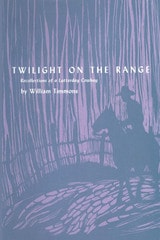
Twilight on the Range
Recollections of a Latterday CowboyBy William Timmons
University of Texas Press, 1962
Billie Timmons was fourteen when he met Charles Goodnight—over a wagonload of manure that had been jammed on a gatepost—and he went to work on the Goodnight Cross J Ranch shortly thereafter. The spirit of helpfulness that led Mr. Goodnight to strip off his coat and lift the wagon free for a lad in need sets the tone of this book, in which the author unwinds a spool of recollections of range-riding in Texas and North Dakota over an eighteen-year period.
When Billie Timmons went to work for Mr. Goodnight in 1892, Texas was undergoing a rapid transition from open range to fences. But around Texas campfires he heard tales about the northern range, told by cowboys who had ridden there and who had seen the northern lights, the tall free grass, swollen streams, and stampeding cattle. A longing to see that exciting country took hold of young Timmons.
His chance came when four buffaloes from the Goodnight ranch needed a nursemaid for their freight car trip to Yellowstone Park. Once in the northern country, Timmons stayed, casting his lot with the cowmen of North Dakota. He became the protégé of an extraordinary man, William Ray; he was foreman, friend, and confidant of banker-rancher Wilse Richards, a member of the Cowboy Hall of Fame. But even during his days in North Dakota he never lost touch with Charles Goodnight, a lifelong friend, and his portrayal of Goodnight provides much insight into the character of the man whose name belongs to the West.
In this book you experience the terror of being lost in the dead-white expanse of a North Dakota snowstorm; the gaiety of cowboy dances, for which there were never enough women available; the excitement of a near-riot in a Hebron, North Dakota, saloon, where cowboys from the 75 Ranch drank up or poured out all the liquor, then smashed all the glasses and bottles—one day before the state became bone-dry; and the loneliness of work on the range, where a flickering lantern on the side of a chuck wagon on a stormy night meant home for many a cowboy. Running like a bright thread through the narrative is Billie Timmons’s love of horses, from whom he learned the wisdom that some horses and some men are to be handled with great care and others are not to be handled at all. His chapter on Buck, his best-loved horse, is memorable.
In North Dakota, as in Texas, fences brought the end of the big herds and the end of cowboying for a man who enjoyed it to the hilt.