Results by title
26 books match the query 'Reader-response criticism'
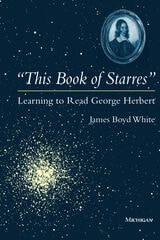
"This Book of Starres"
Learning to Read George HerbertJames Boyd White
University of Michigan Press, 1995
"This Book of Starres" is one of those all-too-rare books in which an author's love of someone's work--in this case, the seventeenth-century English poet George Herbert--leads to a journey of exploration.
Herbert's poetry presents a special set of challenges: It is to the modern ear archaic, difficult in thought and structure, and entirely theological in character. Yet no poet is more deeply admired by those who know him well. "This Book of Starres" is meant to engage the reader in a process of reading by which this verse can be seen to be vivid and alive. It is the record of one person's life-changing involvement with the poetry of George Herbert; in this it is about not only how, but why we read great poetry.
"It is a joy to experience Herbert's poetry in the company of James Boyd White, whose affinity for the work is always convincing and seems at times preternatural. 'This Book of Starres' is a necessary pleasure: all readers of poetry, whether expert or inexpert, will find it enriching." --Alice Fulton
". . . both a delight to read, and one of the most instructive exercises in literature and theology I have read for a long time. . . . Herbert emerges as one of the greatest, a writer to test and change the imagination, the very way in which we think about the world and that which is beyond it." --Literature and Theology
James Boyd White is Hart Wright Professor of Law, Professor of English, and Adjunct Professor of Classical Studies, University of Michigan.
After the Death of Poetry
Poet and Audience in Contemporary AmericaVernon Shetley
Duke University Press, 1993
In exemplary case studies, Shetley identifies the very different ways in which three postwar poets—Elizabeth Bishop, James Merrill, and John Ashbery—try to restore some of the challenge and risk that characterized modernist poetry's relation to its first readers. Sure to be controversial, this cogent analysis offers poets and readers a clear sense of direction and purpose, and so, the hope of reaching each other again.

Charlotte Bronte and the Storyteller's Audience
Carol Bock
University of Iowa Press, 1992

Citizen Critics
Literary Public SpheresRosa A. Eberly
University of Illinois Press, 2000
The condition of our public discussions about literary and cultural works has much to say about the state of our democracy. Classrooms, newspapers, magazines, Internet forums, and many other places grant citizens a place to hold public discourses—and claim a voice on national artistic matters.
Rosa A. Eberly looks at four censorship controversies where professionals asserted their authority to deny citizen critics a voice—and effectively removed discussion of literature from the public sphere. Eberly compares the outrage sparked by the publication of James Joyce's Ulysses and Henry Miller's Tropic of Cancer with the relative quiescence that greeted the much more violent and sexually explicit content of Bret Easton Ellis's American Psycho and Andrea Dworkin's Mercy. Through a close reading of letters to the editor, reviews, media coverage, and court cases, Eberly shows how literary critics and legal experts defused censorship debates—and undercut the authority of citizen critics—by shifting the focus from content to aesthetics and from social values to publicity.
Crossing Borders
Reception Theory, Poststructuralism, DeconstructionRobert C. Holub
University of Wisconsin Press, 1992
Robert C. Holub critically investigates the histories of reception theory, poststructuralism, and deconstruction in postwar Germany and the United States. He looks at how imported theories assume a place in the political discourse of a country, and how indigenous intellectual traditions and prejudices affect, modify, or even distort foreign theories.
Holub addresses many timely questions: Why did reception theory, so prominent in Germany in the 1960s and 1970s, fail to have an impact on American academics until the 1980s? Why did postructuralism, and specifically the writings of Michel Foucault, fail to find a home in German academia while becoming an important theoretical voice in the United States? How did deconstruction, originally considered by American scholars as merely a sophisticated tool for analysis, get taken up by leftists who argued for an affinity between the critique of language and the critique of capitalism? And finally, how have American intellectuals responded to revelations of fascism in the pasts of Paul de Man and Martin Heidegger?
Crossing Borders effectively demonstrates the extent to which theoretical work needs to be understood in cultural, intellectual, and institutional contexts. Holub argues that the praxis of theories is determined not only by their content and style, but also by the environment in which they must function. The success of a transplanted theory, he contends, is due less to its inherent merits than to the hospitability of the environment on to which it is grafted.

Dear Charles Dickens, Love, South LA
Literature, Place, and BelongingJacqueline Jean Barrios
University of Iowa Press, 2026
Jacqueline Jean Barrios confronts the cultural challenges that big canonical books pose to new generations of readers. Instead of erasing the differences between Dickens’s implied audiences and his current ones, Barrios demonstrates how youth can serve as the visionaries who bridge the gap. By placing literature in everyday surroundings, students at any school and in any location can learn from the embodied and the poetic and even question the universalism that masks unexamined reverence for the Western canon.
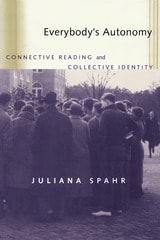
Everybody's Autonomy
Connective Reading and Collective IdentityJuliana Spahr
University of Alabama Press, 2001
Contemporary avant garde writing has often been overlooked by those who study literature and identity. Such writing has been perceived as unrelated, as disrespectful of subjectivity. But Everybody's Autonomy instead locates within avant garde literature models of identity that are communal, connective, and racially concerned. Everybody's Autonomy, as it tackles literary criticism's central question of what sort of selves do works create, looks at works that encourage connection, works that present and engage with large, public worlds that are in turn shared with readers. With this intent, it aligns the iconoclastic work of Gertrude Stein with foreign, immigrant Englishes and their accompanying subjectivities. It examines the critique of white individualism and privilege in the work of language writers Lyn Hejinian and Bruce Andrews. It looks at how Harryette Mullen mixes language writing's open text with the distinctivesness of African-American culture to propose a communal, yet still racially conscious identity. And it examines Theresa Hak Kyung Cha's use of broken English and French to unsettle readers' fluencies and assimilating comprehensions, to decolonize reading. Such works, the book argues, well represent and expand changing notions of the public, of everybody.
Experiencing Fiction
Judgments, Progressions, and the Rhetorical Theory of NarrativeJames Phelan
The Ohio State University Press, 2007
Feminism Beyond Modernism
Elizabeth Flynn
Southern Illinois University Press, 2002
Misunderstanding and denigration of postmodern feminism are widespread. Elizabeth Flynn’s Feminism Beyond Modernism comes to its defense in a cogent and astute manner by first distinguishing between postmodern and antimodern feminisms and then reclaiming postmodern feminism by reconfiguring its relationship to modernism.
Too often postmodern feminism is unfairly identified as opposed to modernism and associated with subjectivism and relativism. Flynnaddresses these problems by provisionally defining postmodern feminism as problematizing and critiquing modernism without directly opposing it. Flynn also suggests that feminist traditions that reject modernism, such as radical and cultural feminisms, are antimodern rather than postmodern.
In this interdisciplinary study, Flynn defines feminist traditions broadly, situating her discussions within the contexts of literary studies and rhetoric and composition while simultaneously exploring the troubled relationship between these fields. Departing from accepted definitions of modernism, Flynn distinguishes between aesthetic modernism and Enlightenment modernism and uses the work of John Locke, Sigmund Freud, Charlotte Perkins Gilman, Michel Foucault, Donna Haraway, and others as benchmarks for historical placement. In addition, rereadings of works by Virginia Woolf, Adrienne Rich, Alice Walker, Louise Rosenblatt, and others demonstrate the complex ways in which they respond to modernist pressures and tendencies. From this context, Flynn’s Feminism Beyond Modernism reconfigures feminist traditions by defining postmodern feminism as a critique of modernism rather than as an antimodern opponent.
Framed Narratives
Diderot’s Genealogy of the BeholderJay CaplanAfterword by Jochen Schulte-Sasse
University of Minnesota Press, 1985
Framed Narratives was first published in 1985. Minnesota Archive Editions uses digital technology to make long-unavailable books once again accessible, and are published unaltered from the original University of Minnesota Press editions.
The work of French philosophe Denis Diderot (1713-1784) has inspired conflicting reactions in those who encounter him. Diderot has been admired and despised; he has moved his readers and irritated them - often at the same time. His work continually shifts between mutually exclusive positions - neither of which provides an entirely satisfactory answer to the question at hand, yet neither of which can be disregarded. The nature of these paradoxes has been the fundamental problem in Diderot, a problem that his interpreters have approached by imagining synthetic perspectives or frames within which the paradoxes could be resolved.
In Framed Narratives, Jay Caplan focuses on the problem of framing in and of Diderot. He proposes an interpretive model that draws upon the notion of dialogue developed by Mikhail Bakhtin. For Bakhtin, no utterance can be reduced to a univocal meaning; one's discourse is always marked by other voices. In Diderot, Caplan shows, the narrative device of the tableau engages the reader (or beholder) in a dialogic relationship with the author and the characters. Diderot defines the players of those roles as members of a family, one of whom is always missing, and that sacrificial relationship becomes an integral part of the text. Caplan then uses the concept of the tableau to interpret the rhetoric of gender, genre, and pathos in Diderot's works for and about the theater, his novel The Nun, the philosophical dialogue D'Alembert's Dream,and his correspondence.
What emerges from these readings is not only an interpretation of certain texts, but a description of Diderot's—and, by implication, early bourgeois—poetics. Framed Narratives is, in addition, one of the first attempts to rely upon Bakhtin's concepts in the interpretation of specific texts, in this case the work of an essentially dialogic writer. A socio-historical supplement to Framed Narratives is provided in Jochen Schulte-Sasse's afterword.
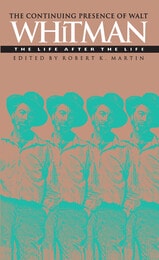
From Blue Mills to Columbia
Cedar Falls and the Civil WarRobert K. Martin
University of Iowa Press, 1992

Ibsen’s Drama
Author to AudienceEinar Haugen
University of Minnesota Press, 1979
Ibsen's Drama was first published in 1979. Minnesota Archive Editions uses digital technology to make long-unavailable books once again accessible, and are published unaltered from the original University of Minnesota Press editions.
"A dramatist for all seasons" Einar Haugen calls Henrik Ibsen in this series of lectures given in honor of the 150th anniversary of the Norwegian playwright's birth. Using a modified version of the communications model developed by linguist Roman Jakobson, Haugen provides a readable, succinct analysis of Ibsen's thinking and dramaturgy. He examines the ways in which Ibsen the author communicated with his nineteenth-century audience and is able, still, to move and inform playgoers today.
Haugen brings to this work a lifetime of familiarity with Ibsen in Norwegian and in translation, and he draws upon his own experience as a theatergoer and as an observer of student and audience reaction to the plays. Ibsen's Drama will bring pleasure and a deeper understanding of the playwright to students and playgoers alike.
Einar Haugen is Victor S. Thomas Professor of Scandinavian and Linguistics, emeritus, at Harvard University. He is author, editor, or translator of many books and articles in linguistics, literature, and immigrant history, notably The Norwegian Language in America (1953), The Scandinavian Languages (1976), and Land of the Free (1978).

On the Bullet Train with Emily Brontë
Wuthering Heights in JapanJudith Pascoe
University of Michigan Press, 2017
In this and in her previous book, The Sarah Siddons Audio Files, Pascoe’s engaging narrative innovates a new scholarly form involving immersive research practice to attempt a cross-cultural version of reader-response criticism. On the Bullet Train with Emily Brontë will appeal to scholars in the fields of 19th-century British literature, adaptation studies, and Japanese literary history.
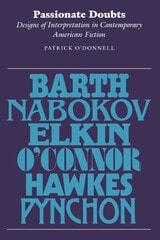
Passionate Doubts
Interpretation In FictionPatrick O'Donnell
University of Iowa Press, 1986
In an introductory dialogue and a closing chapter on the reader in contemporary fiction, O'Donnell shows that the formation of the reader's self, like character, plot, or any other element in fiction, is also part of the experience of the text, requiring a distinctive conception of interpretation. Calling upon a wide assemblage of modern theorists including Foucault, Derrida, Serres, Binswanger, Geertz, and Gadamer, O'Donnell elicits a broad range of interpretive possibilities—philosophical, psychological, archaeological, and linguistic—which speak to each novel's central concern with the act of reading as a form of signification.
While Passionate Doubts is broadly a hermeneutic study of contemporary fiction, the heart of this intriguing work resides in the close scrutiny of six modern novels which so richly evoke the very elements from which theories derive: language, form, and impulse. It is this specific application of theory that sets Passionate Doubts apart from other works in the field, yielding a series of important insights on the subject of language, sign, and the self in modern literature.

Reading Piers Plowman and the Pilgrim's Progress
Reception and the Protestant ReaderBarbara A. Johnson
Southern Illinois University Press, 1992
Centering her discussion on two historical "ways of reading"—which she calls the Protestant and the lettered—Barbara A. Johnson traces the development of a Protestant readership as it is reflected in the reception of Langland’s Piers Plowman and Bunyan’s Pilgrim’s Progress.
Informed by reader-response and reception theory and literacy and cultural studies, Johnson’s ambitious examination of these two ostensibly literary texts charts the cultural roles they played in the centuries following their composition, roles far more important than their modern critical reputations can explain.
Johnson argues that much more evidence exists about how earlier readers read than has hitherto been acknowledged. The reception of Piers Plowman, for example, can be inferred from references to the work, the apparatus its Renaissance printer inserted in his editions, the marginal comments readers inscribed both in printed editions and in manuscripts, and the apocryphal "plowman" texts that constitute interpretations of Langland’s poem. She demonstrates by example that what is culturally transmitted has not been just the work itself; it includes vestiges of past readers’ encounters with the text that are traceable both in the way a text is presented as well as in the way that presentation is received.
Conditioned more by religious, historical, and economic forces than by literary concerns, Langland’s poem became a part of the reformist tradition that culminated in Bunyan’s Pilgrim’s Progress. By understanding this tradition, Bunyan’s place in it, and the way the reception of The Pilgrim’s Progress illustrates the beginning of a new, more realistic fictional tradition, Johnson concludes, we can begin to delineate a more accurate history of the ways literature and society intersect, a history of readers reading.
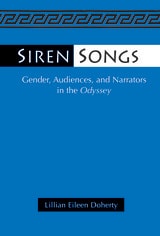
Siren Songs
Gender, Audiences, and Narrators in the OdysseyLillian Eileen Doherty
University of Michigan Press, 1995
Siren Songs synthesizes audience-oriented and narratological approaches, and examines the relationships among three kinds of audiences: internal, implied, and actual. The author prefaces her own reading of the Odyssey with an analysis of the issues posed by the earlier feminist readings on which she builds. Should the Odyssey be read as a "closed" text, that is, as one whose meaning is highly determined, or as an "open" text whose contradictions and ambiguities undercut its overt meanings?
Siren Songs presents a feminist critique of the Odyssey in an accessible manner aimed at a more general audience. All Greek is translated, and critical terminology is clearly defined.
Lillian Eileen Doherty is Associate Professor of Classics, University of Maryland, College Park.
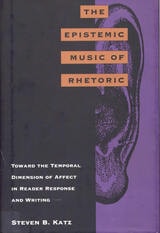
The Epistemic Music of Rhetoric
Toward the Temporal Dimension of Affect in Reader Response and WritingSteven B. Katz
Southern Illinois University Press, 1996
Arguing for an oral theory of Reader Response Criticism, Steven B. Katz conducts a philosophical investigation into the possibility and desirability of teaching reading and writing as rhetorical music.
In the course of this investigation, Katz deals with New Physics, the sophists, Cicero, orality, epistemology, voice, writing, temporality, and sound. He demonstrates that Reader Response Criticism—as part of a new sophistic that has entered the mainstream of pedagogy and practice in our culture—parallels the philosophy of science engendered by the Copenhagen school of New Physics, which theoretically holds that knowledge of subatomic phenomena is probable, relative, contingent, and uncertain, thus requiring more nonformalistic, nonrationalistic methods in understanding and reconstructing it; Katz shows how the same methods are required in the study of affect in reading and writing. Katz also demonstrates that, like New Physics, Reader Response Criticism, in its commitment to interpretation as the primary function and goal of writing about literature, must remain somewhat committed to the formalistic, rationalistic epistemology it seeks to redress.
Basing his oral theory of Reader Response Criticism on notions of language as physical, sensuous, and musical and understanding reception as participatory performance rather that interpretation, Katz suggests a way to reconceptualize Reader Response Criticism. He accounts for "voice," "felt sense," "dissonance," and aesthetic response generally as it is created by the temporal, musical patterns of language, noting that the physical, musical dimension of language has been relatively neglected in contemporary movements in rhetoric, composition, and literature.
Thus, set against the relationship between literature and science, especially between Reader Response Criticism and the philosophy of science engendered by New Physics, Katz examines the sophistic and Ciceronian conceptions of rhetoric. He reinterprets Cicero’s rhetorical theory in light of recent revisionist scholarship on the sophists and reevaluates his assigned position in rhetorical history as neo-Aristotelian by focusing on his oral notions of style as epistemic music. In so doing, Katz offers a new interpretation of Cicero within the sophistic tradition.
Discussing the relationship between sophistic and Ciceronian conceptions of style as an oral, physical, nonrational, indirect form of knowledge and viewing philosophical conceptions of language as sensuous, temporal gestalten or "shapes" in consciousness, Katz suggests that response to and performance of the epistemic music of language can supplement analysis and interpretation in the teaching of reading and writing and can provide less formalistic, less rationalistic foundation for a reader response criticism as a new sophistic.
The Intimate Critique
Autobiographical Literary CriticismDiane P. Freedman, Olivia Frey, and Frances Murphy Zauhar, eds.
Duke University Press, 1993
Grounded in feminism and connected to the race, class, and gender paradigms in cultural studies, the twenty-six contributors to this volume—including Jane Tompkins, Henry Louis Gates, Jr., Shirley Nelson Garner, and Shirley Goek-Lin Lim—respond in new, refreshing ways to literary subjects ranging from Homer to Freud, Middlemarch to The Woman Warrior, Shiva Naipaul to Frederick Douglass. Revealing the beliefs and formative life experiences that inform their essays, these writers characteristically recount the process by which their opinions took shape--a process as conducive to self-discovery as it is to critical insight. The result—which has been referred to as "personal writing," "experimental critical writing," or "intellectual autobiography"—maps a dramatic change in the direction of literary criticism.
Contributors. Julia Balen, Dana Beckelman, Ellen Brown, Sandra M. Brown, Rosanne Kanhai-Brunton, Suzanne Bunkers, Peter Carlton, Brenda Daly, Victoria Ekanger, Diane P. Freedman, Olivia Frey, Shirley Nelson Garner, Henry Louis Gates, Jr., Melody Graulich, Gail Griffin, Dolan Hubbard, Kendall, Susan Koppelman, Shirley Geok-Lin Lim, Linda Robertson, Carol Taylor, Jane Tompkins, Cheryl Torsney, Trace Yamamoto, Frances Murphy Zauhar
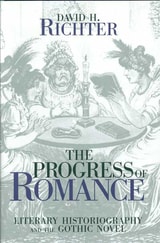
The Progress of Romance
Literary Historiography and the Gothic NovelDavid H. Richter
The Ohio State University Press, 1900

The Reader and the Detective Story
George N. Dove
University of Wisconsin Press, 1997
George Dove demonstrates how the English soft-boiled mystery and the American private-eye story, although they have different settings and develop different plots, belong in the same subgenre and follow the same formula, inherited directly from Poe’s “The Murders in the Rue Morgue.”
The Reader, the Text, the Poem
The Transactional Theory of the Literary WorkLouise M. Rosenblatt
Southern Illinois University Press, 1994
Louise M. Rosenblatt’s award-winning work continues increasingly to be read in a wide range of academic fields—literary criticism, reading theory, aesthetics, composition, rhetoric, speech communication, and education. Her view of the reading transaction as a unique event involving reader and text at a particular time under particular circumstances rules out the dualistic emphasis of other theories on either the reader or the text as separate and static entities. The transactional concept accounts for the importance of factors such as gender, ethnicity, culture, and socioeconomic context. Essential reading for the specialist, this book is also well suited for courses in criticism, critical theory, rhetoric, and aesthetics.
Starting from the same nonfoundationalist premises, Rosenblatt avoids the extreme relativism of postmodern theories derived mainly from Continental sources. A deep understanding of the pragmatism of Dewey, James, and Peirce and of key issues in the social sciences is the basis for a view of language and the reading process that recognizes the potentialities for alternative interpretations and at the same time provides a rationale for the responsible reading of texts.
The book has been praised for its lucid explanation of the multidimensional character of the reading process—evoking, interpreting, and evaluating the work. The nonliterary (efferent) and the literary (aesthetic) are shown not to be opposites but to represent a continuum of reading behaviors. The author amply illustrates her theoretical points with interpretations of varied texts. The epilogue carries further her critique of rival contemporary theories.
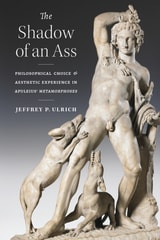
The Shadow of an Ass
Philosophical Choice and Aesthetic Experience in Apuleius' MetamorphosesJeffrey P. Ulrich
University of Michigan Press, 2024
Situating the novel in a long history of philosophical and literary conversations, Ulrich suggests that the Metamorphoses anticipates much of the philosophical burlesque we tend to associate with early modern fiction, from Don Quixote to Lewis Carroll.
The Sign of the Cannibal
Melville and the Making of a Postcolonial ReaderGeoffrey Sanborn
Duke University Press, 1998
Sanborn focuses on the representations of cannibalism in three of Melville’s key texts—Typee, Moby-Dick, and “Benito Cereno.” Drawing on accounts of Pacific voyages from two centuries and virtually the entire corpus of the post-Enlightenment discourse on cannibalism, he shows how Melville used his narratives to work through the ways in which cannibalism had been understood. In so doing, argues Sanborn, Melville sought to move his readers through stages of possible responses to the phenomenon in order to lead them to consider alternatives to established assumptions and conventions—to understand that in the savage they see primarily their own fear and fascination. Melville thus becomes a narrator of the postcolonial encounter as he uncovers the dynamic of dread and menace that marks the Western construction of the “non-savage” human.
Extending the work of Slavoj Zizek and Homi Bhabha while providing significant new insights into the work of Melville, The Sign of the Cannibal represents a breakthrough for students and scholars of postcolonial theory, American literary history, critical anthropology, race, and masculinity.
The Theoretical Dimensions of Henry James
John Carlos Rowe
University of Wisconsin Press, 1985
Rowe examines James from the perspectives of the psychology of literary influence, feminism, Marxism, psychoanalysis, literary phenomenology and impressionism, and reader-response criticism, transforming a literary monument into the telling point of intersection for modern critical theories.

Toward an Aesthetic of Reception
Hans Jauss
University of Minnesota Press, 1982
Transgressions of Reading
Narrative Engagement as Exile and ReturnRobert D. Newman
Duke University Press, 1992
Newman describes this psychodrama of narrative engagement as that of exile and return, an experience in which narrative becomes a type of homeland, beckoning and elusive, endlessly defining and disrupting the borders of a reader's identity. Within this paradigm, he considers a fascinating variety of narrative texts: from the Jim Jones episode in Guyana to Freud's repression of personal history in his story of Moses; from a surrealistic collage novel by Max Ernst to the horror films of Alfred Hitchcock; from the works of James Joyce, Ariel Dorfman, Milan Kundera, and D. M. Thomas to the tales of abjection in pornography.
Transgressions of Reading is itself an engaging work, as interesting for its provocative readings of particular works as for its theoretical insights. It will appeal to readers from all fields in which narrative plays a crucial role, in the study of film and art, modern and contemporary literature, popular culture, and feminist, psychoanalytic, and reader response theory.