Results by title
45 books match the query 'Real Estate'

A Moveable Shore
The Fate of the Connecticut CoastPeter C. Patton and James M. Kent
Duke University Press, 1992
Beginning with the hurricane of 1938, the biggest natural disaster to strike Connecticut since its settlement by Europeans, the authors demonstrate the continuing pattern of development of coastal land prone to flooding and high winds. Although the Connecticut coast faces Long Island and Block Island sounds, it is subject to the same natural hazards, land-use risks, and regulations as opean ocean shorelines. Global climatic events--glaciation, global warming, and rising sea levels--influence the shape and composition of the Connecticut shoreline, as do small-scale forces such as wind, waves, and tides.
Patton and Kent seek to instill a respect for the force of natural events and provide a guide for lessening the dangers of construction and development. A practical question-and-answer chapter explains what homeowners need to know to meet land-use regulations along the coast. In a state where the entire population lives within 100 miles of the coast, this important book will serve as a citizens’ guide to living with the Connecticut shore and will be of interest to coastal residents, developers, geologists, policymakers, and vacationers.
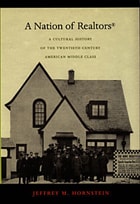
A Nation of Realtors®
A Cultural History of the Twentieth-Century American Middle ClassJeffrey M. Hornstein
Duke University Press, 2005
Hornstein draws on trade journals, government documents on housing policy, material from the archives of the National Association of Realtors and local real estate boards, demographic data, and fictional accounts of real estate agents. He chronicles the early efforts of real estate brokers to establish their profession by creating local and national boards, business practices, ethical codes, and educational programs and by working to influence laws from local zoning ordinances to national housing policy. A rich and original work of American history, A Nation of Realtors® illuminates class, gender, and business through a look at the development of a profession and its enormously successful effort to make the owner-occupied, single-family home a key element of twentieth-century American identity.
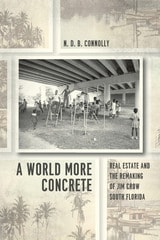
A World More Concrete
Real Estate and the Remaking of Jim Crow South FloridaN. D. B. Connolly
University of Chicago Press, 2014
A World More Concrete argues that black and white landlords, entrepreneurs, and even liberal community leaders used tenements and repeated land dispossession to take advantage of the poor and generate remarkable wealth. Through a political culture built on real estate, South Florida’s landlords and homeowners advanced property rights and white property rights, especially, at the expense of more inclusive visions of equality. For black people and many of their white allies, uses of eminent domain helped to harden class and color lines. Yet, for many reformers, confiscating certain kinds of real estate through eminent domain also promised to help improve housing conditions, to undermine the neighborhood influence of powerful slumlords, and to open new opportunities for suburban life for black Floridians.
Concerned more with winners and losers than with heroes and villains, A World More Concrete offers a sober assessment of money and power in Jim Crow America. It shows how negotiations between powerful real estate interests on both sides of the color line gave racial segregation a remarkable capacity to evolve, revealing property owners’ power to reshape American cities in ways that can still be seen and felt today.
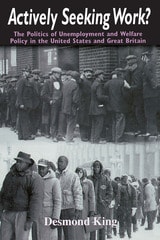
Actively Seeking Work?
The Politics of Unemployment and Welfare Policy in the United States and Great BritainDesmond King
University of Chicago Press, 1995
The goal of work-welfare policy in both countries has been to provide financial aid, training, and placement services for the unemployed. In order to muster support for these programs, however, work-welfare programs had to incorporate liberal requirements that they not interfere with private market forces, and that they prevent the "undeserving" from obtaining benefits. For King, the attempt to integrate these incompatible functions is the defining feature of British and American policies as well as the cause of their failure.
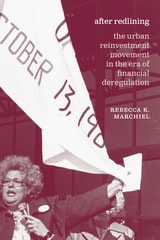
After Redlining
The Urban Reinvestment Movement in the Era of Financial DeregulationRebecca K. Marchiel
University of Chicago Press, 2020
American banks, to their eternal discredit, long played a key role in disenfranchising nonwhite urbanites and, through redlining, blighting the very city neighborhoods that needed the most investment. Banks long showed little compunction in aiding and abetting blockbusting, discrimination, and outright theft from nonwhites. They denied funds to entire neighborhoods or actively exploited them, to the benefit of suburban whites—an economic white flight to sharpen the pain caused by the demographic one.
And yet, the dynamic between banks and urban communities was not static, and positive urban development, supported by banks, became possible. In After Redlining, Rebecca K. Marchiel illuminates how, exactly, urban activists were able to change some banks’ behavior to support investment in communities that they had once abandoned. The leading activists arose in an area hit hard by banks’ discriminatory actions and politics: Chicago’s West Side. A multiracial coalition of low- and moderate-income city residents, this Saul Alinsky–inspired group championed urban reinvestment. And amazingly, it worked: their efforts inspired national action, culminating in the federal Home Mortgage Disclosure Act and the Community Reinvestment Act.
While the battle for urban equity goes on, After Redlining provides a blueprint of hope.
After Redlining
The Urban Reinvestment Movement in the Era of Financial DeregulationRebecca K. Marchiel
University of Chicago Press, 2020
Focusing on Chicago's West Side, After Redlining illuminates how urban activists were able to change banks’ behavior to support investment in communities that they had once abandoned.
American banks, to their eternal discredit, long played a key role in disenfranchising nonwhite urbanites and, through redlining, blighting the very city neighborhoods that needed the most investment. Banks long showed little compunction in aiding and abetting blockbusting, discrimination, and outright theft from nonwhites. They denied funds to entire neighborhoods or actively exploited them, to the benefit of suburban whites—an economic white flight to sharpen the pain caused by the demographic one.
And yet, the dynamic between banks and urban communities was not static, and positive urban development, supported by banks, became possible. In After Redlining, Rebecca K. Marchiel illuminates how, exactly, urban activists were able to change some banks’ behavior to support investment in communities that they had once abandoned. The leading activists arose in an area hit hard by banks’ discriminatory actions and politics: Chicago’s West Side. A multiracial coalition of low- and moderate-income city residents, this Saul Alinsky–inspired group championed urban reinvestment. And amazingly, it worked: their efforts inspired national action, culminating in the federal Home Mortgage Disclosure Act and the Community Reinvestment Act.
While the battle for urban equity goes on, After Redlining provides a blueprint of hope.
American Hotel
The Waldorf-Astoria and the Making of a CenturyDavid Freeland
Rutgers University Press, 2021
American Hotel takes us behind the glittering image to reveal the full extent of the Waldorf’s contribution toward shaping twentieth-century life and culture. Historian David Freeland examines the Waldorf from the opening of its first location in 1893 through its rise to a place of influence on the local, national, and international stage. Along the way, he explores how the hotel’s mission to provide hospitality to a diverse range of guests was put to the test by events such as Prohibition, the anticommunist Red Scare, and civil rights struggles.
Alongside famous guests like Frank Sinatra, Martin Luther King, Richard Nixon, and Eleanor Roosevelt, readers will meet the lesser-known men and women who made the Waldorf a leader in the hotel industry and a key setting for international events. American Hotel chronicles how institutions such as the Waldorf-Astoria played an essential role in New York’s growth as a world capital.
Broken Buildings, Busted Budgets
How to Fix America's Trillion-Dollar Construction IndustryBarry B. LePatner with Robert E. Wright and Timothy C. Jacobson
University of Chicago Press, 2007
With three decades of experience representing clients that include eminent architects and engineers, as well as corporations, institutions, and developers, LePatner has firsthand knowledge of the bad management, ineffective supervision, and insufficient investment in technology that plagues the risk-averse construction industry. In an engaging and direct style, he here pinpoints the issues that underlie the industry’s woes while providing practical tips for anyone in the business of building, including advice on the precise language owners should use during contract negotiations.
Armed with Broken Buildings, Busted Budgets, everyone involved in the purchase or renovation of a building or any structure—from homeowners seeking to remodel to civic developers embarking on large-scale projects—has the information they need to change this antiquated industry, one project at a time.
“LePatner describes what is wrong with the current system and suggests ways that architects can help—by retaking their rightful place as master builders.”—Fred A. Bernstein, Architect Magazine
Catastrophic Coastal Storms
Hazard Mitigation and Development ManagementDavid R. Godschalk, David J. Brower, and Timothy Beatley
Duke University Press, 1988
Catastrophic Coastal Storms offers a solution to the policy problem by proposing a merger of hazard mitigation with development management, basing this on extensive surveys of at-risk coastal locations and case studies of post-hurricane recovery. Starting with the local level of government and proceeding to state and federal levels, the authors propose a strategy for overcoming the formidable obstacles to safeguarding the shoreline population and its structures from hurricanes and other severe storms.

Cities on the Beach
Management Issues of Developed Coastal BarriersEdited by Rutherford H. Platt, Sheila G. Pelczarski, and Barbara K. Burbank
University of Chicago Press, 1987
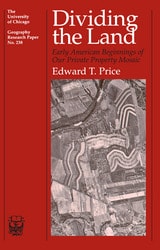
Dividing the Land
Early American Beginnings of Our Private Property MosaicEdward T. Price
University of Chicago Press, 1995
In this unprecedented study, Edward T. Price covers most areas of the United States in which the initial division of land was controlled by colonial governments—the original thirteen colonies, and Maine, Vermont, Kentucky, West Virginia, Tennessee, Louisiana, and Texas. By examining different land policies and the irregular pattern of property that resulted from them, Price chronicles the many ways colonies managed land to promote settlement, develop agriculture, defend frontiers, and attract investment. His analysis reveals as much about land planning techiniques carried to America from Europe as innovations spurred by the unique circumstances of the new world.
Price’s analysis draws on his thorough survey of property records from the first land plans in Virginia in 1607 to empresario grants in Texas in the 1820s. This breadth of data allows him to identify regional differences in allocating land, assess the impact of land planning by historical figures like William Penn of Pennsylvania and Lord Baltimore of Maryland, and trace changes in patterns of land division and ownership through transfers of power among Britain, the Netherlands, France, Spain, Mexico, and the Republic of Texas.
From Boom to Bubble
How Finance Built the New ChicagoRachel Weber
University of Chicago Press, 2015
In From Boom to Bubble, Rachel Weber debunks the idea that booms occur only when cities are growing and innovating. Instead, she argues, even in cities experiencing employment and population decline, developers rush to erect new office towers and apartment buildings when they have financial incentives to do so. Focusing on the main causes of overbuilding during the early 2000s, Weber documents the case of Chicago’s “Millennial Boom,” showing that the Loop’s expansion was a response to global and local pressures to produce new assets. An influx of cheap cash, made available through the use of complex financial instruments, helped transform what started as a boom grounded in modest occupant demand into a speculative bubble, where pricing and supply had only tenuous connections to the market. From Boom to Bubble is an innovative look at how property markets change and fail—and how that affects cities.
Geography, Resources and Environment, Volume 2
Themes from the Work of Gilbert F. WhiteEdited by Robert W. Kates and Ian Burton
University of Chicago Press, 1986
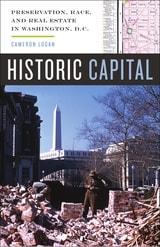
Historic Capital
Preservation, Race, and Real Estate in Washington, D.C.Cameron Logan
University of Minnesota Press, 2017
Washington, D.C. has long been known as a frustrating and sometimes confusing city for its residents to call home. The monumental core of federal office buildings, museums, and the National Mall dominates the city’s surrounding neighborhoods and urban fabric. For much of the postwar era, Washingtonians battled to make the city their own, fighting the federal government over the basic question of home rule, the right of the city’s residents to govern their local affairs.
In Historic Capital, urban historian Cameron Logan examines how the historic preservation movement played an integral role in Washingtonians’ claiming the city as their own. Going back to the earliest days of the local historic preservation movement in the 1920s, Logan shows how Washington, D.C.’s historic buildings and neighborhoods have been a site of contestation between local interests and the expansion of the federal government’s footprint. He carefully analyzes the long history of fights over the right to name and define historic districts in Georgetown, Dupont Circle, and Capitol Hill and documents a series of high-profile conflicts surrounding the fate of Lafayette Square, Rhodes Tavern, and Capitol Park, SW before discussing D.C. today.
Diving deep into the racial fault lines of D.C., Historic Capital also explores how the historic preservation movement affected poor and African American residents in Anacostia and the U Street and Shaw neighborhoods and changed the social and cultural fabric of the nation’s capital. Broadening his inquiry to the United States as a whole, Logan ultimately makes the provocative and compelling case that historic preservation has had as great an impact on the physical fabric of U.S. cities as any other private or public sector initiative in the twentieth century.
House of Debt
How They (and You) Caused the Great Recession, and How We Can Prevent It from Happening AgainAtif Mian and Amir Sufi
University of Chicago Press, 2014
Though the banking crisis captured the public’s attention, Mian and Sufi argue strongly with actual data that current policy is too heavily biased toward protecting banks and creditors. Increasing the flow of credit, they show, is disastrously counterproductive when the fundamental problem is too much debt. As their research shows, excessive household debt leads to foreclosures, causing individuals to spend less and save more. Less spending means less demand for goods, followed by declines in production and huge job losses. How do we end such a cycle? With a direct attack on debt, say Mian and Sufi. More aggressive debt forgiveness after the crash helps, but as they illustrate, we can be rid of painful bubble-and-bust episodes only if the financial system moves away from its reliance on inflexible debt contracts. As an example, they propose new mortgage contracts that are built on the principle of risk-sharing, a concept that would have prevented the housing bubble from emerging in the first place.
Thoroughly grounded in compelling economic evidence, House of Debt offers convincing answers to some of the most important questions facing the modern economy today: Why do severe recessions happen? Could we have prevented the Great Recession and its consequences? And what actions are needed to prevent such crises going forward?
House of Debt
How They (and You) Caused the Great Recession, and How We Can Prevent It from Happening AgainAtif Mian and Amir Sufi
University of Chicago Press, 2014
Though the banking crisis captured the public’s attention, Mian and Sufi argue strongly with actual data that current policy is too heavily biased toward protecting banks and creditors. Increasing the flow of credit, they show, is disastrously counterproductive when the fundamental problem is too much debt. As their research shows, excessive household debt leads to foreclosures, causing individuals to spend less and save more. Less spending means less demand for goods, followed by declines in production and huge job losses. How do we end such a cycle? With a direct attack on debt, say Mian and Sufi. More aggressive debt forgiveness after the crash helps, but as they illustrate, we can be rid of painful bubble-and-bust episodes only if the financial system moves away from its reliance on inflexible debt contracts. As an example, they propose new mortgage contracts that are built on the principle of risk-sharing, a concept that would have prevented the housing bubble from emerging in the first place.
Thoroughly grounded in compelling economic evidence, House of Debt offers convincing answers to some of the most important questions facing the modern economy today: Why do severe recessions happen? Could we have prevented the Great Recession and its consequences? And what actions are needed to prevent such crises going forward?
Housing and Mortgage Markets in Historical Perspective
Edited by Eugene N. White, Kenneth Snowden, and Price V. Fishback
University of Chicago Press, 2014
This volume begins to answer these questions, providing a much-needed context for understanding recent events by examining how historical housing and mortgage markets worked—and how they sometimes failed. Renowned economic historians Eugene N. White, Kenneth Snowden, and Price Fishback survey the foundational research on housing crises, comparing that of the 1930s to that of the early 2000s in order to authoritatively identify what contributed to each crisis. Later chapters explore notable historical experiences with mortgage securitization and the role that federal policy played in the surge in home ownership between 1940 and 1960. By providing a broad historical overview of housing and mortgage markets, the volume offers valuable new insights to inform future policy debates.
Integrated Water Development
Water Use and Conservation Practice in Western ColoradoJames L. Wescoat Jr.
University of Chicago Press, 1984
Landscapes of Accumulation
Real Estate and the Neoliberal Imagination in Contemporary IndiaLlerena Guiu Searle
University of Chicago Press, 2016
In Landscapes of Accumulation, Llerena Guiu Searle examines India’s booming developments and offers a nuanced ethnographic treatment of late capitalism. India’s land, she shows, is rapidly transforming from a site of agricultural and industrial production to an international financial resource. Drawing on intensive fieldwork with investors, developers, real estate agents, and others, Searle documents the new private sector partnerships and practices that are transforming India’s built environment, as well as widely shared stories of growth and development that themselves create self-fulfilling prophecies of success. As a result, India’s cities are becoming ever more inaccessible to the country’s poor. Landscapes of Accumulation will be a welcome contribution to the international study of neoliberalism, finance, and urban development and will be of particular interest to those studying rapid—and perhaps unsustainable—development across the Global South.
Living by the Rules of the Sea
David M. Bush, Orrin H. Pilkey and William J. Neal
Duke University Press, 1996
Living by the Rules of the Sea is a primer for people living along the nation's coastlines, those considering moving to the coast, or those who want a greater understanding of the risks and dangers posed by living at the seacoast. Published as part of Duke University Press's Living with the Shore series, but without a direct focus on the coastline of one particular state, this book is intended as an overall guide to coastal physical processes, risk assessment of potential property damage from coastal natural hazards, and property damage mitigation.
Over the past twenty years, the authors have mapped and studied most of the barrier islands in the United States and have experienced coastal processes such as storms and shoreline retreat at close range. They represent a coastal geology/oceanographic perspective that is decidedly in favor of preserving the natural protective capabilities of the native coastal environment. While strongly anti-engineering in outlook, Living by the Rules of the Sea does provide a review of coastal engineering techniques. It also examines methods of repairing damage to the natural environment that lessen the prospect of further property damage. Finally, it employs a more inclusive "coastal zone" approach rather than simply concentrating on a more narrowly defined shoreline. Barrier islands are viewed as part of a larger system in which changes in one part of the system—for example, the mining of sand dunes or dredging offshore for beach replenishment sand—can have profound effects on another part of the system, predictable effects even though they may not be visible for years or decades.
A comprehensive handbook with references to recent storms including hurricanes Andrew, Gilbert, Hugo, Emily, and Opal, Living by the Rules of the Sea is designed to help people make better and more informed choices about where or if to live at the coast.
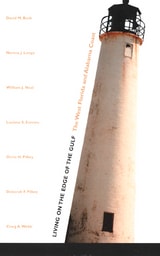
Living on the Edge of the Gulf
The West Florida and Alabama CoastDavid M. Bush, Norma J. Longo, William J. Neal, Luciana S. Esteves, Orrin H. Pilkey, Deborah F. Pilkey, Craig A. Webb
Duke University Press, 2001
The Gulf coast of Florida and Alabama is a fragile combination of barrier islands, low-lying marshes, and highly erodable mainland shores. In addition to sea-level rise, winter storms, and altered sediment supplies, hurricanes frequently damage or destroy the human developments and infrastructures that line this coast. Indeed, a single storm can cause billions of dollars in losses. Memories of such hurricanes as Camille, Frederic, Opal, and Andrew cause great concern for residents and property owners alike; events of equal magnitude are always just beyond the horizon and the uninformed have much to lose.
The authors of Living on the Edge of the Gulf seek to counteract potential loss by providing an illustrated introduction to coastal processes, a history of hazards for the region, and risk-reduction guidance in the form of site evaluations, community mitigation techniques, and storm-resistant construction practices. Risk maps that focus on individual coastal beaches are designed to assist property owners, community planners, and officials in prudent decision making, while a review of coastal regulations helps owners to understand and navigate various permit requirements.
This latest book in the Living with the Shore series replaces the earlier guide Living with the West Florida Shore and supplements the Alabama portion of Living with the Alabama/Mississippi Shore.
Living with Long Island's South Shore
Larry McCormick, William Neal, Orrin Pilkey Jr., and Orrin Pilkey, Sr.
Duke University Press, 1984
The south shore of Long Island, one of New York's greatest recreational assets, is receding at the rate of up to six feet per year. In many cases, efforts to halt this erosion actually have increased it. Buildings cone thought safely constructed back from high tidemarks today protrude far into the water.
Even more, the number of homes an facilities built too close to the sea's edge has dramatically increased, making the south shore probably less ready to withstand a major storm than at the time of the cataclysmic hurricane of 1938.
Thus, the question of what to do now to overcome and avoid these hazards takes on real urgency. Pointing to past mistakes, many Long Islanders insist that only by acting in an informed reasonable way can safe and environmentally sound development be possible for everyone.
Living with the Alabama/Mississippi Shore
Wayne F. Canis, William F. Neal, Orrin H. Pilkey Jr. and Orrin H. Pilkey Sr.
Duke University Press, 1985
Yet this same serene shoreline has been ravaged by seven major hurricanes during this century. Several years more than one fearful storm has come hurtling in during a single "season." Loss of life an property damage have been devastating. And newcomers seem almost unaware of the potential dangers.
The authors of this book offer a vivid, historical overview for understanding the environment of the Alabama-Mississippi shore. They describe the risks faced by new residents, and they point the way toward safe and sane coastal development.
Living with the Chesapeake Bay and Virginia's Ocean Shores
Larry G. Ward, Peter S. Rosen, William J. Neal. Orrin H. Pilkey Jr., Orrin H. Pilkey Sr., Gary L. Anderson, and Stephen J. Howie
Duke University Press, 1989
Living with the Coast of Maine
Joseph T. Kelley and Alice R. Kelley
Duke University Press, 1989
Maine is known for its rockbound coast and pristine shoreline. Yet there is more to this shore than rocky cliffs. This book describes the origin of the more common "soft coast" of eroding bluffs, sand beaches, and salt marshes. A central theme is the formation of the present shoreline during the current ongoing rise in sea level and the ways in which coastal residents can best cope with the changes to come. Although it is not widely known, Maine is experiencing a rapid, uneven drowning of its shore at the same time that coastal development is at an all-time high. The authors explain how the shoreline is changing and provide a series of highly detailed maps that show the relative safety of particular locations on the coast.
Specific guidelines for recognizing various safe and unsafe coastal settings are presented, as are recommendations for sound construction techniques in hazardous coastal areas. Photographs and drawings illustrate the danger of living too near the shoreline, and an up-to-date review of Maine's regulations governing coastal construction is simply and readably described. A bibliography of important coastal literature is also included, as well as a guide to federal, state, and local sources of information.
Living with the East Florida Shore
Orrin H. Pilkey, Dinesh Sharma, Harold Wanless, Larry Doyle, Orrin H. Pilkey Sr., William J. Neal, and Barbara Gruver
Duke University Press, 1984
More than one transplanted Floridian has paid $150,000 for a beautiful condominium with a sea view only to learn that, to keep the building from becoming part of the view, considerable additional money must be spent to build and repair seawalls or to pump up new beaches by dredging sand from offshore.
Most of Florida's beachfront property lies on narrow strips of sand called barrier islands, which are low in elevation and subject to flooding during storms and hurricanes. Some of the construction is poor, adding to the problems facing homeowners, most whom came from other parts of the country with little awareness of the hazards of beaches. In Living with the East Florida Shore, Orrin H. Pilkey, Jr., of Duke University, along with his co-authors, has described the varied problems that confront the east shore of Florida today.
Living with the Georgia Shore
Tonya D. Clayton, Lewis A. Taylor Jr., William J. Cleary, Paul Hosier, Peter H.F. Graber, and Orrin H. Pilkey Sr.
Duke University Press, 1992
Recounting the human and natural history of the islands, the authors look in particular at the phenomenon of coastal erosion and the implications of various responses to this process. In Georgia, as elsewhere in the United States, the future of the shore is in doubt as recreational and residential development demands increase. This book provides guidelines for living with the shore, as opposed to simply living on it. The former requires planning and a wise choice of property or house site. The latter ignores the potential hazards unique to coastal life and may make inadequate allowance for the dramatic changes that can occur on any sandy ocean shore.
Living with the Georgia Shore includes an introduction to each of the Georgia isles, an overview of federal and state coastal land-use regulations, pointers on buying and building at the shore, a hurricane preparation checklist, a history of recent hurricanes in Georgia, an extensive annotated bibliography, and a guide to government agencies and private groups involved in issues of coastal development.
Living with the Louisiana Shore
Joseph T. Kelley, Alice R. Kelley, Orrin Pilkey Sr., and Albert Clark
Duke University Press, 1984
But the most striking feature of Louisiana's coastline is rapidly accelerating change, which means (1) some coastal parishes may literally disappear by the year 2000; (2) the loss of marshland will damage the prolific seafood industry; (3) a retreating coastline could cost the state hundreds of millions of dollars in tax revenues from offshore oil facilities; (4) present and potential shoreline residents will face many new problems and possibilities.
Living with the New Jersey Shore
Karl Nordstrom, Paul A. Garés, Norbert P. Psuty, Orrin H. Pilkey Jr., William Neal, and Orrin H. Pilkey Sr.
Duke University Press, 1986
Living with the Puerto Rico Shore
David M. Bush, Richard M. T. Webb, José González Liboy, Lisbeth Hyman, and William J. Neal
Duke University Press, 1995
The book provides detailed descriptions of the entire shoreline, noting the specific coastal hazards of each coastal reach. These hazards include coastal erosion, storm surge flooding, and potential damage from earthquakes. Where high-density development or significant roads and utilities are particularly at risk, these are also noted. The effects that sand mining, seawalls, jetties, and other attempts at coastal engineering have had on the island are examined. Finally, the authors discuss historical and legal aspects of coastal planning in Puerto Rico, presenting guidelines for selecting building sites.
Of interest to all concerned with protecting our shores and beaches and useful to the coastal planner and manager, Living With the Puerto Rico Shore contains an extensive bibliography and a list of agencies involved in coastal issues.

Living with the Shore of Puget Sound and the Georgia Strait
Thomas A. Terich
Duke University Press, 1987
Living with the South Carolina Coast
Gered Lennon, William J. Neal, David Bush, Orrin H. Pilkey, Matthew Stutz and Jane Bullock
Duke University Press, 1996
Powerful storms have always played a major role in coastal processes in South Carolina, and the effects of Hurricane Hugo, the storm that ravaged the area in 1989, are thoroughly discussed. A series of Coastal Risk Maps are also included. These maps, graphically depicting areas of predictable erosion and storm damage potential, have been provided for every developed beach or barrier island in the state. Beyond the threat of hurricanes and coastal erosion, South Carolina, home of the Charleston Seismic Region, is also at risk for earthquakes. An entire chapter is devoted to earthquake-resistant construction, and the great Charleston earthquake of 1886 is examined in detail. Fires and floods are discussed. The Beachfront Management Act of 1990—the first state legislation of its kind that provides a system for dealing with migrating shorelines while preserving beaches for future generations—is also explained.
Covering everything from a history of the development of South Carolina's coast to recommendations on how to select an island homesite, this book will be a resource to professional coastal planners and managers, residents, prospective homeowners, and naturalists.
Marketable Values
Inventing the Property Market in Modern BritainDesmond Fitz-Gibbon
University of Chicago Press, 2018
In Marketable Values, Desmond Fitz-Gibbon seeks to answer that question. He tells the story of how Britons imagined, organized, and debated the buying and selling of land from the mid-eighteenth to the early twentieth century. In a society organized around the prestige of property, the desire to commodify land required making it newly visible through such spectacles as public auctions, novel professions like auctioneering, and real estate journalism. As Fitz-Gibbon shows, these innovations sparked impassioned debates on where, when, and how to demarcate the limits of a market society. As a result of these collective efforts, the real estate business became legible to an increasingly attentive public and a lynchpin of modern economic life.
Drawing on an eclectic range of sources—from personal archives and estate correspondence to building designs, auction handbills, and newspapers—Marketable Values explores the development of the British property market and the seminal role it played in shaping the relationship we have to property around the world today.
Northern Frontiers of Qing China and Tokugawa Japan
A Comparative Study of Frontier PolicyRichard Louis Edmonds
University of Chicago Press, 1985
Pious Property
Islamic Mortgages in the United StatesBill Maurer
Russell Sage Foundation, 2006
Race, Real Estate and Education
Inventing Gentrification in Philadelphia, 1960-2020Edward M. Epstein
Temple University Press, 2025
Epstein outlines the citywide context for the plan to create “University City” in West Philadelphia. He recounts the attempts to correct the segregation, overcrowding, and authoritarian management that plagued Philadelphia’s public schools. As the West Philadelphia Corporation, the proxy for the universities and hospitals, initiated gentrification efforts, the local community resisted and protested, causing the project to fail. The effort was revived with spectacular success, however, with the launch of the well-funded Penn Alexander School in 2001.
Race, Real Estate, and Education shows how the pursuit of urbanist ideals sometimes deepens neighborhood injustice. Epstein’s exploration of whether Philadelphia’s overall approach was beneficial or misguided presents a cautionary tale.
In the series Urban Life, Landscape, and Policy
Selling The Dream
The Gulf American Corporation and the Building of Cape Coral, FloridaDavid Dodrill
University of Alabama Press, 1993
Examining real estate ambition and urban growth in Cape Coral’s creation.
The Gulf American Corporation played a significant role in the development and urbanization of the state of Florida, especially southwest Florida, during the late 1950s and 1960s. The Miami-based company promoted living in Florida to people residing throughout North America and in several foreign countries. It also enabled people of average incomes to purchase home sites in Florida on an installment basis. As a result, Gulf American had a heavy influence on the migration of people to Florida as early as 1957.
Leonard and Julius J. Rosen of Baltimore, Maryland, founded and controlled the corporation during its 12-year existence from 1957 to 1969. The sale and promotion of Florida real estate was an extension of their marketing style developed in previous years when they sold mail-order cosmetics and other products. Their innovative sales strategies ultimately resulted in conflicts with state and federal regulatory agencies in the mid 1960s over the firm’s aggressive sales methods. The struggle with the state of Florida over regulation, which degenerated into a personal conflict between Governor Claude Kirk and the Rosens, resulted in the Rosens’ selling the business to GAC Corporation of Allentown, Pennsylvania, in 1969. After a series of business setbacks and continuing accusations of misrepresentations by salespeople, GAC declared bankruptcy in 1975 and was eventually resurrected as Avatar Holding, Inc., in 1980.
Gulf American left a mixed legacy to the state of Florida by building several growing cities like Cape Coral and Golden Gate, while at the same time selling worthless underwater swampland near the Everglades. The building of their first development was planned by the company. In that sense, Cape Coral was designed to be the Rosens’ most elaborate sales tool.
Based on 31 personal interviews with former Gulf American Corporation, GAC/Avatar Holding company officials and supplemented by articles from 25 different newspapers, this book provides a comprehensive and fascinating look at the Gulf American Corporation—the largest land sales firm in the United States in the 1960s. In many ways the story of Gulf American is a rags-to-riches tale of Leonard and Julius (Jack) Rosen, complete with intrigue and the fluctuations of fortune that matched the rising tides that covered much of the land they sold.
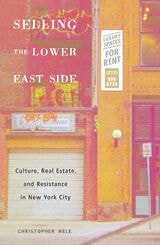
Selling The Lower East
Culture, Real Estate, and Resistance in New York CityChristopher Mele
University of Minnesota Press, 2000
Tracks the shifting views of the Lower East Side from ghetto to desirable urban niche.
The Lower East Side of Manhattan is rich in stories-of poor immigrants who flocked there in the late nineteenth and early twentieth centuries; of beatniks, hippies, and artists who peopled it mid-century; and of the real estate developers and politicians who have always shaped what is now termed the "East Village." Today, the musical Rent plays on Broadway to a mostly white and suburban audience, MTV exploits the neighborhood’s newly trendy squalor in a film promotion, and on the Internet a cyber soap opera and travel-related Web pages lure members of the middle class to enjoy a commodified and sanitized version of the neighborhood.
In this sweeping account, Christopher Mele analyzes the political and cultural forces that have influenced the development of this distinctive community. He describes late nineteenth-century notions of the Lower East Side as a place of entrenched poverty, ethnic plurality, political activism, and "low" culture that elicited feelings of revulsion and fear among the city’s elite and middle classes. The resulting-and ongoing-struggle between government and residents over affordable and decent housing has in turn affected real estate practices and urban development policies. Selling the Lower East Side recounts the resistance tactics used by community residents, as well as the impulse on the part of some to perpetuate the image of the neighborhood as dangerous, romantic, and bohemian, clinging to the marginality that has been central to the identity of the East Village and subverting attempts to portray it as "new and improved." Ironically, this very image of urban grittiness has been appropriated by a cultural marketplace hungry for new fodder. Mele explores the ways that developers, media executives, and others have coopted the area’s characteristics-analyzing the East Village as a "style provider" where what is being marketed is "difference." The result is a visionary look at how political and economic actions transform neighborhoods and at what happens when a neighborhood is what is being "consumed."A comprehensive web site for Selling the Lower East Side can be found at www.upress.umn.edu/sles.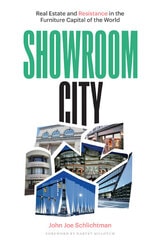
Showroom City
Real Estate and Resistance in the Furniture Capital of the WorldJohn Joe Schlichtman
University of Minnesota Press, 2022
A unique and engaging account of local urban decision-making within the globalizing world
High Point, North Carolina, is known as the “Furniture Capital of the World.” Once a manufacturing stronghold, most of its furniture factories have closed over the past forty years, with production shipped off to low-wage countries. Yet as manufacturing left, the city tightened its hold on a biannual global exposition that serves as the world’s furniture fashion runway. At the High Point Market, visitors from more than one hundred nations traverse twelve million square feet of meticulous design. Downtown buildings—once courthouses, movie theaters, post offices, and gas stations—are now chic showroom spaces, even as many sit empty between each exposition.
In Showroom City, John Joe Schlichtman applies an ethnographic lens to the global exposition’s relationship with High Point after it defeated rival Chicago in the 1960s and established itself as the world’s dominant furniture center. In recent decades, following trends in global finance, private equity firms were increasingly behind downtown High Point’s real estate transactions, coordinated by buyers far removed from the region. Then, in one massive transaction in 2011, a firm funded by Bain Capital purchased every major showroom building, and the majority of downtown real estate was under one owner.
Showroom City is a story of exclusionary growth and unchecked development, of a city flailing to fill the void left by its dwindling factories. But beyond that Schlichtman engages the general lessons behind both High Point’s deindustrialization and its stunning reinvention as a furniture fashion, merchandising, and design node. With great nuance, he delves deeply to reveal how power operates locally and how citizens may affirm, exploit, influence, and resist the takeover of their community.
The Beaches Are Moving
The Drowning of America's ShorelineWallace Kaufman and Orrin H. Pilkey Jr.
Duke University Press, 1983
Our beaches are eroding, sinking, washing out right under our houses, hotels, bridges; vacation dreamlands become nightmare scenes of futile revetments, fills, groins, what have you—all thrown up in a frantic defense against the natural system. The romantic desire to live on the seashore is in doomed conflict with an age-old pattern of beach migration. Yet it need not be so. Conservationist Wallace Kaufman teams up with marine geologist Orrin H. Pilkey Jr., in an evaluation of America's beaches from coast to coast, giving sound advice on how to judge a safe beach development from a dangerous one and how to live at the shore sensibly and safely.
The North Carolina Shore and Its Barrier Islands
Restless Ribbons of SandOrrin H. Pilkey, William J. Neal, Stanley R. Riggs, Craig A. Webb, David M. Bush, Deborah F. Pilkey, Jane Bullock, and Brian A. Cowan
Duke University Press, 1998
Evidence that the North Carolina shore is changing is never hard to find, but recently the devastation wrought by Hurricane Fran and the perilous situation of the historic lighthouse at Cape Hatteras have reminded all concerned of the fragility of this coast. Arguing for a policy of intelligent development, one in which residential and commercial structures meet rather than confront the changing nature of the shore, the authors have included practical information on hazards of many kinds—storms, tides, floods, erosion, island migration, and earthquakes. Diagrams and photographs clearly illustrate coastal processes and aid in understanding the impact of hurricanes and northeasters, wave and current dynamics, as well as pollution and other environmental destruction due to overdevelopment. A chapter on estuaries provides related information on the shores of back barrier areas that are growing in popularity for recreational residences. Risk maps focus on the natural hazards of each island and together with construction guidelines provide a basis for informed island management. Lastly, the dynamics of coastal politics and management are reviewed through an analysis of the controversies over the decision to move the Cape Hatteras lighthouse and a proposed effort to stabilize Oregon Inlet.
From the natural and historic perspective of the opening chapters to the regional discussions of individual barrier islands, this book is both a primer on coastal processes for the first time visitor as well as a guide to hazard identification for property owners.
The Struggle for Water
Politics, Rationality, and Identity in the American SouthwestWendy Nelson Espeland
University of Chicago Press, 1998
In the 1970s, the three groups most intimately involved in the Orme Dam—younger Bureau of Reclamation employees committed to "rational choice" decision making, older Bureau engineers committed to the dam, and the Yavapai community—all found themselves and their values transformed by their struggles. Wendy Nelson Espeland lays bare the relations between interests and identities that emerged during the conflict, creating a contemporary tale of power and colonization, bureaucracies and democratic practice, that asks the crucial question of what it means to be "rational."
Upsold
Real Estate Agents, Prices, and Neighborhood InequalityMax Besbris
University of Chicago Press, 2020
Stratification defines cities in the contemporary United States. In an era marked by increasing income segregation, one of the main sources of this inequality is housing prices. A crucial part of wealth inequality, housing prices are also directly linked to the uneven distribution of resources across neighborhoods and to racial and ethnic segregation. Upsold shows how the interactions between real estate agents and buyers make or break neighborhood reputations and construct neighborhoods by price.
Employing revealing ethnographic and quantitative housing data, Besbris outlines precisely how social influences come together during the sales process. In Upsold, we get a deep dive into the role that the interactions with sales agents play in buyers’ decision-making and how neighborhoods are differentiated, valorized, and deemed to be worthy of a certain price.
Well Worth Saving
How the New Deal Safeguarded Home OwnershipPrice Fishback, Jonathan Rose, and Kenneth Snowden
University of Chicago Press, 2013
Well Worth Saving tells the story of the disastrous housing market during the Great Depression and the extent to which an immensely popular New Deal relief program, the Home Owners’ Loan Corporation (HOLC), was able to stem foreclosures by buying distressed mortgages from lenders and refinancing them. Drawing on historical records and modern statistical tools, Price Fishback, Jonathan Rose, and Kenneth Snowden investigate important unanswered questions to provide an unparalleled view of the mortgage loan industry throughout the 1920s and early ’30s. Combining this with the stories of those involved, the book offers a clear understanding of the HOLC within the context of the housing market in which it operated, including an examination of how the incentives and behaviors at play throughout the crisis influenced the effectiveness of policy.
More than eighty years after the start of the Great Depression, when politicians have called for similar programs to quell the current mortgage crisis, this accessible account of the Home Owners’ Loan Corporation holds invaluable lessons for our own time.
Wetlands of the American Midwest
A Historical Geography of Changing AttitudesHugh Prince
University of Chicago Press, 1997
As attitudes changed, so did scientific research agendas, government policies, and farmers' strategies for managing their land. Originally viewed as bountiful sources of wildlife by indigenous peoples, wet areas called "wet prairies," "swamps," or "bogs" in the late nineteenth and early twentieth centuries were considered productive only when drained for agricultural use. Beginning in the 1950s, many came to see these renamed "wetlands" as valuable for wildlife and soil conservation.
Prince's book will appeal to a wide readership, ranging from geographers and environmental historians to the many government and private agencies and individuals concerned with wetland research, management, and preservation.