Results by title
9 books match the query 'Real estate development'
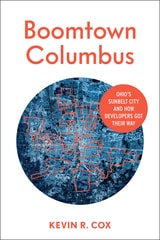
Boomtown Columbus
Ohio’s Sunbelt City and How Developers Got Their WayKevin R. Cox
The Ohio State University Press, 2021
How have development interests become entwined with government? How has a policy of annexation reformed the city’s map? Why have airline service and major league prestige lagged behind its status as a regional center? And what, if anything, makes this city with a reputation for being average stand apart? In Boomtown Columbus, Cox applies both scholarly expertise and his personal experience as a long-time resident of the city to look at the real-life costs of policy. The resulting narrative will fascinate not only locals but anyone with a stake in understanding American cities and a path toward urban livability for all.
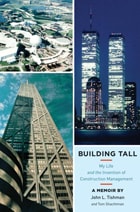
Building Tall
My Life and the Invention of Construction ManagementJohn L. Tishman and Tom Shachtman
University of Michigan Press, 2011
"John Tishman is a true pioneer in the Construction Management industry. Through his CM leadership, some of America's most well-known buildings have been brought to successful completion."
---Bruce D'Agostino, president and chief executive, Construction Management Association of America
"Building Tall will provide readers with insights into John Tishman's career as a visionary engineer, landmark builder, and great businessman. Responsible for some of the construction world's most magnificent projects, John is one of the preeminent alumni in the history of Michigan Engineering. His perspectives have helped me throughout my time as dean, and his impact will influence generations of Construction Management professionals and students."
---David C. Munson, Jr., Robert J. Vlasic Dean of Engineering, University of Michigan
In this memoir, University of Michigan graduate John L. Tishman recounts the experiences and rationale that led him to create the entirely new profession now recognized and practiced as Construction Management. It evolved from his work as the construction lead of the "owner/builder" firm Tishman Realty and Construction, and his personal role as hands-on Construction Manager in the building of an astonishing array of what were at the time the world's tallest and most complex projects. These include
- The world's first three 100-story towers---the original "twin towers" of the World Trade Center in Manhattan and the Hancock Tower in Chicago.
- The Epcot Center at Disney World.
- The Renaissance Center in Detroit.
- New York's Madison Square Garden.
Tishman interweaves the stories behind the construction of these and many other important buildings and projects with personal reminiscences of his dealings with Henry Ford, Jr., Disney's Michael Eisner, casino magnate Steve Wynn, and many others into a practical history of the field of Construction Management, which he pioneered.
This book will be of interest not only to a general public interested in the stories and personalities behind many of the most iconic construction projects of the post–World War II period in the United States but to students of engineering and architecture and members of the new field of Construction Management.
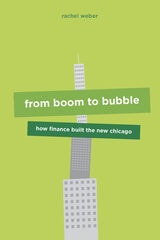
From Boom to Bubble
How Finance Built the New ChicagoRachel Weber
University of Chicago Press, 2015
In From Boom to Bubble, Rachel Weber debunks the idea that booms occur only when cities are growing and innovating. Instead, she argues, even in cities experiencing employment and population decline, developers rush to erect new office towers and apartment buildings when they have financial incentives to do so. Focusing on the main causes of overbuilding during the early 2000s, Weber documents the case of Chicago’s “Millennial Boom,” showing that the Loop’s expansion was a response to global and local pressures to produce new assets. An influx of cheap cash, made available through the use of complex financial instruments, helped transform what started as a boom grounded in modest occupant demand into a speculative bubble, where pricing and supply had only tenuous connections to the market. From Boom to Bubble is an innovative look at how property markets change and fail—and how that affects cities.
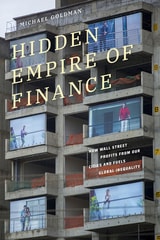
Hidden Empire of Finance
How Wall Street Profits from Our Cities and Fuels Global InequalityMichael Goldman
Duke University Press, 2026
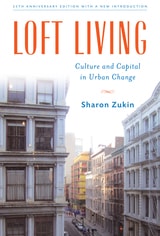
Loft Living
Culture and Capital in Urban ChangeZukin, Sharon
Rutgers University Press, 2014

Loft Living
Culture and Capital in Urban ChangeZukin, Sharon
Rutgers University Press, 1989
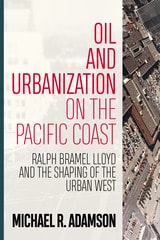
Oil and Urbanization on the Pacific Coast
Ralph Bramel Lloyd and the Shaping of the Urban WestMichael R. Adamson
West Virginia University Press, 2018
Oil and Urbanization on the Pacific Coast tells the story of oilman Ralph Bramel Lloyd, a small business owner who drove the development of one of America’s largest oil fields. Lloyd invested his petroleum earnings in commercial real estate—much of it centered around automobiles and the fuel they require—in several western cities, notably Portland, Oregon. Putting the history of extractive industry in dialogue with the history of urban development, Michael R. Adamson shows how energy is woven into the fabric of modern life, and how the “energy capital” of Los Angeles exerted far-flung influence in the US West.
A contribution to the relatively understudied history of small businesses in the United States, Oil and Urbanization on the Pacific Coast explores issues of interest to multiple audiences, such as the competition for influence over urban development waged among local growth machines and outside corporate interests; the urban rivalries of a region; the importance of public capital in mobilizing the commercial real estate sector during the Great Depression and World War II; and the relationships among owners, architects, and contractors in the execution of commercial building projects.
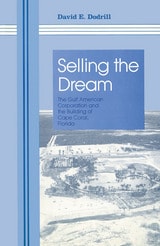
Selling The Dream
The Gulf American Corporation and the Building of Cape Coral, FloridaDavid Dodrill
University of Alabama Press, 1993
Examining real estate ambition and urban growth in Cape Coral’s creation.
The Gulf American Corporation played a significant role in the development and urbanization of the state of Florida, especially southwest Florida, during the late 1950s and 1960s. The Miami-based company promoted living in Florida to people residing throughout North America and in several foreign countries. It also enabled people of average incomes to purchase home sites in Florida on an installment basis. As a result, Gulf American had a heavy influence on the migration of people to Florida as early as 1957.
Leonard and Julius J. Rosen of Baltimore, Maryland, founded and controlled the corporation during its 12-year existence from 1957 to 1969. The sale and promotion of Florida real estate was an extension of their marketing style developed in previous years when they sold mail-order cosmetics and other products. Their innovative sales strategies ultimately resulted in conflicts with state and federal regulatory agencies in the mid 1960s over the firm’s aggressive sales methods. The struggle with the state of Florida over regulation, which degenerated into a personal conflict between Governor Claude Kirk and the Rosens, resulted in the Rosens’ selling the business to GAC Corporation of Allentown, Pennsylvania, in 1969. After a series of business setbacks and continuing accusations of misrepresentations by salespeople, GAC declared bankruptcy in 1975 and was eventually resurrected as Avatar Holding, Inc., in 1980.
Gulf American left a mixed legacy to the state of Florida by building several growing cities like Cape Coral and Golden Gate, while at the same time selling worthless underwater swampland near the Everglades. The building of their first development was planned by the company. In that sense, Cape Coral was designed to be the Rosens’ most elaborate sales tool.
Based on 31 personal interviews with former Gulf American Corporation, GAC/Avatar Holding company officials and supplemented by articles from 25 different newspapers, this book provides a comprehensive and fascinating look at the Gulf American Corporation—the largest land sales firm in the United States in the 1960s. In many ways the story of Gulf American is a rags-to-riches tale of Leonard and Julius (Jack) Rosen, complete with intrigue and the fluctuations of fortune that matched the rising tides that covered much of the land they sold.
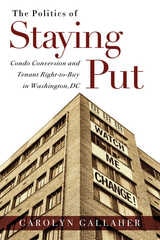
The Politics of Staying Put
Condo Conversion and Tenant Right-to-Buy in Washington, DCCarolyn Gallaher
Temple University Press, 2016
When cities gentrify, it can be hard for working-class and low-income residents to stay put. Rising rents and property taxes make buildings unaffordable, or landlords may sell buildings to investors interested in redeveloping them into luxury condos.
In her engaging study The Politics of Staying Put, Carolyn Gallaher focuses on a formal, city-sponsored initiative—The Tenant Opportunity to Purchase Act (TOPA)—that helps people keep their homes. This law, unique to the District of Columbia, allows tenants in apartment buildings contracted for sale the right to refuse the sale and purchase the building instead. In the hands of tenants, a process that would usually hurt them—conversion to a condominium or cooperative—can instead help them.
Taking a broad, city-wide assessment of TOPA, Gallaher follows seven buildings through the program’s process. She measures the law’s level of success and its constraints. Her findingshave relevance for debates in urban affairs about condo conversion, urban local autonomy, and displacement.