Results by title
8 books match the query 'Recognition'

Aboriginal TM
The Cultural and Economic Politics of RecognitionJennifer Adese
University of Manitoba Press, 2022
[more]

Native Acts
Law, Recognition, and Cultural AuthenticityJoanne Barker
Duke University Press, 2011
In the United States, Native peoples must be able to demonstrably look and act like the Natives of U.S. national narrations in order to secure their legal rights and standing as Natives. How they choose to navigate these demands and the implications of their choices for Native social formations are the focus of this powerful critique. Joanne Barker contends that the concepts and assumptions of cultural authenticity within Native communities potentially reproduce the very social inequalities and injustices of racism, ethnocentrism, sexism, homophobia, and fundamentalism that define U.S. nationalism and, by extension, Native oppression. She argues that until the hold of these ideologies is genuinely disrupted by Native peoples, the important projects for decolonization and self-determination defining Native movements and cultural revitalization efforts are impossible. These projects fail precisely by reinscribing notions of authenticity that are defined in U.S. nationalism to uphold relations of domination between the United States and Native peoples, as well as within Native social and interpersonal relations. Native Acts is a passionate call for Native peoples to decolonize their own concepts and projects of self-determination.
[more]
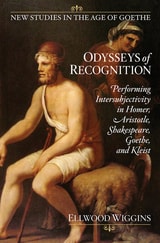
Odysseys of Recognition
Performing Intersubjectivity in Homer, Aristotle, Shakespeare, Goethe, and KleistWiggins, Ellwood
Bucknell University Press, 2019
Literary recognition is a technical term for a climactic plot device. Odysseys of Recognition claims that interpersonal recognition is constituted by performance, and brings performance theory into dialogue with poetics, politics, and philosophy. By observing Odysseus figures from Homer to Kleist, Ellwood Wiggins offers an alternative to conventional intellectual histories that situate the invention of the interior self in modernity. Through strategic readings of Aristotle, this elegantly written, innovative study recovers an understanding of interpersonal recognition that has become strange and counterintuitive. Penelope in Homer’s Odyssey offers a model for agency in ethical knowledge that has a lot to teach us today. Early modern and eighteenth-century characters, meanwhile, discover themselves not deep within an impenetrable self, but in the interpersonal space between people in the world. Recognition, Wiggins contends, is the moment in which epistemology and ethics coincide: in which what we know becomes manifest in what we do.
Published by Bucknell University Press. Distributed worldwide by Rutgers University Press.
Published by Bucknell University Press. Distributed worldwide by Rutgers University Press.
[more]
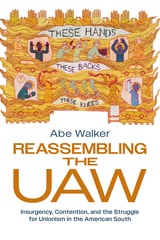
Reassembling the UAW
Insurgency, Contention, and the Struggle for Unionism in the American SouthAbe Walker
Temple University Press, 2026
When Volkswagen’s Chattanooga Assembly Plant opened in 2012, the United Auto Workers were excited by the golden opportunity to organize in the anti-union South, where their efforts had been routinely thwarted. However, it took ten years and several attempts before the UAW was successful in unionizing the plant. Reassembling the UAW explains why.
Abe Walker chronicles the organizing campaign from its origin in 2014 to the union’s breakthrough victory in 2024, illustrating what went wrong—and what went right—along the way. Walker provides a systematic analysis of the strategic challenges and tactical shifts, showing the patterns that persisted across three election cycles while highlighting their differences, from global-level alliances to local labor issues.
Reassembling the UAW also demonstrates how rebel rank-and-file workers ousted the old-guard leadership and transformed the UAW into a militant union to achieve results. Ultimately, Walker offers valuable lessons for organizational strategy, the power of collective action, and the future of the labor movement.
[more]
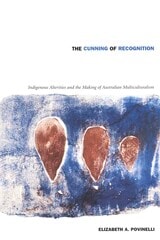
The Cunning of Recognition
Indigenous Alterities and the Making of Australian MulticulturalismElizabeth A. Povinelli
Duke University Press, 2002
The Cunning of Recognition is an exploration of liberal multiculturalism from the perspective of Australian indigenous social life. Elizabeth A. Povinelli argues that the multicultural legacy of colonialism perpetuates unequal systems of power, not by demanding that colonized subjects identify with their colonizers but by demanding that they identify with an impossible standard of authentic traditional culture.
Povinelli draws on seventeen years of ethnographic research among northwest coast indigenous people and her own experience participating in land claims, as well as on public records, legal debates, and anthropological archives to examine how multicultural forms of recognition work to reinforce liberal regimes rather than to open them up to a true cultural democracy. The Cunning of Recognition argues that the inequity of liberal forms of multiculturalism arises not from its weak ethical commitment to difference but from its strongest vision of a new national cohesion. In the end, Australia is revealed as an exemplary site for studying the social effects of the liberal multicultural imaginary: much earlier than the United States and in response to very different geopolitical conditions, Australian nationalism renounced the ideal of a unitary European tradition and embraced cultural and social diversity.
While addressing larger theoretical debates in critical anthropology, political theory, cultural studies, and liberal theory, The Cunning of Recognition demonstrates that the impact of the globalization of liberal forms of government can only be truly understood by examining its concrete—and not just philosophical—effects on the world.
[more]

The Face on the Screen
Death, Recognition & SpectatorshipTherese Davis
Intellect Books, 1995
There was a time in screen culture when the facial close-up was a spectacular and mysterious image…
The constant bombardment of the super-enlarged, computer-enhanced faces of advertising, the endless 'talking heads' of television and the ever-changing array of film stars' faces have reduced the face to a banal image, while the dream of early film theorists that the 'giant severed heads' of the screen could reveal 'the soul of man' to the masses is long since dead. And yet the end of this dream opens up the possibility for a different view of the face on the screen. The aim of the book is to seize this opportunity to rethink the facial close-up in terms other than subjectivity and identity by shifting the focus to questions of death and recognition.
In doing so, the book proposes a dialectical reversal or about-face. It suggests that we focus our attention on the places in contemporary media where the face becomes unrecognisable, for it is here that the facial close-up expresses the powers of death. Using Walter Benjamin's theory of the dialectical image as a critical tool, the book provides detailed studies of a wide range of media spectacles of faces becoming unrecognisable. It shows how the mode of recognition enabled by these faces is a shock experience that can open our eyes to the underside of the mask of self - the unrecognisable mortal face of self we spend our lives trying not to see. Turning on itself, so to speak, the face exposes the fragile relationship between social recognition and facial recognizability in the images-cultures of contemporary media.
[more]
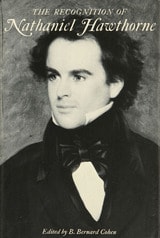
The Recognition of Nathaniel Hawthorne
Selected Criticism Since 1828Edited by B. Bernard Cohen
University of Michigan Press, 1969
What is Hawthorne's eminent literary reputation — "enduring" or "hypertrophied"? Both views are represented in this basic collection of seminal 19th- and 20th-century evaluations. Hawthorne's reputation appears secure, yet his work is still the subject of significant critical controversy.Reviews by Hawthorne's contemporaries take up the first section of The Recognition of Nathaniel Hawthorne—including an early review that predicted future greatness for the then-anonymous author of Fanshawe, and important pieces by Duyckinck, Longfellow, Poe, Melville, and Lowell. These estimates reveal many of the critical issues that were to concern successive generations of readers.Cohen's second section, covering the period from 1865 to 1910, includes criticism by Henry James, William Dean Howells, Paul Elmer More, Bliss Perry, and William C. Brownell. In the final section, T. S. Eliot, Vernon Louis Parrington, Austin Warren, F. O. Matthiessen, Hyatt H. Waggoner, Martin Green, and Frederick C. Crews are among the critics who explore, from a wide variety of viewpoints, the complex mind of this great American writer.The Recognition of Nathaniel Hawthorne is prefaced by a valuable survey of the criticism by Professor Cohen, and headnotes are provided for each of the selections.
[more]
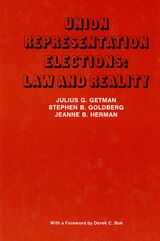
Union Representation Elections
Law and RealityJulius Getman
Russell Sage Foundation, 1976
Provides the first major effort to test the rules and regulations that underlie current practices in union elections and, at the same time, explores the role played by the National Labor Relations Board in regulating these elections. The book reports the findings of an empirical field study of thirty-one union representation elections involving over 1,000 employees to determine their pre-campaign attitudes, voting intent, actual vote, and the effect of the campaign on voting. It focuses on campaign issues, unlawful campaigning, working conditions, demographic factors, job-related variables, and other topics.
[more]