Results by title
19 books match the query 'Redemption'
American Fantastic
Myths of Violence and RedemptionDerek J. Thiess
University of Wisconsin Press, 2025
Thiess’s interdisciplinary study examines America’s past and present imperial projects, from the Hawaiian Islands to the Eastern Seaboard, as they proliferate in popular story forms. By interrogating American myths, legends, and fantastic narratives across an impressive array of genres, including folk narratives, science fiction, movies, and more, Thiess exposes how the “myth of redemptive violence” manifests in contemporary constructions of America’s fantastic imaginaries.
American Prophecy
Race and Redemption in American Political CultureGeorge Shulman
University of Minnesota Press, 2008
The political meaning of prophetic language in America
Prophecy is the fundamental idiom of American politics—a biblical rhetoric about redeeming the crimes, suffering, and promise of a special people. Yet American prophecy and its great practitioners—from Frederick Douglass and Henry Thoreau to Martin Luther King, James Baldwin, and Toni Morrison—are rarely addressed, let alone analyzed, by political theorists. This paradox is at the heart of American Prophecy, a work in which George Shulman unpacks and critiques the political meaning of American prophetic rhetoric.
In the face of religious fundamentalisms that associate prophecy and redemption with dogmatism and domination, American Prophecy finds connections between prophetic language and democratic politics, particularly racial politics. Exploring how American critics of white supremacy have repeatedly reworked biblical prophecy, Shulman demonstrates how these writers and thinkers have transformed prophecy into a political language and given redemption a political meaning. To examine how antiracism is linked to prophecy as a vernacular idiom is to rethink political theology, recast democratic theory, and reassess the bearing of religion on American political culture. Still, prophetic language is not always liberatory, and American Prophecy maintains a critical dispassion about a rhetoric that is both prevalent and problematic.
Catholic Dogmatic Theology
A Synthesis: Book 2: On the Incarnation and RedemptionJean-Herve Nicolas
Catholic University of America Press, 2022
Dry River
Stories of Life, Death, and Redemption on the Santa CruzKen Lamberton
University of Arizona Press, 2011
Here, Ken Lamberton finds his way through a lifetime of exploring southern Arizona’s Santa Cruz River. This river—dry, still, and silent one moment, a thundering torrent of mud the next—serves as a reflection of the desert around it: a hint of water on parched sand, a path to redemption across a thirsty landscape.
With his latest book, Lamberton takes us on a trek across the land of three nations—the United States, Mexico, and the Tohono O’odham Nation—as he hikes the river’s path from its source and introduces us to people who draw identity from the river—dedicated professionals, hardworking locals, and the author’s own family. These people each have their own stories of the river and its effect on their lives, and their narratives add immeasurable richness and depth to Lamberton’s own astute observations and picturesque descriptions.
Unlike books that detail only the Santa Cruz’s decline, Dry River offers a more balanced, at times even optimistic, view of the river that ignites hope for reclamation and offers a call to action rather than indulging in despair and resignation. At once a fascinating cultural history lesson and an important reminder that learning from the past can help us fix what we have damaged, Dry River is both a story about the amazing complexity of this troubled desert waterway and a celebration of one man’s lifelong journey with the people and places touched by it.
In the Work of Their Hands Is Their Prayer
Cultural Narrative and Redemption on the American Frontiers, 1830-1930Joel Daehnke
Ohio University Press, 2003
Westward expansion on the North American continent by European settlers generated a flurry of writings on the frontier experience over the course of a hundred years. Asserting that the dominant ideology of America’s Manifest Destiny embodied a tense, often contradictory union of Christian and secular republican views of social progress, In the Work of Their Hands Is Their Prayer investigates the ambivalence of the frontier as it was inscribed with redemptive, historical significance by a host of frontier writers.
Enlisting canonical and noncanonical sources, Joel Daehnke examines the manner in which the imagery of the human figure at work and play in the frontier landscape participated in the nationalist, “civilizing” project of westward expansion. While he acknowledges the growing secularization of American life, Professor Daehnke surveys the continuing claims of the Christian redemptive scheme as a powerful symbolic domain for these writers’ meditations on social progress and the potential for human perfectibility in the landscapes of the West.
Whether discussing the Edenic imagery of women’s gardens, the advocacy of an ethics of land use, or the affairs of fortune in the mining districts of Nevada, In the Work of Their Hands Is Their Prayer presents an enlightening reexamination of an American ideology of progress and its enduring fascination with mission, Manifest Destiny, and the ends of history.
In the Work of Their Hands Is Their Prayer is a welcome addition to the extended library of critical attention to the ideology, history, and literary traditions of the American frontier.
Living without the Dead
Loss and Redemption in a Jungle CosmosPiers Vitebsky
University of Chicago Press, 2017
Today, young Sora are rejecting the worldview of their ancestors and switching their allegiance to warring sects of fundamentalist Christianity or Hinduism. Communion with ancestors is banned as sacred sites are demolished, female shamans are replaced by male priests, and debate with the dead gives way to prayer to gods. For some, this shift means liberation from jungle spirits through literacy, employment, and democratic politics; others despair for fear of being forgotten after death.
How can a society abandon one understanding of reality so suddenly and see the world in a totally different way? Over forty years, anthropologist Piers Vitebsky has shared the lives of shamans, pastors, ancestors, gods, policemen, missionaries, and alphabet worshippers, seeking explanations from social theory, psychoanalysis, and theology. Living without the Dead lays bare today’s crisis of indigenous religions and shows how historical reform can bring new fulfillments—but also new torments and uncertainties.
Vitebsky explores the loss of the Sora tradition as one for greater humanity: just as we have been losing our wildernesses, so we have been losing a diverse range of cultural and spiritual possibilities, tribe by tribe. From the award-winning author of The Reindeer People, this is a heartbreaking story of cultural change and the extinction of an irreplaceable world, even while new religious forms come into being to take its place.
Opioid Reckoning
Love, Loss, and Redemption in the Rehab StateAmy C. Sullivan
University of Minnesota Press, 2021
Examines the complexity and the humanity of the opioid epidemic
America’s opioid epidemic continues to ravage families and communities, despite intense media coverage, federal legislation, criminal prosecutions, and harm reduction efforts to prevent overdose deaths. More than 450,000 Americans have died from opioid overdoses since the late 1990s. In Opioid Reckoning, Amy C. Sullivan explores the complexity of the crisis through firsthand accounts of people grappling with the reverberating effects of stigma, treatment, and recovery.
Nearly everyone in the United States has been touched in some way by the opioid epidemic, including the author and her family. Sullivan uses her own story as a launching point to learn how the opioid epidemic challenged longstanding recovery protocols in Minnesota, a state internationally recognized for pioneering addiction treatment. By centering the voices of many people who have experienced opioid use, treatment, recovery, and loss, Sullivan exposes the devastating effects of a one-size-fits-all approach toward treatment of opioid dependency. Taking a clear-eyed, nonjudgmental perspective of every aspect of these issues—drug use, parenting, harm reduction, medication, abstinence, and stigma—Opioid Reckoning questions current treatment models, healthcare inequities, and the criminal justice system. Sullivan also imagines a future where anyone suffering an opioid-use disorder has access to the individualized care, without judgment, available to those with other health problems.
Opioid Reckoning presents a captivating look at how the state that invented “rehab” addresses the challenges of the opioid epidemic and its overdose deaths while also taking readers into the intimate lives of families, medical and social work professionals, grassroots activists, and many others impacted by the crisis who contribute their insights and potential solutions. In sharing these stories and chronicling their lessons, Sullivan offers a path forward that cultivates empathy, love, and hope for anyone affected by chaotic drug use and its harms.
Out of the Red
My Life of Gangs, Prison, and RedemptionChristian L. Bolden
Rutgers University Press, 2020
Faculty Senate Award for Research from Loyola University New Orleans
Out of the Red is one man’s pathbreaking story of how social forces and personal choices combined to deliver an unfortunate fate. After a childhood of poverty, institutional discrimination, violence, and being thrown away by the public education system, Bolden's life took him through the treacherous landscape of street gangs at the age of fourteen. The Bloods offered a sense of family, protection, excitement, and power. Incarcerated during the Texas prison boom, the teenage former gangster was thrust into a fight for survival as he navigated the perils of adult prison. As mass incarceration and prison gangs swallowed up youth like him, survival meant finding hope in a hopeless situation and carving a path to his own rehabilitation. Despite all odds, he forged a new path through education, ultimately achieving the seemingly impossible for a formerly incarcerated ex-gangbanger.
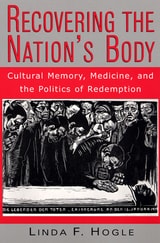
Recovering the Nation's Body
Cultural Memory, Medicine, and the Politics of RedemptionLinda F Hogle
Rutgers University Press, 1999
The body is both a site for medical practice and a source of therapeutic and scientific tools. As such, there are a variety of meanings ascribed to the body which both affect and are affected by cultural, economic, political and legal complexities. In order to access and use body parts, Linda F. Hogle states, transformative scientific and cultural processes are brought into play. Nowhere is this more evident than present-day Germany, where the spectre of Nazi medical experimentation still plays a large role in national policies governing the use of body parts and the way these policies are put into practice. In their efforts to be perceived as not repeating atrocities of the past, German medical practitioners and policy-makers reformulate ideas of bodily violation. To further confuse the issue, the reunification of East and West Germany has engendered new questions about the relationship between individuals’ bodies, science, and the state.
Hogle shows how “universal” medicine is reinterpreted through the lens of national and transnational politics and history, using comparative examples from her research in the United. States. Recovering the Nation’s Body is the first book to analyze the actual practices involved in procuring human tissue, and the first to examine how the German past and the unique present-day situation within the European Union are key in understanding the form that medical practices take within various contexts.
Redemption and the Merchant God
Dostoevsky's Economy of Salvation and AntisemitismSusan McReynolds
Northwestern University Press, 2011
Dostoevsky’s Russian chauvinism and anti-Semitism have long posed problems for his readers and critics. How could the author of The Brothers Karamazov also be the source of the slurs against Jews in Diary of a Writer? And where is the celebrated Christian humanist in the nationalist outbursts of The Idiot? These enigmas—the coexistence of humanism and hatred, faith and doubt—are linked, Susan McReynolds tells us in Redemption and the Merchant God. Her book analyzes Dostoevsky’s novels and Diary to show how the author’s anxieties about Christianity can help solve the riddle of his anti-Semitism as well as that of his Russian messianism.
McReynolds’ reading demonstrates Dostoevsky suffered from a profound discomfort with the crucifixion as a vehicle for redemption. Through his work, she traces this ambivalence to certain beliefs and values that Dostoevsky held consistently throughout his life. And she reveals how this persistent ambivalence about the crucifixion led Dostoevsky to project what he didn’t like about Christianity onto the Jews—and to invest those aspects of the crucifixion that he could approve with the “Russian idea.”
A radical rereading of one of the Western canon’s most revered and perplexing authors, McReynolds’ book is also a major reconfiguring of Dostoevsky’s intellectual biography and a significant contribution to literary and cultural studies.
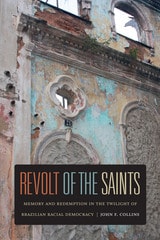
Revolt of the Saints
Memory and Redemption in the Twilight of Brazilian Racial DemocracyJohn F. Collins
Duke University Press, 2015
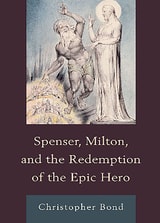
Spenser, Milton, and the Redemption of the Epic Hero
Christopher Bond
University of Delaware Press, 2011

The Psalms of Israel Jones
A NovelEd Davis
West Virginia University Press, 2014
Secrets and snakes, rock and gospel, guilt and grace.
The Psalms of Israel Jones is the story of a father and son’s journey towards spiritual redemption. This novel tells the tale of a famous father trapped inside the suffocating world of rock and roll, and his son who is stranded within the bounds of conventional religion.
When Reverend Thomas Johnson receives an anonymous phone call, he learns his Dylanesque rock star father is acting deranged on stage, where he’s being worshipped by a cult of young people who slash their faces during performances. In his declining years, Israel Jones has begun to incite his fans to violence. They no longer want to watch the show—they want to be the show.
Eager to escape troubles with his congregation as well as gain an apology from his dad for abandoning his family, Reverend Johnson leaves town and joins Israel Jones’s Eternal Tour. This decision propels him to the center of a rock and roll hell, giving him one last chance to reconnect with his father, wife, congregation—and maybe even God.
The Psalms of Israel Jones is the 2010 Hackney Literary Award winner for an unpublished manuscript.
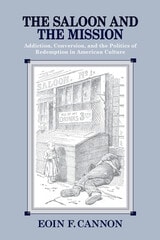
The Saloon and the Mission
Addiction, Conversion, and the Politics of Redemption in American CultureEoin F. Cannon
University of Massachusetts Press, 2013
In this book Eoin Cannon illuminates the role that sobriety movements have played in placing notions of personal and societal redemption at the heart of modern American culture. He argues against the dominant scholarly perception that recovery narratives are private and apolitical, showing that in fact the genre's conventions turn private experience to public political purpose. His analysis ranges from neglected social reformer Helen Stuart Campbell's embrace of the "gospel rescue missions" of postbellum New York City to William James's use of recovery stories to consider the regenerative capabilities of the mind, to writers such as Upton Sinclair and Djuna Barnes, who used this narrative form in much different ways.
Cannon argues that rather than isolating recovery from these realms of wider application, the New Deal–era Alcoholics Anonymous refitted the "drunkard's conversion" as a model of selfhood for the liberal era, allowing for a spiritual redemption story that could accommodate a variety of identities and compulsions. He concludes by considering how contemporary recovery narratives represent both a crisis in liberal democracy and a potential for redemptive social progress.
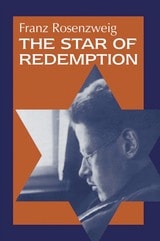
The Star of Redemption
Franz Rosenzweig; Translated by Barbara E. Galli; Foreword by Michael Oppenheim, introduction by Elliot R. Wolfson
University of Wisconsin Press, 2005
The Star of Redemption is essential reading for anyone interested in understanding religion and philosophy in the twentieth century. Fusing philosophy and theology, the book assigns both Judaism and Christianity distinct but equally important roles in the spiritual structure of the world. Franz Rosenzweig finds in both biblical religions approaches to a comprehension of reality.
The major themes and motifs of The Star—the birth, life, death, and the immortality of the soul; Eastern philosophies and Jewish mysticism; the relationship between God, world and humanity over time; and revelation as the real biblical miracle of faith and path to redemption—resonate meaningfully.
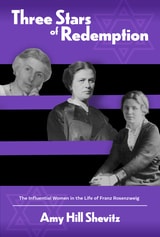
Three Stars of Redemption
The Influential Women in the Life of Franz RosenzweigAmy Hill Shevitz
University of Alabama Press, 2026
A revelatory study of the overlooked ways that Franz Rosenzweig’s closest relationships with women shaped his philosophical legacy and reframed Jewish thought
Three Stars of Redemption: The Influential Women in the Life of Franz Rosenzweig by Amy Hill Shevitz offers a groundbreaking reexamination of Franz Rosenzweig, one of the most influential Jewish philosophers of the twentieth century, through the lens of three pivotal women in his life. The book is a compelling study of the ways that Rosenzweig’s intellectual and emotional world were shaped by his mother, Adele Alsberg Rosenzweig, his wife, Edith Hahn Rosenzweig, and his lover Margrit Rosenstock-Huessy, charting the influence those women had, by extension, on modern Jewish thought.
Rosenzweig is best known for his work of essential religious philosophy The Star of Redemption and his role in the Weimar Jewish Renaissance. Yet Shevitz reveals how the maternal, romantic, and marital relationships he maintained were not peripheral but central to his philosophical development and lived Judaism. Drawing on archival research and close readings of correspondence and historical context, Shevitz restores agency to these women, whose lives have been marginalized or misrepresented in scholarship. Adele’s bourgeois upbringing and intimate intellectual bond with her son, Edith’s independent journey into Judaism, and Margrit’s complex role as both muse and thinker are explored with nuance and depth. Shevitz challenges reductive portrayals and brings their full humanity to light. This richly contextualized study expands the understanding of Jewish cultural history, gender, and the personal dimensions of philosophical inquiry. Three Stars of Redemption is a vital contribution to Jewish studies, women’s history, and the legacy of Rosenzweig’s thought.
Violence and Redemption, Volume 15
Candace Vogler and Patchen Markell
Duke University Press, 0
The essays examine topics such as the socioeconomic crisis in Mexico in the 1980s; continuities between plantation slavery, colonization, and the emergence of independent states as war machines in Africa; the culture of a Palestinian suicide bomber; the architecture of mass rioting and rape in Indonesia; the experience of unredeemed suffering in Herman Melville’s “Shiloh;” and the aggression of Aborigines in Australia.
Contributors. Tim Blackmore, John Borneman, Gillian Cowlishaw, Richard Falk, Ken Graves, Ghassan Hage, Abidin Kusno, Eva Lipman, Claudio Lomnitz, Patchen Markell, Achille Mbembe, Laura Nader, Steven Sampson, Nancy Scheper-Hughes, Candace Vogler, Michael Warner, Margaret Werry, Richard Ashby Wilson
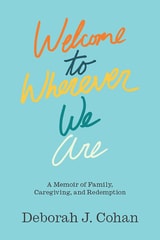
Welcome to Wherever We Are
A Memoir of Family, Caregiving, and RedemptionDeborah J. Cohan
Rutgers University Press, 2020
ESS Public Sociology Award
Recommended Book in Domestic Violence by DomesticShelters.org
How do you go about caregiving for an ill and elderly parent with a lifelong history of abuse and control, intertwined with expressions of intense love and adoration? How do you reconcile the resulting ambivalence, fear, and anger?
Welcome to Wherever We Are is a meditation on what we hold onto, what we let go of, how we remember others and ultimately how we’re remembered. Deborah Cohan shares her story of caring for her father, a man who was simultaneously loud, gentle, loving and cruel and whose brilliant career as an advertising executive included creating slogans like “Hey, how ‘bout a nice Hawaiian punch?” Wrestling with emotional extremes that characterize abusive relationships, Cohan shows how she navigated life with a man who was at once generous and affectionate, creating magical coat pockets filled with chocolate kisses when she was a little girl, yet who was also prone to searing, vicious remarks like “You’d make my life easier if you’d commit suicide.”
In this gripping memoir, Cohan tells her unique personal story while also weaving in her expertise as a sociologist and domestic abuse counselor to address broader questions related to marriage, violence, divorce, only children, intimacy and loss. A story most of us can relate to as we reckon with past and future choices against the backdrop of complicated family dynamics, Welcome to Wherever We Are is about how we might come to live our own lives better amidst unpredictable changes through grief and healing.
Questions for Discussion (https://d3tto5i5w9ogdd.cloudfront.net/wp-content/uploads/2020/05/11140346/Cohan_Discussion.docx)
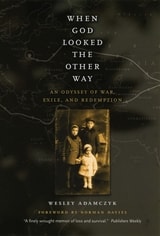
When God Looked the Other Way
An Odyssey of War, Exile, and RedemptionWesley Adamczyk
University of Chicago Press, 2004
Adamczyk was a young Polish boy when he was deported with his mother and siblings from their comfortable home in Luck to Soviet Siberia in May of 1940. His father, a Polish Army officer, was taken prisoner by the Red Army and eventually became one of the victims of the Katyn massacre, in which tens of thousands of Polish officers were slain at the hands of the Soviet secret police. The family's separation and deportation in 1940 marked the beginning of a ten-year odyssey in which the family endured fierce living conditions, meager food rations, chronic displacement, and rampant disease, first in the Soviet Union and then in Iran, where Adamczyk's mother succumbed to exhaustion after mounting a harrowing escape from the Soviets. Wandering from country to country and living in refugee camps and the homes of strangers, Adamczyk struggled to survive and maintain his dignity amid the horrors of war.
When God Looked the Other Way is a memoir of a boyhood lived in unspeakable circumstances, a book that not only illuminates one of the darkest periods of European history but also traces the loss of innocence and the fight against despair that took root in one young boy. It is also a book that offers a stark picture of the unforgiving nature of Communism and its champions. Unflinching and poignant, When God Looked the Other Way will stand as a testament to the trials of a family during wartime and an intimate chronicle of episodes yet to receive their historical due.
“A finely wrought memoir of loss and survival.”—Publishers Weekly
“Adamczyk’s unpretentious prose is well-suited to capture that truly awful reality.” —Andrew Wachtel, Chicago Tribune Books
“Mr. Adamczyk writes heartfelt, straightforward prose. . . . This book sheds light on more than one forgotten episode of history.”—Gordon Haber, New York Sun
“One of the most remarkable World War II sagas I have ever read. It is history with a human face.”—Andrew Beichman, Washington Times