Results by title
6 books match the query 'Reformed Church'
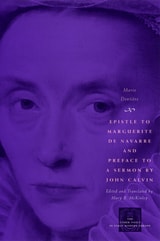
Epistle to Marguerite de Navarre and Preface to a Sermon by John Calvin
Marie Dentière
University of Chicago Press, 2004
Dentière's Very Useful Epistle (1539) is the first explicit statement of reformed theology by a woman to appear in French. Addressed to Queen Marguerite of Navarre, sister of the French king Francis I, the Epistle asks the queen to help those persecuted for their religious beliefs. Dentière offers a stirring defense of women and asserts their right to teach the word of God in public. She defends John Calvin against his enemies and attacks the hierarchy of the Roman Catholic Church. Her Preface (1561) to one of Calvin's sermons criticizes immodesty and extravagance in clothing and warns the faithful to be vigilant. Undaunted in the face of suppression and ridicule, this outspoken woman persisted as an active voice in the Reformation.
Politics Reformed
The Anglo-American Legacy of Covenant TheologyGlenn A. Moots
University of Missouri Press, 2022
The Disciplinary Revolution
Calvinism and the Rise of the State in Early Modern EuropePhilip S. Gorski
University of Chicago Press, 2003
The Other Jonathan Edwards
Selected Writings on Society, Love, and JusticeGerald McDermott
University of Massachusetts Press, 2015
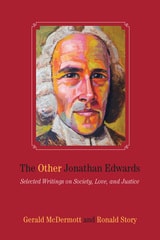
Widely regarded as perhaps America's greatest theologian, Jonathan Edwards still suffers the stereotype of hellfire preacher obsessed with God's wrath. In this anthology, Gerald McDermott and Ronald Story seek to correct that common view by showing that Edwards was also a compassionate, socially conscious minister of the first order.
Through a selection of sermons and primary writings, McDermott and Story reveal an Edwards who preached love toward all humanity regardless of belief or appearance; who demanded private and public charity to the poor; who criticized hard-hearted business dealings as impious and socially destructive; and who condemned envy and status-seeking as anti-Christian and anti-community. This “other” Jonathan Edwards preached about grace and the love of God but also about responsive constitutional government, the iniquities of hypocrisy and corruption, and the nature of wise leadership. He acknowledged the need for national defense but left room for popular revolt from tyranny. He anticipated a millennial age of peace and prosperity and believed that people should live in the world as they would live through grace in heaven.
Jonathan Edwards was, in sum, a worldly as well as spiritual reformer who resisted the materialistic, acquisitive, and individualistic currents of American culture. For these reasons, McDermott and Story think he may have lessons to teach us today.
Whether a Christian Woman Should Be Educated and Other Writings from Her Intellectual Circle
Anna Maria van Schurman
University of Chicago Press, 1998
Gathered here in meticulous translation are Anna Maria van Schurman's defense of women's education, her letters to other learned women, and her own account of her early life, as well as responses to her work from male contemporaries, and rare writings by Schurman's mentor, Voetius. This volume will interest the general reader as well as students of women's, religious, and social history.
Zion on the Hudson
Dutch New York and New Jersey in the Age of RevivalsFabend, Firth Haring
Rutgers University Press, 2000
Winner of the 2001 New Jersey Author's Award by the New Jersey Academic Alliance
The Dutch came to the New World in the seventeenth century as explorers and traders, but religion soon followed, for it was accepted in the Netherlands that state and church were mutually benefited by advancing the “true Christian religion.” The influence of “Dutchness”—defined here as loyalty to what are presumed to be the distinctive qualities of Dutch national character and culture—persisted in New York and New Jersey for more than 200 years after Dutch emigration ended. Why?
Firth Haring Fabend finds the explanation in the devotion of the Reformed Dutch Church membership to the doctrines and traditions of their church. She looks at the individual and personal beliefs and behaviors of this often-neglected ethnic group. Thus, Zion on the Hudson presents both a broad and an intimate look at the way one mainstream Protestant denomination dealt with the transformative events of the evangelical era.
As Fabend describes the efforts of the Dutch to preserve the European standards and traditions of their church, while developing a taste for a new kind of theology and a preference for an American identity, she documents how Dutchness finally became a historical memory. The Americanization of the Reformed Dutch Church, Fabend writes, is a microcosm of the story of the Americanization of the United States itself.