Results by title

13 books match the query 'Refuse and refuse disposal'
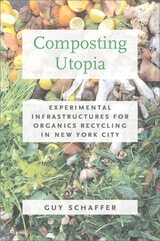
cover of Composting Utopia: Experimental Infrastructures for Organics Recycling in New York City

Composting Utopia

Experimental Infrastructures for Organics Recycling in New York City

Guy Schaffer

University of Massachusetts Press, 2023

New Yorkers generate millions of tons of trash annually, which, through the magic of infrastructure and one of the largest waste management systems in the world, disappears from city sidewalks each night. Under pressure from environmentalists, activists, policymakers, and industry, the New York City Department of Sanitation started exploring ways to divert organic material from the waste stream, and in 2013, launched its composting pilot program.

Drawing on three years of ethnographic fieldwork with community composters and microhaulers in New York City, alongside the rollout of the city’s curbside organics collection system, Composting Utopia describes how local, grassroots organizations intervened in the city’s waste system, enacting change and presenting an alternative vision of the composting city. As Guy Shaffer argues, movement-driven infrastructure projects develop new tools for organizing the world, give communities agency over urban design, and promote just sustainability.
[more]
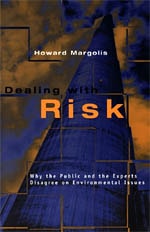
cover of Dealing with Risk: Why the Public and the Experts Disagree on Environmental Issues

Dealing with Risk

Why the Public and the Experts Disagree on Environmental Issues

Howard Margolis

University of Chicago Press, 1997

For decades, policymakers and analysts have been frustrated by the stubborn and often dramatic disagreement between experts and the public on acceptable levels of environmental risk. Most experts, for instance, see no severe problem in dealing with nuclear waste, given the precautions and safety levels now in place. Yet public opinion vehemently rejects this view, repudiating both the experts' analysis and the evidence.

In Dealing with Risk, Howard Margolis moves beyond the usual "rival rationalities" explanation proffered by risk analysts for the rift between expert and lay opinion. He reveals the conflicts of intuition that undergird those concerns, and proposes a new approach to the psychology of persuasion and belief. Examining the role of intuition, mental habits, and cognitive frameworks in the construction of public opinion, this compelling account bridges the public policy impasse that has plagued controversial environmental issues.
[more]
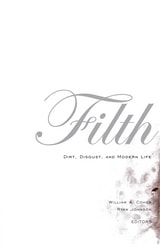
cover of Filth: Dirt, Digust, and Modern Life

Filth

Dirt, Digust, and Modern Life

William A. Cohen

University of Minnesota Press, 2004
From floating barges of urban refuse to dung-encrusted works of art, from toxic landfills to dirty movies, filth has become a major presence and a point of volatile contention in modern life. This book explores the question of what filth has to do with culture: what critical role the lost, the rejected, the abject, and the dirty play in social management and identity formation. It suggests the ongoing power of culturally mandated categories of exclusion and repression.Focusing on filth in literary and cultural materials from London, Paris, and their colonial outposts in the nineteenth and early twentieth centuries, the essays in Filth, all but one previously unpublished, range over topics as diverse as the building of sewers in nineteenth-century European metropolises, the link between interior design and bourgeois sanitary phobias, fictional representations of laboring women and foreigners as polluting, and relations among disease, disorder, and sexual-racial disharmony. Filth provides the first sustained consideration, both theoretical and historical, of a subject whose power to horrify, fascinate, and repel is as old as civilization itself.Contributors: David S. Barnes, U of Pennsylvania; Neil Blackadder, Knox College; Joseph Bristow, U of California, Los Angeles; Joseph W. Childers, U of California, Riverside; Eileen Cleere, Southwestern U; Natalka Freeland, U of California, Irvine; Pamela K. Gilbert, U of Florida; Christopher Hamlin, U of Notre Dame; William Kupinse, U of Puget Sound; Benjamin Lazier, U of Chicago; David L. Pike, American U; David Trotter, U of Cambridge.William A. Cohen is associate professor of English at the University of Maryland and the author of Sex Scandal: The Private Parts of Victorian Fiction.Ryan Johnson is completing his Ph.D. in the Department of English at Stanford University, where he has served as general editor of the Stanford Humanities Review.
[more]
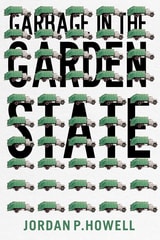
cover of Garbage in the Garden State

Garbage in the Garden State

Jordan P. Howell

Rutgers University Press, 2023

Garbage in the Garden State is the only book to examine the history of waste management in New Jersey. The state has played a pioneering role in the overall trajectory of waste management in the US. Howell's book is unique in the way that it places the contemporary challenges of waste management into their proper historical context – for instance, why does the system for recycling seem to work so poorly? Why do we have so many landfills in New Jersey, but also simultaneously not enough landfills or incinerators? 

Howell acknowledges that New Jersey is sometimes imagined, particularly by non-New Jerseyans, as a giant garbage dump for New York and Philadelphia. But every place has had to struggle with the challenges of waste management. New Jersey's trash history is in fact more interesting and more important than most. New Jersey’s waste history includes intensive planning, deep-seated political conflict, organized crime, and literally every level of state and federal judiciary. It is a colorful history, to say the least, and one that includes a number of firsts with regard to recycling, comprehensive planning, and the challenging economics of trash.
 
[more]
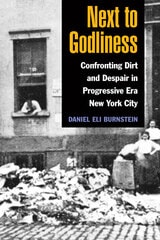
cover of Next to Godliness: Confronting Dirt and Despair in Progressive Era New York City

Next to Godliness

Confronting Dirt and Despair in Progressive Era New York City

Daniel Burnstein

University of Illinois Press, 2010
To many Progressive Era reformers, the extent of street cleanliness was an important gauge for determining whether a city was providing the conditions necessary for impoverished immigrants to attain a state of "decency"--a level of individual well-being and morality that would help ensure a healthy and orderly city. Daniel Eli Burnstein's study examines prominent street sanitation issues in Progressive Era New York City--ranging from garbage strikes to "juvenile cleaning leagues"--to explore how middle-class reformers amassed a cross-class and cross-ethnic base of support for social reform measures to a degree greater than in practically any other period of prosperity in U.S. history. The struggle for enhanced civic sanitation serves as a window for viewing Progressive Era social reformers' attitudes, particularly their emphasis on mutual obligations between the haves and have-nots, and their recognition of the role of negative social and physical conditions in influencing individual behaviors.
[more]
cover of Patterns, Thinking, and Cognition: A Theory of Judgment

Patterns, Thinking, and Cognition

A Theory of Judgment

Howard Margolis

University of Chicago Press, 1988

What happens when we think? How do people make judgments? While different theories abound—and are heatedly debated—most are based on an algorithmic model of how the brain works. Howard Margolis builds a fascinating case for a theory that thinking is based on recognizing patterns and that this process is intrinsically a-logical. Margolis gives a Darwinian account of how pattern recognition evolved to reach human cognitive abilities.

Illusions of judgment—standard anomalies where people consistently misjudge or misperceive what is logically implied or really present—are often used in cognitive science to explore the workings of the cognitive process. The explanations given for these anomalous results have generally explained only the anomaly under study and nothing more. Margolis provides a provocative and systematic analysis of these illusions, which explains why such anomalies exist and recur.

Offering empirical applications of his theory, Margolis turns to historical cases to show how an individual's cognitive repertoire—the available cognitive patterns and their relation to cues—changes or resists changes over time. Here he focuses on the change in worldview occasioned by the Copernican discovery: not only how an individual might come to see things in a radically new way, but how it is possible for that new view to spread and become the dominant one. A reanalysis of the trial of Galileo focuses on social cognition and its interactions with politics.

In challenging the prevailing paradigm for understanding how the human mind works, Patterns, Thinking, and Cognition is certain to stimulate fruitful debate.
[more]
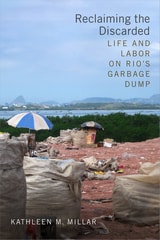
cover of Reclaiming the Discarded: Life and Labor on Rio's Garbage Dump

Reclaiming the Discarded

Life and Labor on Rio's Garbage Dump

Kathleen M. Millar

Duke University Press, 2018
In Reclaiming the Discarded Kathleen M. Millar offers an evocative ethnography of Jardim Gramacho, a sprawling garbage dump on the outskirts of Rio de Janeiro, where roughly two thousand self-employed workers known as catadores collect recyclable materials. While the figure of the scavenger sifting through garbage seems iconic of wageless life today, Millar shows how the work of reclaiming recyclables is more than a survival strategy or an informal labor practice. Rather, the stories of catadores show how this work is inseparable from conceptions of the good life and from human struggles to realize these visions within precarious conditions of urban poverty. By approaching the work of catadores as highly generative, Millar calls into question the category of informality, common conceptions of garbage, and the continued normativity of wage labor. In so doing, she illuminates how waste lies at the heart of relations of inequality and projects of social transformation.
[more]
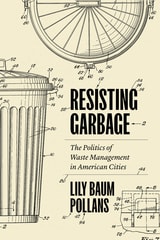
cover of Resisting Garbage: The Politics of Waste Management in American Cities

Resisting Garbage

The Politics of Waste Management in American Cities

Lily Baum Pollans

University of Texas Press, 2021

Resisting Garbage presents a new approach to understanding practices of waste removal and recycling in American cities, one that is grounded in the close observation of case studies while being broadly applicable to many American cities today.

Most current waste practices in the United States, Lily Baum Pollans argues, prioritize sanitation and efficiency while allowing limited post-consumer recycling as a way to quell consumers’ environmental anxiety. After setting out the contours of this “weak recycling waste regime,” Pollans zooms in on the very different waste management stories of Seattle and Boston over the last forty years. While Boston’s local politics resulted in a waste-export program with minimal recycling, Seattle created new frameworks for thinking about consumption, disposal, and the roles that local governments and ordinary people can play as partners in a project of resource stewardship. By exploring how these two approaches have played out at the national level, Resisting Garbage provides new avenues for evaluating municipal action and fostering practices that will create environmentally meaningful change.
[more]
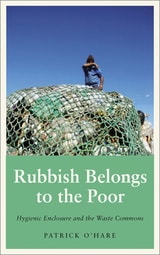
cover of Rubbish Belongs to the Poor: Hygienic Enclosure and the Waste Commons

Rubbish Belongs to the Poor

Hygienic Enclosure and the Waste Commons

Patrick O’Hare

Pluto Press, 2021

Rubbish. Waste. Trash. Whatever term you choose to describe the things we throw away, the connotations are the same; of something dirty, useless and incontrovertibly 'bad'. But does such a dismissive rendering mask a more nuanced reality? In Rubbish Belongs to the Poor, Patrick O'Hare journeys to the heart of Uruguay's waste disposal system in order to reconceptualize rubbish as a 21st century commons, at risk of enclosure. On a giant landfill site outside the capital Montevideo we meet the book's central protagonists, the 'classifiers': waste-pickers who recover and recycle materials in and around its fenced but porous perimeter. Here the struggle of classifiers against the enclosure of the landfill, justified on the grounds of hygiene, is brought into dialogue with other historical and contemporary enclosures - from urban privatizations to rural evictions - to shed light on the nature of contemporary forms of capitalist dispossession. Supplementing this rich ethnography with the author's own insights from dumpster diving in the UK, the book analyzes capitalism's relations with its material surpluses and what these tell us about its expansionary logics, limits and liminal spaces. Rubbish Belongs to the Poor ultimately proposes a fundamental rethinking of the waste-capitalism nexus.
[more]
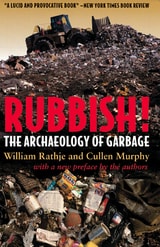
cover of Rubbish!: The Archaeology of Garbage

Rubbish!

The Archaeology of Garbage

William Rathje and Cullen Murphy

University of Arizona Press, 2001
It is from the discards of former civilizations that archaeologists have reconstructed most of what we know about the past, and it is through their examination of today’s garbage that William Rathje and Cullen Murphy inform us of our present. Rubbish! is their witty and erudite investigation into all aspects of the phenomenon of garbage. Rathje and Murphy show what the study of garbage tells us about a population’s demographics and buying habits. Along the way, they dispel the common myths about our “garbage crisis”—about fast-food packaging and disposable diapers, about biodegradable garbage and the acceleration of the average family’s garbage output. They also suggest methods for dealing with the garbage that we do have.
[more]
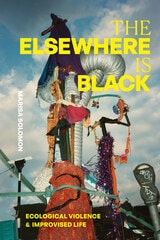
cover of The Elsewhere Is Black: Ecological Violence and Improvised Life

The Elsewhere Is Black

Ecological Violence and Improvised Life

Marisa Solomon

Duke University Press, 2025
In The Elsewhere Is Black, Marisa Solomon examines how waste is a mundane part of poor Black survival and a condition of settler colonial racial capitalism. Tracing the flow of trash and waste across Black spaces, from Brooklyn’s historically Black Bedford-Stuyvesant to the post-plantation towns of Virginia’s Tidewater, Solomon contends that waste infrastructures concentrate environmental risk in an elsewhere that is routinely Black. Solomon emphasizes that ecological violence is a form of racialized heteropatriarchal environmental control that upholds whiteness as a propertied way of life and criminalizes Black survival. As she points to acute sites of toxicity, Solomon theorizes the relationship between the devaluation of land and Black and more-than-human life to reveal how the risks of poisoning, police violence, dispossession, and poverty hold Black life captive. Locating Black survival as a site from which alternative eco-political imaginations spring, she foregrounds how people live and dream amidst waste’s daily accumulation. Solomon opens new ecological horizons to ask: What forms of environmentalism emerge when Black un/freedom has never been distant from waste?
[more]
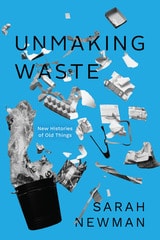
cover of Unmaking Waste: New Histories of Old Things

Unmaking Waste

New Histories of Old Things

Sarah Newman

University of Chicago Press, 2023

Explores the concept of waste from fresh historical, cultural, and geographical perspectives.
 
Garbage is often assumed to be an inevitable part and problem of human existence. But when did people actually come to think of things as “trash”—as becoming worthless over time or through use, as having an end?
 
Unmaking Waste tackles these questions through a long-term, cross-cultural approach. Drawing on archaeological finds, historical documents, and ethnographic observations to examine Europe, the United States, and Central America from prehistory to the present, Sarah Newman traces how different ideas about waste took shape in different times and places. Newman examines what people consider to be “waste” and how they interact with it, as well as what happens when different perceptions of trash come into conflict. Conceptions of waste have shaped forms of reuse and renewal in ancient Mesoamerica, early modern ideas of civility and forced religious conversion in New Spain, and even the modern discipline of archaeology. Newman argues that centuries of assumptions imposed on other places, times, and peoples need to be rethought. This book is not only a broad reconsideration of waste; it is also a call for new forms of archaeology that do not take garbage for granted. Unmaking Waste reveals that waste is not—and never has been—an obvious or universal concept.
[more]