Results by title
92 books match the query 'Regimental histories' and 14 start with a
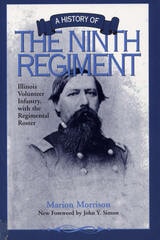
A History of the Ninth Regiment
Illinois Volunteer Infantry, with the Regimental RosterMarion Morrison. Foreword by John Y. Simon
Southern Illinois University Press, 1997
When the Civil War erupted in April 1861, many German immigrants in Illinois rushed to enlist in the Union Army. Volunteers from Illinois towns in St. Clair County—Belleville, Millstadt, Mascoutah, Lebanon, and others—marched to Springfield under the command of August Mersy, a veteran of the failed 1848 revolt in Baden, Germany.
Marion Morrison notes that when the German immigrants reached Springfield, August Mersy was rejected as commander because of his limited facility with English. Replaced by Colonel Eleazer A. Paine, an Ohioan and West Point graduate, Lieutenant Colonel Mersy fell to second in command of the Ninth Illinois Infantry Volunteers. Within a few months, however, Paine received a promotion to general that left Mersy in charge of the "Bloody Ninth."
Once Grant began his Tennessee River campaign, the Ninth found itself in the thick of battle, bearing the brunt of the Confederate attempt at Fort Donelson to break Grant’s siege lines. Less than two months later, the Ninth shored up sagging Union lines after the surprise Confederate attack at Shiloh Church, retreating only when their ammunition was gone.
Morrison’s account of the "Bloody Ninth" is one of the few histories written during the war.

A Machine-Gunner in France
The Memoirs of Ward Schrantz, 35th Division, 1917-1919Ward Schrantz
University of North Texas Press, 2019
A Perfect Picture Of Hell
Eyewitness Accounts By Civil War Prisoners From 12Th IoTed Genoways
University of Iowa Press, 2000
From the shooting of an unarmed prisoner at Montgomery, Alabama, to a successful escape from Belle Isle, from the swelling floodwaters overtaking Cahaba Prison to the inferno that finally engulfed Andersonville, A Perfect Picture of Hell is a collection of harrowing narratives by soldiers from the 12th Iowa Infantry who survived imprisonment in the South during the Civil War.
Editors Ted Genoways and Hugh Genoways have collected the soldiers' startling accounts from diaries, letters, speeches, newspaper articles, and remembrances. Arranged chronologically, the eyewitness descriptions of the battles of Shiloh, Corinth, Jackson, and Tupelo, together with accompanying accounts of nearly every famous Confederate prison, create a shared vision
A Small but Spartan Band
The Florida Brigade in Lee's Army of Northern VirginiaZack C. Waters
University of Alabama Press, 2013
A Soldier in World War I
The Diary of Elmer W. SherwoodRobert H. Ferrell
Indiana Historical Society Press, 2004
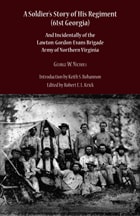
A Soldier's Story of His Regiment (61st Georgia)
And Incidentally of the Lawton-Gordon-Evans Brigade Army of Northern VirginiaGeorge W. Nichols
University of Alabama Press, 2011
Nichol’s 61st Georgia fought in the renowned brigade commanded consecutively by generals Alexander R. Lawton, John B. Gordon, and Clement A. Evans.
Framed without any excess of sentimental hindsight, in addition to reporting on great battles and dramatic moments, Nichol’s told the story of two cousins killing each other in a quarrel about cooking duties and described maggot-infested corpses around Spotsylvania’s Bloody Angle.
Includes an annotated roster of the 61st supplies which details about Nichol’s fellow veterans, some of which is not available anywhere else.
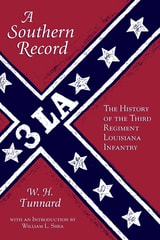
A Southern Record
The History of the Third Regiment Louisiana InfantryWilliam Tunnard
University of Arkansas Press, 1997
Originally published in a limited edition in 1866, this memoir of Will Tunnard’s experiences and observations of the Civil War in the West, where he served in the famed Third Louisiana Infantry, is one of only a handful of chronicles left by western Confederate soldiers. His first-person account of the battles of Wilson’s Creek, Pea Ridge, Iuka, and Corinth as well as the seige of Vicksburg, is a vivid history of these hard-fought campaigns which determined the outcome of the war in the Trans-Mississippi theater.
Using letters and diaries assembled from former comrades as well as his own daily journal, Tunnard tells the story of his regiment and its extraordinary odyssey from the Gulf of Mexico to the Ozark Plateau and from the Indian Territory to Mobile Bay. He offers an extensive and valuable account of capture and parole at Vicksburg and includes muster rolls which will interest genealogists as well as Civil War scholars and history enthusiasts. With a clear eye for detail and an engaging, objective style, Tunnard conveys the pathos of war and recounts the trials of camp life, social conditions, and the war’s affect on the civilian population.
Noted Civil War scholar William L. Shea supports the original text with background on the regiment and the time period, sketching a helpful chronology of events. In retelling this remarkable story of comradeship, hardship, endurance, courage, pride, and eventual defeat, Tunnard and Shea give modern readers a rare glimpse of the war in the West.
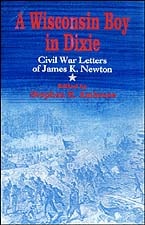
A Wisconsin Boy in Dixie
Civil War Letters of James K. NewtonSelected and Edited by Stephen E. Ambrose
University of Wisconsin Press, 1995
“When I wrote to you last I was at Madison with no prospect of leaving very soon, but I got away sooner than I expected to.” So wrote James Newton upon leaving Camp Randall for Vicksburg in 1863 with the Fourteenth Wisconsin Volunteer Infantry. Newton, who had been a rural schoolteacher before he joined the Union army in 1861, wrote to his parents of his experiences at Shiloh, Corinth, Vicksburg, on the Red River, in Missouri, at Nashville, at Mobile, and as a prisoner of war. His letters, selected and edited by noted historian Stephen E. Ambrose, reveal Newton as a young man who matured in the war, rising in rank from private to lieutenant.
A Wisconsin Boy in Dixie reveals Newton as a young man who grew to maturity through his Civil War experience, rising in rank from private to lieutenant. Writing soberly about the less attractive aspects of army life, Newton's comments on fraternizing with the Rebs, on officers, and on discipline are touched with a sense of humor—"a soldier's best friend," he claimed. He also became sensitive to the importance of political choices. After giving Lincoln the first vote he had ever cast, Newton wrote: "In doing so I felt that I was doing my country as much service as I have ever done on the field of battle."
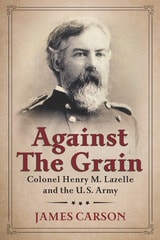
Against the Grain
Colonel Henry M. Lazelle and the U.S. ArmyJames Carson
University of North Texas Press, 2015
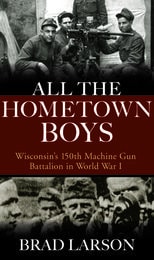
All the Hometown Boys
Wisconsin's 150th Machine Gun Battalion in World War IBrad Larson
University of Wisconsin Press, 2019
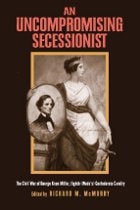
An Uncompromising Secessionist
The Civil War of George Knox Miller, Eighth (Wade's) Confederate CavalryGeorge Knox Miller, edited by Richard M. McMurry
University of Alabama Press, 2006
Offers significant insight into the life, heart, mind, and attitudes of an intelligent, educated, young mid-19th-century white Southerner
This book contains the letters of George Knox Miller who served as a line officer in the Confederate cavalry and participated in almost all of the major campaigns of the Army of Tennessee. He was, clearly, a very well-educated young man. Born in 1836 in Talladega, Alabama, he developed a great love for reading and the theater and set his sights upon getting an education that would lead to a career in law or medicine; meanwhile he worked as an apprentice in a painting firm to earn tuition. Miller then enrolled in the University of Virginia, where he excelled in his studies.
Eloquent, bordering on the lyrical, the letters provide riveting first-hand accounts of cavalry raids, the monotony of camp life, and the horror of battlefield carnage. Miller gives detailed descriptions of military uniforms, cavalry tactics, and prison conditions. He conveys a deep commitment to the Confederacy, but he was also critical of Confederate policies that he felt hindered the army's efforts. Dispersed among these war-related topics is the story of Miller's budding relationship with Celestine “Cellie” McCann, the love of his life, whom he would eventually marry.
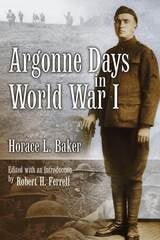
Argonne Days in World War I
Horace L. Baker, Edited & Intro by Robert H. Ferrell
University of Missouri Press, 2007
This poignant memoir recalls the great battle of the Meuse-Argonne, an epic conflict waged by well over a million men that saw casualties of 26,277 killed and 95,786 wounded. Many books have been written about General Pershing’s planning of the offensive; this one tells what happened to the soldiers who had to carry out his orders.
The Thirty-second was a shock division made up largely of National Guard units—farm boys from the Upper Midwest. But as casualties mounted, replacements were rushed into battle with little training—and devastating results. Baker knew friends and tent mates who were alive one day, dead the next, and he kept track of the battle in diary entries tucked into his Bible—and made evasively short in case of capture.
He shares his and his comrades’ thoughts about fighting in a harsh climate and terrain, relates their ongoing problems with short supplies, and tells how they managed to overcome their fears. It is a straightforward narrative that doesn’t glorify battle or appeal to patriotism yet conveys the horrors of warfare with striking accuracy. Historian Robert Ferrell’s new introduction puts Baker’s recollections in the context of the larger theater of war.
Baker fleshed out his diary in a book that saw limited publication in 1927 but has remained essentially unknown. Argonne Days in World War I is a masterpiece brimming with insight about the ordinary doughboys who fought in the European trenches. It conveys the spirit of a man who did his duty in a time of trouble—and is a testament to the spirit shared by thousands like him.
Army Life
From a Soldier's JournalA. O. Marshall
University of Arkansas Press, 2009
Army Of Israel
David Bigler
Utah State University Press, 2000