Results by title
3 books match the query 'Reimers, Adrian'
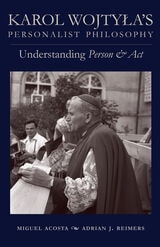
Karol Wojtyla's Personalist Philosophy
Miguel Acosta
Catholic University of America Press, 2016

The Ethos of the Christian Heart
Reading Veritatis SplendorAdrian Reimers
St. Augustine's Press, 2024
One of the most studied and critiqued documents of the papal magisterium is largely spoken of with regards to moral theology and the refutation of modern error. Yet Adrian Reimers points out that, as affirmed by this encyclical, the moral life is itself a realm of love and freedom, a place of intimacy with the Creator as much as interaction with others. Reimers is eager to show that the Encyclical is more innovative than it looks, just as morality is not just about the correction of error. It is not content to defend the traditional positions; it traces the paths of a profound renewal in the presentation of Catholic morality. "We would gladly say that it performs a kind of discreet revolution in the conception of Christian morality, affecting the very bases that support it."
The publication of Veritatis Splendor met with vigorous opposition and even rejection within the Catholic theological community. But in Veritatis Splendor John Paul II addresses these contemporary conceptions, including dissention, coming to grips with the roots of the modern errors that have resulted in the loss of transcendence. However, the scope of Veritatis Splendor is far broader than evil and judgment of sin. The pope addresses such issues as conscience, intrinsically evil acts, and the theory of fundamental freedom. Inevitably, these discussions revolve around how to conceive the nature of the human act and the conception of natural law.
This present work examines this encyclical against the backdrop of the philosophers with whom Karol Wojtyła engaged in his own philosophical project. Of central concern to Wojtyła throughout his career were the nature and prerogatives of the human person. Among his most frequent modern interlocutors were David Hume, Immanuel Kant, the utilitarian school, and Max Scheler. The program of Wojtyła’s philosophical corpus is to present an alternative account of the human person to that which has marked the post-Enlightenment world. Having shared in the sufferings of his native Poland under the Nazi occupation and then as a scholar working in Communist Poland, Wojtyła was keenly aware of the forms of materialism which formed the environment of his own life and work. He offers not only his own analyses but also provides a model for engaging with the contemporary culture.
Veritatis Splendor is a timeless examination of human, personal acts that challenges the post-modern conception of morality, love, and freedom. Reimers reorients this presentation for contemporary readers and invites readers who may have missed this foundational treatment to incorporate it into the questions and issues of our own times.

The Good Is Love
The Body and Human Acts in Humanae Vitae and John Paul IIAdrian Reimers
St. Augustine's Press, 2020
Reimers draws upon the encyclical Humanae Vitae and John Paul II’s catechesis known as the theology of the body to respond to the stalled development of moral theology on the issues most crucial to human love and intimacy. “It is time, we are told, for a ‘paradigm shift’ in the Catholic Church’s moral teaching, such shift representing a more pastoral and less dogmatic approach to moral issues,” writes Reimers. His claim that “a paradigm shift in moral theology and philosophy may be valuable––perhaps vital––to scholars who think and write about these sciences and to teachers who communicate moral truth” is not an exhortation to redefine moral truths. Rather, he argues that an approach to contraception, for example, that relies exclusively on natural law is a hackneyed one and often “tedious.”
John Paul II’s series of catechetical addresses known as the theology of the body was originally composed in the 1970s after Paul VI’s encyclical Humanae Vitae. Albeit derived from the writing of an archbishop and not yet pope, Reimers identifies John Paul II’s perspectives on love, sex and contraception as an essential force behind this so-called paradigm shift in continuity with the profound and unchanging truths set forth in Humanae Vitae. As Reimers states, “Moral truths do not change, even if our ways to understand them improve.”
How, then, is our sense of the goodness or badness of contraception meant to be helped by such a development of thought? Ethics grounded philosophically tends to lean toward legalism in the context of moral actions, says Reimers, as it emphasizes conformity to God’s law and largely overlooks “the relationship between moral behavior and the human person’s ultimate end of beatitude with God.” The important principle of the necessarily two-fold description that natural law gives to sex––namely, as unitive and procreative––must not be the authoritative end of the discussion regarding the moral nature of contraception. In an age where technology has given human beings new power it seems there must be new rules as well, and the conquest of procreative acts changes the human perception of the limitations once associated with harmful acts. Herein lies the importance of John Paul II’s catechesis––the goodness or badness of acts is not just concerned with end of a particular act. As Reimers writes, “If we are to understand the complex relationships among love, marriage, and their sexual expression, we must situate these within the context of the end of the human being.”
A position on contraception and human sexuality cannot be comprehensive without a concept of love properly understood. Human acts must bring us closer to sanctity, not to comfort or possession. Holiness is the perfection of love, and its pursuit aims at ultimate beatitude. This end, the truest love human can know, is the end which ultimately condemns contraception once and for all, as “contracepted sex is contrary to holiness.” Reimers unpacks this sometimes difficult truth in eight chapters, which begin with love and conclude with faithfulness to moral norms and a spirituality of marriage.
The arguments surrounding contraception and “good sex” seem to have set the grounds for coherently choosing a side rather than to have succeeded in presenting certain human acts as definitively immoral. As Reimers notes, a natural law position on contraception often fails to employ its greatest ally: the reality of authentic human love and “victory” of the individual in one’s sanctity as achieved through that love. This work will reorient the objectives and claims of the moral debate, as well as influence the popular notion of what love is and what it cannot be. It is an aid to scholars, students and study groups, humanists, and those who seek to deepen the sense of love’s highest physical expression.