Results by title
16 books match the query 'Relations with Jews'
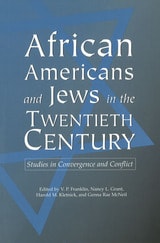
African Americans and Jews in the Twentieth Century
Studies in Convergence and ConflictEdited by V.P. Franklin, Nancy L. Grant, Harold M. Kletnick, & Genna Rae McNeil
University of Missouri Press, 1998
In 1993 distinguished historian Nancy L. Grant organized "Blacks and Jews: An American Historical Perspective," a conference held at Washington University in St. Louis and dedicated to the exploration of Black-Jewish relations in twentieth-century America. Featuring presentations by historians, sociologists, and political scientists, this conference reflected Grant's devotion to scholarship on multicultural relations and the continuing struggle for racial equality in the United States. After Grant's untimely death in 1995, V. P. Franklin and the other contributors completed the work of readying these essays for publication with the assistance of the coeditors. African Americans and Jews in the Twentieth Century is the culmination of the innovative research and ideas presented at the conference.
In the long struggle to bring social justice to American society, Blacks and Jews have often been close allies. In both the past and the present, however, there has also been serious conflict and competition between the groups in social, economic, and political spheres.
Focusing on the complexity of the relationships between Blacks and Jews in America, these essays examine the convergence and conflict that have characterized Black-Jewish interactions over the past century. African Americans and Jews in the Twentieth Century provides an intellectual foundation for continued dialogue and future cooperative efforts to improve social justice in this society and will be an invaluable resource for the study of race relations in the United States in the twentieth century.
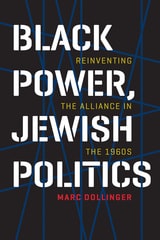
Black Power, Jewish Politics
Reinventing the Alliance in the 1960sMarc Dollinger
Brandeis University Press, 2018
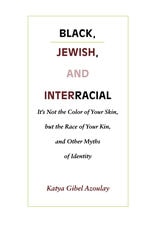
Black, Jewish, and Interracial
It’s Not the Color of Your Skin, but the Race of Your Kin, and Other Myths of IdentityKatya Gibel Azoulay
Duke University Press, 1997
Beginning with an examination of the concept of identity as it figures in philosophical and political thought, Gibel Azoulay moves on to consider and compare the politics and traditions of the Black and Jewish experience in America. Her inquiry draws together such diverse subjects as Plessy v. Ferguson, the Leo Frank case, "passing," intermarriage, civil rights, and anti-Semitism. The paradoxical presence of being both Black and Jewish, she argues, leads questions of identity, identity politics, and diversity in a new direction as it challenges distinct notions of whiteness and blackness. Rising above familiar notions of identity crisis and cultural confrontation, she offers new insights into the discourse of race and multiculturalism as she suggests that identity can be a more encompassing concept than is usually thought. Gibel Azoulay adds her own personal history and interviews with eight other Black and Jewish individuals to reveal various ways in which interracial identities are being lived, experienced, and understood in contemporary America.

Changing Perspectives
Black-Jewish Relations in Houston during the Civil Rights EraAllison E. Schottenstein
University of North Texas Press, 2021
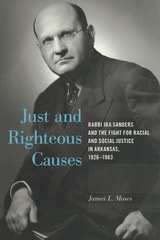
Just and Righteous Causes
Rabbi Ira Sanders and the Fight for Racial and Social Justice in Arkansas, 1926-1963James L. Moses
University of Arkansas Press, 2018
Winner, 2019 Booker Worthen Prize from the Central Arkansas Library System.
A dedicated advocate for social justice long before the term entered everyday usage, Rabbi Ira Sanders began striving against the Jim Crow system soon after he arrived in Little Rock from New York in 1926. Sanders, who led Little Rock’s Temple B’nai Israel for nearly forty years, was a trained social worker as well as a rabbi and his career as a dynamic religious and community leader in Little Rock spanned the traumas of the Great Depression, World War II and the Holocaust, and the social and racial struggles of the 1950s and 1960s.
Just and Righteous Causes—a full biographical study of this bold social-activist rabbi—examines how Sanders expertly navigated the intersections of race, religion, and gender to advocate for a more just society. It joins a growing body of literature about the lives and histories of Southern rabbis, deftly balancing scholarly and narrative tones to provide a personal look into the complicated position of the Southern rabbi and the Jewish community throughout the political struggles of the twentieth-century South.

Mutual Reflections
Jews and Blacks in American ArtHeyd, Milly
Rutgers University Press, 1998
Mutual Reflections is the first book to examine this many-layered relationship through its visual dimension. Milly Heyd investigates how artists of both backgrounds have viewed each other during the last hundred years-how the visual languages and the-matic choices of their art have reflected changing concerns from symbiosis to disillusionment. She explores a wide range of artistic mediums: painting, sculpture, cartoons, comic strips, and installations. Interviews with artists provide additional insight. The post modern discourse poses questions problematizing ethnic and racial stereotyping.
As Heyd states, when an artist of one group investigates the other group, that person is embarking on a journey of self-discovery. And while that journey can lead to disillusionment and criticism, the artist's vision-and final work of art-very often can help put all of us on our own paths of self-discovery.
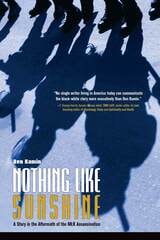
Nothing Like Sunshine
A Story in the Aftermath of the MLK AssassinationBen Kamin
Michigan State University Press, 2010
Rabbi Ben Kamin has written a definitive personal expression about race, coming of age in the 1960s, a forbidden friendship, and his personal love for Dr. Martin Luther King Jr. This is a story that spans a four-decade search for a lost high school chum, a deep misunderstanding, and a coming to terms with an America painfully evolving from the blood of MLK to the promise of Barack Obama.
The book is a remembrance of Kamin's life at Cincinnati's notorious Woodward High School, a microcosm of the 1960s and of America itself, as well as detailing Kamin's search-for Clifton, for America, for the key to understanding what race relations really are in the United States. Simultaneously, it is the story of the emerging rabbi's search for the legacy of his spiritual mentor, Dr. Martin Luther King Jr., taking Kamin from Cincinnati to Cleveland to Memphis to New Orleans and other points, and constantly bringing him home to his friend Clifton and "the heaving hallways" of that high school.
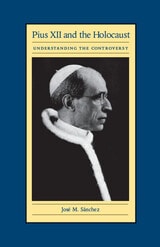
Pius XII and the Holocaust
Understanding the ControversyJosé M. Sánchez
Catholic University of America Press, 2002
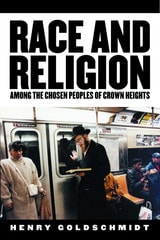
Race and Religion Among the Chosen People of Crown Heights
Goldschmidt, Henry
Rutgers University Press, 2006
In August of 1991, the Brooklyn neighborhood of Crown Heights was engulfed in violence following the deaths of Gavin Cato and Yankel Rosenbaum—a West Indian boy struck by a car in the motorcade of a Hasidic spiritual leader and an orthodox Jew stabbed by a Black teenager. The ensuing unrest thrust the tensions between the Lubavitch Hasidic community and their Afro-Caribbean and African American neighbors into the media spotlight, spurring local and national debates on diversity and multiculturalism. Crown Heights became a symbol of racial and religious division. Yet few have paused to examine the nature of Black-Jewish difference in Crown Heights, or to question the flawed assumptions about race and religion that shape the politics—and perceptions—of conflict in the community.
In Race and Religion among the Chosen Peoples of Crown Heights, Henry Goldschmidt explores the everyday realities of difference in Crown Heights. Drawing on two years of fieldwork and interviews, he argues that identity formation is particularly complex in Crown Heights because the neighborhood’s communities envision the conflict in remarkably diverse ways. Lubavitch Hasidic Jews tend to describe it as a religious difference between Jews and Gentiles, while their Afro-Caribbean and African American neighbors usually define it as a racial difference between Blacks and Whites. These tangled definitions are further complicated by government agencies who address the issue as a matter of culture, and by the Lubavitch Hasidic belief—a belief shared with a surprising number of their neighbors—that they are a “chosen people” whose identity transcends the constraints of the social world.
The efforts of the Lubavitch Hasidic community to live as a divinely chosen people in a diverse Brooklyn neighborhood where collective identities are generally defined in terms of race illuminate the limits of American multiculturalism—a concept that claims to celebrate diversity, yet only accommodates variations of certain kinds. Taking the history of conflict in Crown Heights as an invitation to reimagine our shared social world, Goldschmidt interrogates the boundaries of race and religion and works to create space in American society for radical forms of cultural difference.
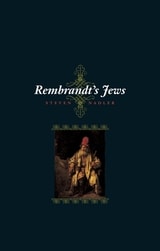
Rembrandt's Jews
Steven Nadler
University of Chicago Press, 2004
Rembrandt's Jews puts this myth to the test as it examines both the legend and the reality of Rembrandt's relationship to Jews and Judaism. In his elegantly written and engrossing tour of Jewish Amsterdam—which begins in 1653 as workers are repairing Rembrandt's Portuguese-Jewish neighbor's house and completely disrupting the artist's life and livelihood—Steven Nadler tells us the stories of the artist's portraits of Jewish sitters, of his mundane and often contentious dealings with his neighbors in the Jewish quarter of Amsterdam, and of the tolerant setting that city provided for Sephardic and Ashkenazic Jews fleeing persecution in other parts of Europe. As Nadler shows, Rembrandt was only one of a number of prominent seventeenth-century Dutch painters and draftsmen who found inspiration in Jewish subjects. Looking at other artists, such as the landscape painter Jacob van Ruisdael and Emmanuel de Witte, a celebrated painter of architectural interiors, Nadler is able to build a deep and complex account of the remarkable relationship between Dutch and Jewish cultures in the period, evidenced in the dispassionate, even ordinary ways in which Jews and their religion are represented—far from the demonization and grotesque caricatures, the iconography of the outsider, so often found in depictions of Jews during the Middle Ages and the Renaissance.
Through his close look at paintings, etchings, and drawings; in his discussion of intellectual and social life during the Dutch Golden Age; and even through his own travels in pursuit of his subject, Nadler takes the reader through Jewish Amsterdam then and now—a trip that, under ever-threatening Dutch skies, is full of colorful and eccentric personalities, fiery debates, and magnificent art.
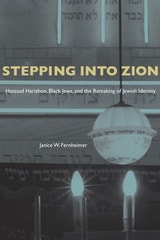
Stepping Into Zion
Hatzaad Harishon, Black Jews, and the Remaking of Jewish IdentityJanice W. Fernheimer
University of Alabama Press, 2014
Considers the question “Who is a Jew?”— a critical rhetorical issue with far-reaching consequences for Jews and non-Jews alike
Hatzaad Harishon ("The First Step") was a New York-based, multiracial Jewish organization that worked to increase recognition and legitimacy for Black Jews in the sixties and seventies. In Stepping into Zion, Janice W. Fernheimer examines the history and archives of Hatzaad Harishon to illuminate the shifting definitions and borders of Jewish identity, which have critical relevance to Jews of all traditions as well as to non-Jews.
Fernheimer focuses on a period when Jewish identity was in flux and deeply influenced by the Civil Rights and Black Power movements. In 1964, white and Black Jews formed Hatzaad Harishon to foster interaction and unity between Black and white Jewish communities. They raised the question of who or what constitutes Jewishness or Jewish identity, and in searching for an answer succeeded—both historically and rhetorically—in gaining increased recognition for Black Jews. Fernheimer traces how, despite deep disagreement over definitions, members of Hatzaad Harishon were able to create common ground in a process she terms "interruptive invention": an incremental model for rhetorical success that allows different groups to begin and continue important but difficult discussions when they share little common ground or make unequal claims to institutional and discursive power, or when the nature of common ground is precisely what is at stake. Consequently, they provide a practical way out of the seemingly incommensurable stalemate incompatible worldviews present.
Through insightful interpretations of Hatzaad Harishon's archival materials, Fernheimer chronicles the group's successes and failures within the larger rhetorical history of conflicts that emerge when cultural identities shift or expand.
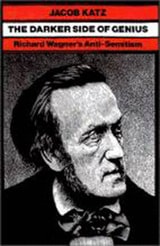
The Darker Side of Genius
Richard Wagner’s Anti-SemitismJacob. Katz
University Press of New England, 2002
The Fatal Embrace
Jews and the StateBenjamin Ginsberg
University of Chicago Press, 1993
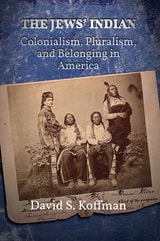
The Jews’ Indian
Colonialism, Pluralism, and Belonging in AmericaKoffman, David S
Rutgers University Press, 2019
Honorable Mention, 2021 Saul Viener Book Prize
The Jews’ Indian investigates the history of American Jewish relationships with Native Americans, both in the realm of cultural imagination and in face-to-face encounters. These two groups’ exchanges were numerous and diverse, proving at times harmonious when Jews’ and Natives people’s economic and social interests aligned, but discordant and fraught at other times. American Jews could be as exploitative of Native cultural, social, and political issues as other American settlers, and historian David Koffman argues that these interactions both unsettle and historicize the often triumphant consensus history of American Jewish life. Focusing on the ways Jewish class mobility and civic belonging were wrapped up in the dynamics of power and myth making that so severely impacted Native Americans, this books is provocative and timely, the first history to critically analyze Jewish participation in, and Jews’ grappling with the legacies of Native American history and the colonial project upon which America rests.
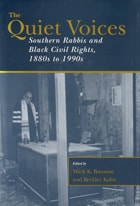
The Quiet Voices
Southern Rabbis and Black Civil Rights, 1880s to 1990sMark K. Bauman
University of Alabama Press, 1997
These wide-ranging essays reveal the various roles played by southern rabbis in the struggle for black civil rights since Reconstruction
The study of black-Jewish relations has become a hotbed of controversy, especially with regard to the role played by Jewish leaders during the Civil Rights movement. Did these leaders play a pivotal role, or did many of them, especially in the South, succumb to societal pressure and strive to be accepted rather than risk being persecuted? If some of these leaders did choose a quieter path, were their reasons valid? And were their methods successful?
Individually, each essay offers a glimpse into both the private and public difficulties these rabbis faced in their struggle to achieve good. Collectively, the essays provide an unparalleled picture of Jewish leadership during the civil rights era.
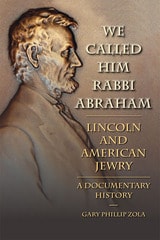
We Called Him Rabbi Abraham
Lincoln and American Jewry, a Documentary HistoryGary Phillip Zola
Southern Illinois University Press, 2014
Over the course of American history, Jews have held many American leaders in high esteem, but they maintain a unique emotional bond with Abraham Lincoln. From the time of his presidency to the present day, American Jews have persistently viewed Lincoln as one of their own, casting him as a Jewish sojourner and, in certain respects, a Jewish role model. This pioneering compendium— The first volume of annotated documents to focus on the history of Lincoln’s image, influence, and reputation among American Jews— considers how Lincoln acquired his exceptional status and how, over the past century and a half, this fascinating relationship has evolved.
Organized into twelve chronological and thematic chapters, these little-known primary source documents—many never before published and some translated into English for the first time—consist of newspaper clippings, journal articles, letters, poems, and sermons, and provide insight into a wide variety of issues relating to Lincoln’s Jewish connection. Topics include Lincoln’s early encounters with Central European Jewish immigrants living in the Old Northwest; Lincoln’s Jewish political allies; his encounters with Jews and the Jewish community as President; Lincoln’s response to the Jewish chaplain controversy; General U. S. Grant’s General Orders No. 11 expelling “Jews, as a class” from the Military Department of Tennessee; the question of amending the U.S. Constitution to legislate the country’s so-called Christian national character; and Jewish eulogies after Lincoln’s assassination. Other chapters consider the crisis of conscience that arose when President Andrew Johnson proclaimed a national day of mourning for Lincoln on the festival of Shavuot (the Feast of Weeks), a day when Jewish law enjoins Jews to rejoice and not to mourn; Lincoln’s Jewish detractors contrasted to his boosters; how American Jews have intentionally “Judaized” Lincoln ever since his death; the leading role that American Jews have played in in crafting Lincoln’s image and in preserving his memory for the American nation; American Jewish reflections on the question “What Would Lincoln Do?”; and how Lincoln, for America’s Jewish citizenry, became the avatar of America’s highest moral aspirations.
With thoughtful chapter introductions that provide readers with a context for the annotated documents that follow, this volume provides a fascinating chronicle of American Jewry’s unfolding historical encounter with the life and symbolic image of Abraham Lincoln, shedding light on how the cultural interchange between American ideals and Jewish traditions influences the dynamics of the American Jewish experience.
Finalist, 2014 National Jewish Book Award
Finalist, 2015 Ohioana Book Award