165 books match the query 'Resistance' and 8 start with a

cover of A Dream of Resistance: The Cinema of Kobayashi Masaki

A Dream of Resistance

The Cinema of Kobayashi Masaki

Prince, Stephen

Rutgers University Press, 2017

Celebrated as one of Japan’s greatest filmmakers, Kobayashi Masaki’s scorching depictions of war and militarism marked him as a uniquely defiant voice in post-war Japanese cinema. A pacifist drafted into Japan’s Imperial Army, Kobayashi survived the war with his principles intact and created a body of work that was uncompromising in its critique of the nation’s military heritage. Yet his renowned political critiques were grounded in spiritual perspectives, integrating motifs and beliefs from both Buddhism and Christianity.  

A Dream of Resistance is the first book in English to explore Kobayashi’s entire career, from the early films he made at Shochiku studio, to internationally-acclaimed masterpieces like The Human Condition, Harakiri, and Samurai Rebellion, and on to his final work for NHK Television. Closely examining how Kobayashi’s upbringing and intellectual history shaped the values of his work, Stephen Prince illuminates the political and religious dimensions of Kobayashi’s films, interpreting them as a prayer for peace in troubled times. Prince draws from a wealth of rare archives, including previously untranslated interviews, material that Kobayashi wrote about his films, and even the young director’s wartime diary. The result is an unprecedented portrait of this singular filmmaker.  
[more]
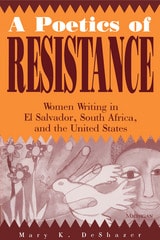
cover of A Poetics of Resistance: Women Writing in El Salvador, South Africa, and the United States

A Poetics of Resistance

Women Writing in El Salvador, South Africa, and the United States

Mary DeShazer

University of Michigan Press, 1994

The recent critical works that look at literature as a weapon of resistance have frequently neglected the genre of poetry, particularly the poetry of Third World women writers. A Poetics of Resistance is the first book-length examination of poetry written by woman of El Salvador, South Africa, and the United States and the ways it bears witness to political struggle and produces new kinds of knowledge.
 
Engaging the works of critics such as Chandra Mohanty, Barbara Harlow, Claribel Alegria, Albie Sachs, and Audre Lorde, among others, Mary DeShazer reconceptualizes traditional notions of resistance and literature and the relationship between them. She argues that women’s voices have been underrepresented in previous analyses of Third World resistance poetry, and that when examined collectively, their work reveals overtly gendered concerns that distinguish it from that of their male counterparts.
 
DeShazer defines resistance as an active quest for justice and a means of collective empowerment. She looks at the diasporic consciousness of exiled and dislocated women, examines the tensions between claims of identity and claims of difference, and explores the ways in which gender and struggle connect women across nationalities and historical imperatives. Her analysis of Salvadoran and South African women’s poetry reveal the ways in which poetic conventions can be seen as “political declarations of privilege,” casting a new light on women’s resistance poetry in the United States.

 
[more]
cover of Acts of Resistance: Antibiotic Use and Prescribing Culture in the United States

Acts of Resistance

Antibiotic Use and Prescribing Culture in the United States

Katharina Rynkiewich

Vanderbilt University Press, 2026

In Acts of Resistance, Katharina Rynkiewich explores the fight to save the utility of antibiotic medicines amid global antimicrobial resistance. This engaging ethnography follows bacteria, patients, and practitioners as they weave in and out of North American medical institutions. Through an examination of the social dynamics and ethical challenges of everyday antibiotic use, the author expands on the limitations of good intentions in current antibiotic stewardship policy. Her ethnographic account shows the lived experience of multiple central figures as she shifts setting and tone, ultimately deepening our understanding of the global antimicrobial resistance crisis as emergency.

Due to the global scale of impact related to antimicrobial resistance, holding industries and institutions accountable is difficult but essential. With new and reemerging multidrug-resistant organisms making their homes within institutions and in the community, tracing the origins of an infection can be an insurmountable challenge. Rynkiewich demonstrates how “microbial highways” coexist along human highways, providing an apt example of how multidrug-resistant organisms spread across hospitals, communities, and entire regions.
[more]
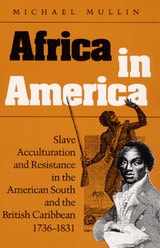
cover of Africa in America: Slave Acculturation and Resistance in the American South and the British Caribbean, 1736-1831

Africa in America

Slave Acculturation and Resistance in the American South and the British Caribbean, 1736-1831

Michael Mullin

University of Illinois Press, 1992
Extensive archival and anecdotal sources support Michael Mullin's description of slavery as it was practiced in tidewater Virginia, on the rice coast of the Carolinas, and in Jamaica and Barbados. Drawing upon case histories, Mullin offers new and definitive information about how African people met and often overcame the challenges and deprivations of their new lives through religion, family life, and economic strategies.
[more]
cover of After Grenfell: Violence, Resistance and Response

After Grenfell

Violence, Resistance and Response

Edited by Dan Bulley, Jenny Edkins and Nadine El-Enany

Pluto Press, 2019

[more]
cover of Anti-Nazi Modernism: The Challenges of Resistance in 1930s Fiction

Anti-Nazi Modernism

The Challenges of Resistance in 1930s Fiction

Mia Spiro

Northwestern University Press, 2013
Mia Spiro's Anti-Nazi Modernism marks a major step forward in the critical debates over the relationship between modernist art and politics. Spiro analyzes the antifascist, and particularly anti-Nazi, narrative methods used by key British and American fiction writers in the 1930s. Focusing on works by Djuna Barnes, Christopher Isherwood, and Virginia Woolf, Spiro illustrates how these writers use an "anti-Nazi aesthetic" to target and expose Nazism’s murderous discourse of exclusion. The three writers challenge the illusion of harmony and unity promoted by the Nazi spectacle in parades, film, rallies, and propaganda. Spiro illustrates how their writings, seldom read in this way, resonate with the psychological and social theories of the period and warn against Nazism’s suppression of individuality.  Her approach also demonstrates how historical and cultural contexts complicate the works, often reinforcing the oppressive discourses they aim to attack. This book explores the textual ambivalences toward the "Others" in society—most prominently the Modern Woman, the homosexual, and the Jew. By doing so, Spirouncovers important clues to the sexual and racial politics that were widespread in Europe and the United States in the years leading up to World War II.


[more]
cover of Apocalypse South: Judgment, Cataclysm, and Resistance in the Regional Imaginary

Apocalypse South

Judgment, Cataclysm, and Resistance in the Regional Imaginary

Anthony Dyer Hoefer

The Ohio State University Press, 2012
While John Winthrop might have famously uttered the phrase “city upon a hill” on the way to Massachusetts, the strands of millennialism and exceptionalism that remain so central to U.S. political discourse are now dominated by eschatological visions that have emerged from the particular historical experiences of the U.S. South. Despite the strategic exploitation of this reality by political communicators, scholars in the humanities have paid little attention to the eschatological visions offered by southern religious culture.
 
Fortunately, writers and artists have not ignored such matters; compared to their academic counterparts, southern novelists have been far better attuned to a southern apocalyptic imaginary—a field of reference, drawn from the cosmology of southern evangelical Protestantism, that maps the apocalyptic possibilities of cataclysm, judgment, deliverance, and even revolution onto the landscape of the region. Apocalypse South rectifies the omissions in existing scholarship by interrogating the role of apocalyptic discourse in selected works of fiction by four southern writers—William Faulkner, Richard Wright, Randall Kenan, and Dorothy Allison. In doing so, it reinvigorates discussions of religion in southern literary scholarship and introduces a new element in the ongoing investigation into how regional identities function in notions of national mission and American exceptionalism. Engaging concerns of religion, race, sexuality, and community in fiction from the 1930s to the present, Apocalypse South offers a new conceptual framework for considering what has long been considered “southern Gothic literature”—a framework less concerned with the conventions of a particular literary genre than with the ways in which literature exposes and even tries to make sense of the contradictions within cultures. 
[more]
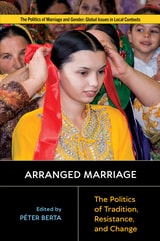
cover of Arranged Marriage: The Politics of Tradition, Resistance, and Change

Arranged Marriage

The Politics of Tradition, Resistance, and Change

Péter Berta

Rutgers University Press, 2023

Arranged Marriage: The Politics of Tradition, Resistance, and Change shows how arranged marriage practices have been undergoing transformation as a result of global and other processes such as the revolution of digital technology, democratization of transnational mobility, or shifting significance of patriarchal power structures. The ethnographically informed chapters not only highlight how the gendered and intergenerational politics of agency, autonomy, choice, consent, and intimacy work in the contexts of partner choice and management of marriage, but also point out that arranged marriages are increasingly varied and they can be reshaped, reinvented, and reinterpreted flexibly in response to individual, family, religious, class, ethnic, and other desires, needs, and constraints. The authors convincingly demonstrate that a nuanced investigation of the reasons, complex dynamics, and consequences of arranged marriages offers a refreshing analytical lens that can significantly contribute to a deeper understanding of other phenomena such as globalization, modernization, and international migration as well as patriarchal value regimes, intergenerational power imbalances, and gendered subordination and vulnerability of women. 
[more]