Results by title
4 books match the query 'Retrospective'
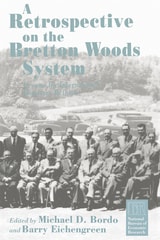
A Retrospective on the Bretton Woods System
Lessons for International Monetary ReformEdited by Michael D. Bordo and Barry Eichengreen
University of Chicago Press, 1993
At the close of the Second World War, when industrialized nations faced serious trade and financial imbalances, delegates from forty-four countries met in Bretton Woods, New Hampshire, in order to reconstruct the international monetary system. In this volume, three generations of scholars and policy makers, some of whom participated in the 1944 conference, consider how the Bretton Woods System contributed to unprecedented economic stability and rapid growth for 25 years and discuss the problems that plagued the system and led to its eventual collapse in 1971.
The contributors explore adjustment, liquidity, and transmission under the System; the way it affected developing countries; and the role of the International Monetary Fund in maintaining a stable rate. The authors examine the reasons for the System's success and eventual collapse, compare it to subsequent monetary regimes, such as the European Monetary System, and address the possibility of a new fixed exchange rate for today's world.
The contributors explore adjustment, liquidity, and transmission under the System; the way it affected developing countries; and the role of the International Monetary Fund in maintaining a stable rate. The authors examine the reasons for the System's success and eventual collapse, compare it to subsequent monetary regimes, such as the European Monetary System, and address the possibility of a new fixed exchange rate for today's world.
[more]
A Retrospective on the Classical Gold Standard, 1821-1931
Edited by Michael D. Bordo and Anna J. Schwartz
University of Chicago Press, 1984
This is a timely review of the gold standard covering the 110 years of its operation until 1931, when Britain abandoned it in the midst of the Depression. Current dissatisfaction with floating rates of exchange has spurred interest in a return to a commodity standard. The studies in this volume were designed to gain a better understanding of the historical gold standard, but they also throw light on the question of whether restoring it today could help cure inflation, high interest rates, and low productivity growth.
The volume includes a review of the literature on the classical gold standard; studies the experience with gold in England, Germany, Italy, Sweden, and Canada; and perspectives on international linkages and the stability of price-level trends under the gold standard. The articles and commentaries reflect strong, conflicting views among hte participants on issues of central bank behavior, purchasing-power an interest-rate parity, independent monetary policies, economic growth, the "Atlantic economy," and trends in commodity prices and long-term interest rates. This is a thoughtful and provocative book.
The volume includes a review of the literature on the classical gold standard; studies the experience with gold in England, Germany, Italy, Sweden, and Canada; and perspectives on international linkages and the stability of price-level trends under the gold standard. The articles and commentaries reflect strong, conflicting views among hte participants on issues of central bank behavior, purchasing-power an interest-rate parity, independent monetary policies, economic growth, the "Atlantic economy," and trends in commodity prices and long-term interest rates. This is a thoughtful and provocative book.
[more]

A return to the village
community ethnographies and the study of Andean culture in retrospectiveEdited by Francisco Ferreira and Billie Jean Isbell
University of London Press, 2016
This edited volume brings together several scholars who have produced outstanding ethnographies of Andean communities, mostly in Peru but also in neighbouring countries. These ethnographies were published between the 1970s and 2000s, following different theoretical and thematic approaches, and they often transcended the boundaries of case studies to become important reference works on key aspects of Andean culture: for example, the symbolism and ritual uses of coca in the case of Catherine J. Allen; agricultural rituals and internal social divisions in the case of Peter Gose; social organisation and kinship in the case of Billie Jean Isbell; the use of khipus and concepts of literacy in the case of Frank Salomon; and the management and ritual dimensions of water and irrigation in the case of Ricardo Valderrama and Carmen Escalante. In their chapters the authors revisit their original works in the light of contemporary anthropology, focusing on different academic and personal aspects of their ethnographies. For example, they explain how they chose the communities they worked in; the personal relations they established there during fieldwork; the kind of links they have maintained; and how these communities have changed over time. They also review their original methodological and theoretical approaches and findings, reassessing their validity and explaining how their views have evolved or changed since they originally conducted their fieldwork and published their studies. This book also offers a review of the evolution and role of community ethnographies in the context of Andean anthropology. These ethnographies had a significant influence between the 1940s and 1980s, when they could be roughly divided – following Olivia Harris – between ‘long-termist’ and ‘short-termist’ approaches, depending on predominant focuses on historical continuities or social change respectively. However, by the 1990s these works came to be widely considered as too limited and subjective in the context of wider academic changes, such as the emergence of postmodern trends, and reflective and literary turns in anthropology. Overall, the book aims to reflect on this evolution of community ethnographies in the Andes, and on their contribution to the study of Andean culture.
[more]
The Art, Science, and Magic of the Data Curation Network
A Retrospective on Cross-Institutional CollaborationJake Carlson
Michigan Publishing Services, 2023
The Data Curation Network (DCN) is a membership organization of institutional and non-profit data repositories whose vision is to advance open research by making data more ethical, reusable, and understandable. Although initially conceived of and established through grant funding, the DCN transitioned to a sustainable, member-funded organization in July 2021, and is now composed of almost 50 data curators from 17 institutions.
The Art, Science, and Magic of the Data Curation Network: A Retrospective on Cross Institutional Collaboration captures the results of a project retrospective meeting and describes the necessary components of the DCN’s sustained collaboration in the hopes that the insights will be of use to other collaborative efforts. In particular, the authors describe the successes of the community and challenges of launching a cross-institutional network. Additionally, this publication details the administrative, tool-based, and trust-based structures necessary for establishing this community, the “radical collaboration” that is the cornerstone of the DCN, and potential future collaborations to address shared challenges in libraries and research data management. This in-depth case study provides an overview of the critical work of launching a collaborative network and transitioning to sustainability. This publication will be of special interest to research librarians, data curators, and anyone interested in academic community building.
The Art, Science, and Magic of the Data Curation Network: A Retrospective on Cross Institutional Collaboration captures the results of a project retrospective meeting and describes the necessary components of the DCN’s sustained collaboration in the hopes that the insights will be of use to other collaborative efforts. In particular, the authors describe the successes of the community and challenges of launching a cross-institutional network. Additionally, this publication details the administrative, tool-based, and trust-based structures necessary for establishing this community, the “radical collaboration” that is the cornerstone of the DCN, and potential future collaborations to address shared challenges in libraries and research data management. This in-depth case study provides an overview of the critical work of launching a collaborative network and transitioning to sustainability. This publication will be of special interest to research librarians, data curators, and anyone interested in academic community building.
[more]