Results by title
2 books match the query 'Revell, Donald'
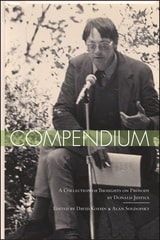
Compendium
A Collection of Thoughts on ProsodyDonald Justice
Omnidawn, 2017
Justice’s insights serve as a sort of de facto taxonomy, an organically designed system that he uses to present his lecture on each respective aspect of the evolution of poetic form. There is no formal thesis here, but rather a kind of scrapbook that has a broader motive. The material possesses no hidden secrets; the treasures lie in plain sight and simply need be discerned to open the artist’s mind to their possibilities.
[more]
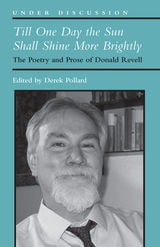
Till One Day the Sun Shall Shine More Brightly
The Poetry and Prose of Donald RevellDerek Pollard, Editor
University of Michigan Press, 2020
Since the publication of From the Abandoned Cities in 1983, Donald Revell has been among the more consistent influencers in American poetry and poetics. Yet, his work has achieved the status it has—his honors include fellowships from the National Endowment for the Arts and the Guggenheim Foundation and awards from the PEN Center USA and American Poetry Review—in a manner that has often tended to belie its abiding significance. This collection of essays, reviews, and interviews is designed to ignite a more wide-ranging critical appraisal of Revell’s writing, from his fourteen collections of poems to his acclaimed translations of French symbolist and modernist poets to his artfully constructed literary criticism. Contributors such as Marjorie Perloff, Stephanie Burt, Dan Beachy-Quick, and Bruce Bond examine key elements in and across Revell’s work, from his visionary postmodernism (“Our words can never say the mystery of our meanings, but there they are: spoken and meaning worlds to us”) to his poetics of radical attention (“And so a poem has nothing to do with picking and choosing, with the mot juste and reflection in tranquility. It is a plain record of one’s entire presence”), in order to enlarge our understanding of how and why that work has come to occupy the place that it has in contemporary American letters.
[more]