Results by title
11 books match the query 'Revolution, 1791-1804'

......And the Dogs Were Silent/......Et les chiens se taisaient
Aimé Césaire. Translated and with an introduction by Alex Gil. With a foreword by Brent Hayes Edwards.
Duke University Press, 2024
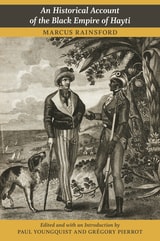
An Historical Account of the Black Empire of Hayti
Marcus Rainsford
Duke University Press, 2013
Cul de Sac
Patrimony, Capitalism, and Slavery in French Saint-DominguePaul Cheney
University of Chicago Press, 2017
Focusing on correspondence between the Ferronnayses and their plantation managers, Cul de Sac proposes that the Caribbean plantation system, with its reliance on factory-like production processes and highly integrated markets, was a particularly modern expression of eighteenth-century capitalism. But it rested on a foundation of economic and political traditionalism that stymied growth and adaptation. The result was a system heading toward collapse as planters, facing a series of larger crises in the French empire, vainly attempted to rein in the inherent violence and instability of the slave society they had built. In recovering the lost world of the French Antillean plantation, Cul de Sac ultimately reveals how the capitalism of the plantation complex persisted not as a dynamic source of progress, but from the inertia of a degenerate system headed down an economic and ideological dead end.
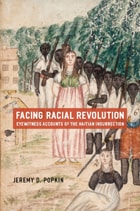
Facing Racial Revolution
Eyewitness Accounts of the Haitian InsurrectionJeremy D. Popkin
University of Chicago Press, 2008
Numerous firsthand narratives of these events survived, but their invaluable insights into the period have long languished in obscurity—until now. In Facing Racial Revolution, Jeremy D. Popkin unearths these documents and presents excerpts from more than a dozen accounts written by white colonists trying to come to grips with a world that had suddenly disintegrated. These dramatic writings give us our most direct portrayal of the actions of the revolutionaries, vividly depicting encounters with the uprising’s leaders—Toussaint Louverture, Boukman, and Jean-Jacques Dessalines—as well as putting faces on many of the anonymous participants in this epochal moment. Popkin’s expert commentary on each selection provides the necessary background about the authors and the incidents they describe, while also addressing the complex question of the witnesses’ reliability and urging the reader to consider the implications of the narrators’ perspectives.
Along with the American and French revolutions, the birth of Haiti helped shape the modern world. The powerful, moving, and sometimes troubling testimonies collected in Facing Racial Revolution significantly expand our understanding of this momentous event.
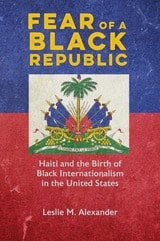
Fear of a Black Republic
Haiti and the Birth of Black Internationalism in the United StatesLeslie M. Alexander
University of Illinois Press, 2023
A bold exploration of Black internationalism’s origins, Fear of a Black Republic links the Haitian revolution to the global Black pursuit of liberation, justice, and social equality.
Making The Black Jacobins
C. L. R. James and the Drama of HistoryRachel Douglas
Duke University Press, 2019
Modernity Disavowed
Haiti and the Cultures of Slavery in the Age of RevolutionSibylle Fischer
Duke University Press, 2004
Fischer draws on history, literary scholarship, political theory, philosophy, and psychoanalytic theory to examine a range of material, including Haitian political and legal documents and nineteenth-century Cuban and Dominican literature and art. She demonstrates that at a time when racial taxonomies were beginning to mutate into scientific racism and racist biology, the Haitian revolutionaries recognized the question of race as political. Yet, as the cultural records of neighboring Cuba and the Dominican Republic show, the story of the Haitian Revolution has been told as one outside politics and beyond human language, as a tale of barbarism and unspeakable violence. From the time of the revolution onward, the story has been confined to the margins of history: to rumors, oral histories, and confidential letters. Fischer maintains that without accounting for revolutionary antislavery and its subsequent disavowal, Western modernity—including its hierarchy of values, depoliticization of social goals having to do with racial differences, and privileging of claims of national sovereignty—cannot be fully understood.

Quiet Dawn
Jean-Claude Fignolé. Translated and with an Introduction by Kaiama L. Glover and Laurent Dubois.
Duke University Press, 2025
The Black Jacobins Reader
Charles Forsdick and Christian Høgsbjerg, editors
Duke University Press, 2017
The Slaves Who Defeated Napoléon
Toussaint Louverture and the Haitian War of Independence, 1801–1804Philippe R. Girard
University of Alabama Press, 2011
A deeply researched and definitive account of the climactic battle at the end of the Haitian Revolution
Among the many rebellions against European colonial empires, the Haitian Revolution against France is among the most dramatic and complex. Having begun in 1791 as France was in the throes of its own young revolution, the conflict reached its dramatic climax when Napoleon dispatched a heavily armed expeditionary force led by his brother-in-law Charles Leclerc to re-establish slavery and the sugar economy that had so enriched France. Philippe Girard’s Slaves Who Defeated Napoleon is a deeply researched and engrossing account of this invasion and its spectacular defeat.
For this ambitious account, Philippe Girard has studied not only primary records in Haiti itself but also rare documents from nineteen public and private archives and research libraries in French, U.S., British, and Spanish collections. His more inclusive approach provides a fuller, more accurate and detailed narrative. He reveals not only key military movements, but also less-known aspects like the activities of U.S. merchants, in-fighting within Napoleon’s government, and communication between both sides and other European powers. Girard fills the work with unforgettable stories of those who led or were caught up in the war, people like poorly armed Black soldiers who ambushed Bonaparte’s columns, French child drummers, Jewish bankers in Kingston, weapon smugglers from Quaker Philadelphia, Polish artillerists, and mixed-raced people struggling to preserve their freedom against both Black and white opponents.
Transcending pat ideological and racial categories, the book brings into focus an Atlantic society at the crossroads of African and European influences, where Haitian rebels fought France while embracing its ideals.
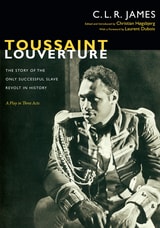
Toussaint Louverture
The Story of the Only Successful Slave Revolt in History; A Play in Three ActsC. L. R. James Edited and Introduced by Christian Høgsbjerg
Duke University Press, 2013