Results by title

2 books match the query 'Revolution, 1952'
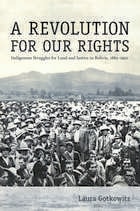
cover of A Revolution for Our Rights: Indigenous Struggles for Land and Justice in Bolivia, 1880-1952

A Revolution for Our Rights

Indigenous Struggles for Land and Justice in Bolivia, 1880-1952

Laura Gotkowitz

Duke University Press, 2008

A Revolution for Our Rights is a critical reassessment of the causes and significance of the Bolivian Revolution of 1952. Historians have tended to view the revolution as the result of class-based movements that accompanied the rise of peasant leagues, mineworker unions, and reformist political projects in the 1930s. Laura Gotkowitz argues that the revolution had deeper roots in the indigenous struggles for land and justice that swept through Bolivia during the first half of the twentieth century. Challenging conventional wisdom, she demonstrates that rural indigenous activists fundamentally reshaped the military populist projects of the 1930s and 1940s. In so doing, she chronicles a hidden rural revolution—before the revolution of 1952—that fused appeals for equality with demands for a radical reconfiguration of political power, landholding, and rights.

Gotkowitz combines an emphasis on national political debates and congresses with a sharply focused analysis of Indian communities and large estates in the department of Cochabamba. The fragmented nature of Cochabamba’s Indian communities and the pioneering significance of its peasant unions make it a propitious vantage point for exploring contests over competing visions of the nation, justice, and rights. Scrutinizing state authorities’ efforts to impose the law in what was considered a lawless countryside, Gotkowitz shows how, time and again, indigenous activists shrewdly exploited the ambiguous status of the state’s pro-Indian laws to press their demands for land and justice. Bolivian indigenous and social movements have captured worldwide attention during the past several years. By describing indigenous mobilization in the decades preceding the revolution of 1952, A Revolution for Our Rights illuminates a crucial chapter in the long history behind present-day struggles in Bolivia and contributes to an understanding of indigenous politics in modern Latin America more broadly.
[more]
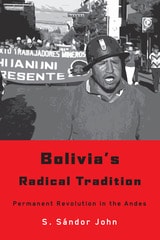
cover of Bolivia's Radical Tradition: Permanent Revolution in the Andes

Bolivia's Radical Tradition

Permanent Revolution in the Andes

S. Sándor John

University of Arizona Press, 2012

In December 2005, following a series of convulsive upheavals that saw the overthrow of two presidents in three years, Bolivian peasant leader Evo Morales became the first Indian president in South American history. Consequently, according to S. Sándor John, Bolivia symbolizes new shifts in Latin America, pushed by radical social movements of the poor, the dispossessed, and indigenous people once crossed off the maps of "official" history. But, as John explains, Bolivian radicalism has a distinctive genealogy that does not fit into ready-made patterns of the Latin American left.
 
According to its author, this book grew out of a desire to answer nagging questions about this unusual place. Why was Bolivia home to the most persistent and heroically combative labor movement in the Western Hemisphere? Why did this movement take root so deeply and so stubbornly? What does the distinctive radical tradition of Trotskyism in Bolivia tell us about the past fifty years there, and what about the explosive developments of more recent years? To answer these questions, John clearly and carefully pieces together a fragmented past to show a part of Latin American radical history that has been overlooked for far too long. Based on years of research in archives and extensive interviews with labor, peasant, and student activists—as well as Chaco War veterans and prominent political figures—the book brings together political, social, and cultural history, linking the origins of Bolivian radicalism to events unfolding today in the country that calls itself "the heart of South America."
[more]