Results by title
3 books match the query 'Revues'

Irish on the Move
Performing Mobility in American Variety TheatreMichelle Granshaw
University of Iowa Press, 2019
A little over a century ago, the Irish in America were the targets of intense xenophobic anxiety. Much of that anxiety centered on their mobility, whether that was traveling across the ocean to the U.S., searching for employment in urban centers, mixing with other ethnic groups, or forming communities of their own. Granshaw argues that American variety theatre, a precursor to vaudeville, was a crucial battleground for these anxieties, as it appealed to both the fears and the fantasies that accompanied the rapid economic and social changes of the Gilded Age.
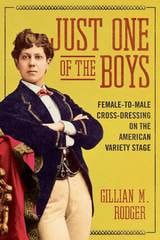
Just One of the Boys
Female-to-Male Cross-Dressing on the American Variety StageGillian Rodger
University of Illinois Press, 2018
Gillian M. Rodger uses the development of male impersonation from the early nineteenth century to the early twentieth century to illuminate the history of the variety show. Exploding notions of high- and lowbrow entertainment, Rodger looks at how both performers and forms consistently expanded upward toward respectable—and richer—audiences. At the same time, she illuminates a lost theatrical world where women made fun of middle-class restrictions even as they bumped up against rules imposed in part by audiences. Onstage, the actresses' changing performance styles reflected gender construction in the working class and shifts in class affiliation by parts of the audiences. Rodger observes how restrictive standards of femininity increasingly bound male impersonators as new gender constructions allowed women greater access to public space while tolerating less independent behavior from them.
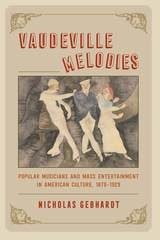
Vaudeville Melodies
Popular Musicians and Mass Entertainment in American Culture, 1870-1929Nicholas Gebhardt
University of Chicago Press, 2017
In Vaudeville Melodies, Nicholas Gebhardt introduces us to the performers, managers, and audiences who turned disjointed variety show acts into a phenomenally successful business. First introduced in the late nineteenth century, by 1915 vaudeville was being performed across the globe, incorporating thousands of performers from every branch of show business. Its astronomical success relied on a huge network of theatres, each part of a circuit and administered from centralized booking offices. Gebhardt shows us how vaudeville transformed relationships among performers, managers, and audiences, and argues that these changes affected popular music culture in ways we are still seeing today. Drawing on firsthand accounts, Gebhardt explores the practices by which vaudeville performers came to understand what it meant to entertain an audience, the conditions in which they worked, the institutions they relied upon, and the values they imagined were essential to their success.