Results by title
10 books match the query 'Rhetoric, Medieval'
Book Of The Incipit
Beginnings in the Fourteenth CenturyD. Vance Smith
University of Minnesota Press, 2001
An intriguing evaluation of the concept of beginnings in the medieval period.
Medieval Studies/Literary Theory
An intriguing evaluation of the concept of beginnings in the medieval period. In the first book to examine one of the most peculiar features of one of the greatest and most perplexing poems of England’s late Middle Ages-the successive attempts of Piers Plowman to begin, and to keep beginning-D. Vance Smith compels us to rethink beginning, as concept and practice, in both medieval and contemporary terms.The problem of beginning was invested with increasing urgency in the fourteenth century, imagined and grappled with in the courts, the churches, the universities, the workshops, the fields, and the streets of England. The Book of the Incipit reveals how Langland’s poem exemplifies a widespread interest in beginning in the thirteenth and fourteenth centuries, an interest that appears in such divergent fields as the physics of motion, the measurement of time, logic, grammar, rhetoric, theology, book production, and insurrection. Smith offers a theoretical understanding of beginning that departs from the structuralisms of Edward Said and the traditional formalisms of A. D. Nuttall and most medievalist and modernist treatments of closure. Instead, he conceives a work’s beginning as a figure of the beginning of the work itself, the inception of language as the problem of beginning to which we continue to return.ISBN 0-8166-3760-1 Cloth/jacket £24.50 $34.95x296 Pages 5 7/8 x 9 MayMedieval Cultures Series, volume 28Translation Inquiries: University of Minnesota Press
Classroom Commentaries
Teaching the Poetria nova across Medieval and Renaissance EuropeMarjorie Curry Woods
The Ohio State University Press, 2009
From Topic to Tale
Logic and Narrativity in the Middle AgesEugene VanceForeword by Wlad Godzich
University of Minnesota Press, 1987
From Topic to Tale was first published in 1987. Minnesota Archive Editions uses digital technology to make long-unavailable books once again accessible, and are published unaltered from the original University of Minnesota Press editions.
The transition from the Middle Ages to the Renaissance has been discussed since the 1940s as a shift from a Latinate culture to one based on a vernacular language, and, since the 1960s, as a shift from orality to literacy. From Topic to Tale focuses on this multifaceted transition, but it poses the problem in different terms: it shows how a rhetorical tradition was transformed into a textual one, and ends ultimately in a discussion of the relationship between discourse and society.
The rise of French vernacular literacy in the twelfth century coincided with the emergence of logic as a powerful instrument of the human mind. With logic come a new concern for narrative coherence and form, a concern exemplified by the work of Chretien de Troyes. Many brilliant poetic achievements crystallized in the narrative art of Chretien, establishing an enduring tradition of literary technique for all of Europe. Eugene Vance explores the intellectual context of Chretien's vernacular literacy, and in particular, the interaction between the three "arts of language" (grammar, logic, and rhetoric) compromising the trivium. Until Vance, few critics have studied the contribution of logic to Chretiens poetics, nor have they assessed the ethical bond between rationalism and the new heroic code of romance.
Vance takes Chretien de Troyes' great romance, Yvain ou le chevalier au lion,as the centerpiece of the Twelfth-Century Renaissance. It is also central to his own thesis, which shows how Chretien forged a bold new vision of humans as social beings situated between beasts and angels and promulgated the symbolic powers of language, money, and heraldic art to regulate the effects of human desire. Vance's reading of the Yvain contributes not only to the intellectual history of the Middle Ages, but also to the continuing dialogue between contemporary critical theory and medieval culture.
Eugene Vance is professor of French and comparative literature at Emory University and principal editor of a University of Nebraska series, Regents Studies in Medieval Culture. Wlad Godzich is director of the Center for Humanistic Studies at the University of Minnesota and co-editor of the series Theory and History of Literature.
Rhetoric in Tooth and Claw
Animals, Language, SensationDebra Hawhee
University of Chicago Press, 2017
Yet when you look at ancient and early modern treatises on rhetoric, what you find is surprising: they’re crawling with animals. With Rhetoric in Tooth and Claw, Debra Hawhee explores this unexpected aspect of early thinking about rhetoric, going on from there to examine the enduring presence of nonhuman animals in rhetorical theory and education. In doing so, she not only offers a counter-history of rhetoric but also brings rhetorical studies into dialogue with animal studies, one of the most vibrant areas of interest in humanities today. By removing humanity and human reason from the center of our study of argument, Hawhee frees up space to study and emphasize other crucial components of communication, like energy, bodies, and sensation.
Drawing on thinkers from Aristotle to Erasmus, Rhetoric in Tooth and Claw tells a new story of the discipline’s history and development, one animated by the energy, force, liveliness, and diversity of our relationships with our “partners in feeling,” other animals.
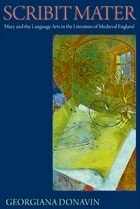
Scribit Mater
Marey and the Language Arts in the Literature of Medieval EnglandGeorgiana Donavin
Catholic University of America Press, 2012
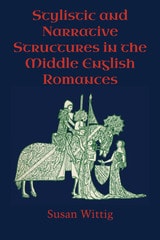
Stylistic and Narrative Structures in the Middle English Romances
By Susan Wittig
University of Texas Press, 1978
This volume provides a generic description, based on a formal analysis of narrative structures, of the Middle English noncyclic verse romances. As a group, these poems have long resisted generic definition and are traditionally considered to be a conglomerate of unrelated tales held together in a historical matrix of similar themes and characters. As single narratives, they are thought of as random collections of events loosely structured in chronological succession. Susan Wittig, however, offers evidence that the romances are carefully ordered (although not always consciously so) according to a series of formulaic patterns and that their structures serve as vehicles for certain essential cultural patterns and are important to the preservation of some community-held beliefs.
The analysis begins on a stylistic level, and the same theoretical principles applied to the linguistic formulas of the poems also serve as a model for the study of narrative structures. The author finds that there are laws that govern the creation, selection, and arrangement of narrative materials in the romance genre and that act to restrict innovation and control the narrative form.
The reasons for this strict control are to be found in the functional relationship of the genre to the culture that produced it. The deep structure of the romance is viewed as a problem-solving pattern that enables the community to mediate important contradictions within its social, economic, and mythic structures. Wittig speculates that these contradictions may lie in the social structures of kinship and marriage and that they have been restructured in the narratives in a “practical” myth: the concept of power gained through the marriage alliance, and the reconciliation of the contradictory notions of marriage for power’s sake and marriage for love’s sake.
This advanced, thorough, and completely original study will be valuable to medieval specialists, classicists, linguists, folklorists, and Biblical scholars working in oral-formulaic narrative structure.
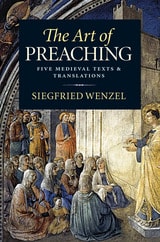
The Art of Preaching
Siegfried Wenzel
Catholic University of America Press, 2013
The Faces of Time
Portrayal of the Past in Old French and Latin Historical Narrative of the Anglo-Norman RegnumJean Blacker
University of Texas Press, 1994
The twelfth century witnessed the sudden appearance and virtual disappearance of an important literary genre—the Old French verse chronicle. These poetic histories of the British kings, which today are treated as fiction, were written contemporaneously with Latin prose narratives, which are regarded as historical accounts. In this pathfinding study, however, Jean Blacker asserts that twelfth-century authors and readers viewed both genres as factual history.
Blacker examines four Old French verse chronicles—Gaimar's Estoire des Engleis (c. 1135), Wace's Roman de Brut (c. 1155) and Roman de Rou (c. 1160–1174), and Benoît de Sainte-Maure's Chronique des Ducs de Normandie (c. 1174–1180) and four Latin narratives—William of Malmesbury's Gesta Regum (c. 1118–1143) and Historia Novella (c. 1140–1143), Orderic Vitalis's Historia Ecclesiastica (c. 1118–1140), and Geoffrey of Monmouth's Historia Regum Britanniae (c. 1138). She compares their similarity in three areas—the authors' stated intentions, their methods of characterization and narrative development, and the possible influences of patronage and audience expectation on the presentation of characters and events.
This exploration reveals remarkable similarity among the texts, including their idealization of historical and even legendary figures, such as King Arthur. It opens fruitful lines of inquiry into the role these writers played in the creation of the Anglo-Norman regnum and suggests that the Old French verse chronicles filled political, psychic, and aesthetic needs unaddressed by Latin historical writing of the period.
The Rose and Geryon
Gabriella I. Baika
Catholic University of America Press, 2014
Theory And The Premodern Text
Paul Strohm
University of Minnesota Press, 2000
A major reconsideration of relations between new theories and old texts.
Medieval Studies/Literary Theory
A major reconsideration of relations between new theories and old texts. The work of Paul Strohm allies the most distinguished traditions of medieval study with the most challenging and innovative of theoretical approaches. These features, working together to revise and expand our understanding of both medieval texts and contemporary critical practice, are apparent in full and compelling force in this collection of essays, most now in print for the first time. In a range of theoretical engagements with late medieval texts, dealing with social practice, time, and narrative, this volume proposes a "practical" relation between the text and the theory that illuminates it.Insisting on the imaginative multiplicity of the text, Strohm finds in theory an augmentation of interpretive possibilities-an augmentation that sometimes requires respectful disagreement with what a work says-or seems to want known-about itself. He thus defines theory as "any standpoint from which we might challenge a text’s self-understanding." Coupled with this strategic disrespect is a new and amplified form of respect-for the text as a meaning-making system, for its unruly power and its unpredictable effects in the world.In this spirit, Strohm offers new and illustrative readings of Hoccleve’s "Male Regle" and Regiment of Princes, Ricardian coronation documents, Chaucer’s "Cook’s Tale," Capgrave’s chronicle, the Gesta Henrici Quinti, records of the king’s bench, Malory’s "Knight of the Cart," and other later medieval texts. Throughout, Strohm traverses categories of "literary" and "non-literary" in the service of a more comprehensive understanding of texts and the resourcefulness with which they accomplish their social work.Medieval Cultures Series, volume 26Translation Inquiries: University of Minnesota Press