Results by title
3 books match the query 'Risk factors'
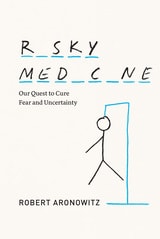
Risky Medicine
Our Quest to Cure Fear and UncertaintyRobert Aronowitz
University of Chicago Press, 2015
Exploring the transformation of health care over the last several decades that has led doctors to become more attentive to treating risk than treating symptoms or curing disease, Aronowitz shows how many aspects of the health system and clinical practice are now aimed at risk reduction and risk control. He argues that this transformation has been driven in part by the pharmaceutical industry, which benefits by promoting its products to the larger percentage of the population at risk for a particular illness, rather than the smaller percentage who are actually affected by it. Meanwhile, for those suffering from chronic illness, the experience of risk and disease has been conflated by medical practitioners who focus on anticipatory treatment as much if not more than on relieving suffering caused by disease. Drawing on such controversial examples as HPV vaccines, cancer screening programs, and the cancer survivorship movement, Aronowitz argues that patients and their doctors have come to believe, perilously, that far too many medical interventions are worthwhile because they promise to control our fears and reduce uncertainty.
Risky Medicine is a timely call for a skeptical response to medicine’s obsession with risk, as well as for higher standards of evidence for risk-reducing interventions and a rebalancing of health care to restore an emphasis on the actual curing of and caring for people suffering from disease.
The Kidney and the Cane
Planetary Health and Plantation Labor in NicaraguaAlex M. Nading
Duke University Press, 2025
To Test or Not To Test
A Guide to Genetic Screening and RiskZallen, Dorris Teichler
Rutgers University Press, 2008
To Test or Not to Test arms readers with questions that should be considered before they pursue genetic screening.
- Am I at higher risk for a disorder?
- Can genetic testing give me useful information?
- Is the timing right for testing?
- Do the benefits of having the genetic information outweigh the problems that testing can bring?
Determining the answers to these questions is no easy task. In this highly readable book, Doris Teichler Zallen provides a template that can guide individuals and families through the decision-making process and offers additional resources where they can gain more information. She shares interviews with genetic specialists, doctors, and researchers, as well as the personal stories of nearly 100 people who have faced genetic-testing decisions. Her examples focus on genetic testing for four types of illnesses: breast/ovarian cancer (different disorders but closely connected), colon cancer, late-onset Alzheimer's disease, and hereditary hemochromatosis. From the more common diseases to the rare hereditary conditions, we learn what genetic screening is all about and what it can tell us about our risks.
Given that we are now bombarded with ads in magazines and on television hawking the importance of pursuing genetic-testing, it is critical that we approach this tough issue with an arsenal of good information. To Test or Not to Test is an essential consumer tool-kit for the genetic decision-making process.