Results by title

9 books match the query 'Rites'
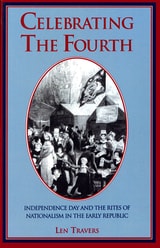
cover of Celebrating the Fourth: Independence Day and the Rites of Nationalism in the Early Republic

Celebrating the Fourth

Independence Day and the Rites of Nationalism in the Early Republic

Len Travers

University of Massachusetts Press, 1997

A CHOICE Outstanding Academic Book

Public rituals have always held a vital place in American culture. By far the noisiest and most popular of these to emerge in the nation's early years was Independence Day. After a decade of fitful starts, the Fourth of July eclipsed local and regional patriotic observances to become the premier “American Jubilee.” Celebrating the Fourth provides a history of this holiday and explores its role in shaping a national identity and consciousness in three cities—Boston, Charleston, and Philadelphia—during the first fifty years of the American republic. Independence Day celebrations justified, validated, and helped maintain nationalism among people unused to offering political allegiance beyond their own state borders. As the observances became increasingly popular and symbolically important, political partisans competed hotly for the right to control the meaning of the festivals.

[more]
cover of Jews, Sports, and the Rites of Citizenship

Jews, Sports, and the Rites of Citizenship

Edited by Jack Kugelmass

University of Illinois Press, 2006
To many, an association between Jews and sports seems almost oxymoronic--yet Jews have been prominent in boxing, basketball, and fencing, and some would argue that hurler Sandy Koufax is America's greatest athlete ever. In Jews, Sports, and the Rites of Citizenship, Jack Kugelmass shows that sports--significant in constructing nations and in determining their degree of exclusivity--also figures prominently in the Jewish imaginary. This interdisciplinary collection brings together the perspectives of anthropologists and historians to provide both methodological and regional comparative frameworks for exploring the meaning of sports for a minority population.
[more]
cover of Rites of Assent: Two Novellas

Rites of Assent

Two Novellas

Abdal Qasim

Temple University Press, 1995
"Written in 1977 and 1981, the novellas translated in this volume form a compelling unity and testify to the creativeness and vitality of contemporary Arab fiction." -Choice Abd al-Hakim Qasim (1935-1990), one of modern Egypt's great novelists, began writing short stories while imprisoned for his leftwing politics under the Nasser regime in the 1960s. This period in Qasim's life, along with his subsequent exile in Germany and his opposition to the Camp David Agreement, led him to avoid political commentary in his writing. He focused on people and events in the Egyptian village and the down-to-earth Sufi Islam practiced there. Still, the history of his political beliefs ensured his work would remain controversial, and most was published abroad in Beirut or Baghdad. The power and inventiveness of modern Egyptian writing are manifest in this first English-language translation of two novellas that Qasim published together during his lifetime. Al-Mahdi is the story of Awadallah, an impoverished Coptic umbrella maker forced to convert to Islam by members of the local Muslim brotherhood. Awadallah's conversion, both unwilling and insincere, torments him with guilt, and he soon falls gravely ill. At the same time, subplots explore the philandering mayor's attempt to seduce his maid, and an affectionate homoerotic relationship between two young men in the Brotherhood. Elegantly narrated and visually evocative, Al-Mahdi illuminates everyday religious tensions in a small Egyptian town. Where Al-Mahdi ends with Awadallah's death, Good News from the Afterlife opens virtually at the mouth of the grave--a testament to Qasim's versatility and compositional sense. This fantastical story brilliantly interweaves a young village boy's thoughts and the spiritual, sensual, and sometimes macabre recollections of a dead man newly lowered into his burial place. Memories and experiences mingle with images of the afterlife, as the deceased is judged by the Muslim angels of death and the boy suddenly hears that his grandfather has died. In the end, the boy awakes atop a grave, throwing into question which, if not all, of the story's strange events had been dreamed. "[T]here's more than Mahfouz in modern Egyptian fiction, and it's good to have Qasim's work among us." -Kirkus Reviews
[more]
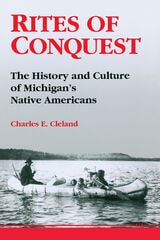
cover of Rites of Conquest: The History and Culture of Michigan's Native Americans

Rites of Conquest

The History and Culture of Michigan's Native Americans

Charles E. Cleland

University of Michigan Press, 1992

For many thousands of years before the arrival of Europeans, Michigan's native peoples, the Anishnabeg, thrived in the forests and along the shores of the Great Lakes. Theirs were cultures in delicate social balance and in economic harmony with the natural order. Rites of Conquest details the struggles of Native Americans Michigan—the Ojibwa, Ottawa, and Potawatomi, and their neighbors—to maintain unique traditions in the wake of contact with Euro-Americans. The French quest for furs, the colonial aggression of the British, and the invasion of native homelands by American settlers is the backdrop for this fascinating saga of their resistance and accommodation to the new social order. Minavavana's victory at Fort Michilimackinac, Pontiac's attempts to expel the British, Pokagon's struggle to maintain a Michigan homeland, and Big Abe Le Blanc's fight for fishing rights are a few of the many episodes recounted in the pages of this book.

Beyond wars and warriors, Rites of Conquest is also about diplomacy and negotiation, mythology and magic, birth and death, and the joys and trials of daily life in the native villages of the Great Lakes region. Today, Michigan's Native American citizens struggle to solve problems that are a legacy of their past, while they attempt to maintain a distinctive place within modern society. In facing this challenge they often turn to the values and traditions that set them apart as the most enduring peoples of the Great Lakes region.
[more]
cover of Rites of Place: Public Commemoration in Russia and Eastern Europe

Rites of Place

Public Commemoration in Russia and Eastern Europe

Julie Buckler and Emily D Johnson

Northwestern University Press, 2013

Ranging widely across time and geography, Rites of Place is to date the most comprehensive and diverse example of memory studies in the field of Russian and East European studies. Leading scholars consider how public rituals and the commemoration of historically significant sites facilitate a sense of community, shape cultural identity, and promote political ideologies. The aims of this volume take on unique importance in the context of the tumultuous events that have marked Eastern European history—especially the revolutions of 1905 and 1917, World War II, and the collapse of the Soviet Union. With essays on topics such as the founding of St. Petersburg, the battle of Borodino, the Katyn massacre, and the Lenin cult, this volume offers a rich discussion of the uses and abuses of memory in cultures where national identity has repeatedly undergone dramatic shifts and remains riven by internal contradictions.
[more]
cover of Rites of Realism: Essays on Corporeal Cinema

Rites of Realism

Essays on Corporeal Cinema

Ivone Margulies, ed.

Duke University Press, 2003

Rites of Realism shifts the discussion of cinematic realism away from the usual focus on verisimilitude and faithfulness of record toward a notion of "performative realism," a realism that does not simply represent a given reality but enacts actual social tensions. These essays by a range of film scholars propose stimulating new approaches to the critical evaluation of modern realist films and such referential genres as reenactment, historical film, adaptation, portrait film, and documentary.
By providing close readings of classic and contemporary works, Rites of Realism signals the need to return to a focus on films as the main innovators of realist representation. The collection is inspired by André Bazin's theories on film's inherent heterogeneity and unique ability to register contingency (the singular, one-time event). This volume features two new translations: of Bazin's seminal essay "Death Every Afternoon" and Serge Daney's essay reinterpreting Bazin's defense of the long shot as a way to set the stage for a clash or risky confrontation between man and animal. These pieces evince key concerns—particularly the link between cinematic realism and contingency—that the other essays explore further.
Among the topics addressed are the provocative mimesis of Luis Buñuel's Land Without Bread; the adaptation of trial documents in Carl Dreyer's Passion of Joan of Arc; the use of the tableaux vivant by Wim Wenders and Peter Greenaway; and Pier Paolo Pasolini's strategies of analogy in his transposition of The Gospel According to St. Matthew from Palestine to southern Italy. Essays consider the work of filmmakers including Michelangelo Antonioni, Maya Deren, Mike Leigh, Cesare Zavattini, Zhang Yuan, and Abbas Kiarostami.


Contributors: Paul Arthur, André Bazin, Mark A. Cohen, Serge Daney, Mary Ann Doane, James F. Lastra, Ivone Margulies, Abé Mark Normes, Brigitte Peucker, Richard Porton, Philip Rosen, Catherine Russell, James Schamus, Noa Steimatsky, Xiaobing Tang
[more]
cover of St. Thomas and the Rites of Man: A Historical Study of the Summa Theologiae, Tertia Pars, Question 83, Articles 4 & 5

St. Thomas and the Rites of Man

A Historical Study of the Summa Theologiae, Tertia Pars, Question 83, Articles 4 & 5

Niels Krogh Rasmussen

Catholic University of America Press, 2026
Long buried in the archives of the Dominican studium at Le Saulchoir, the lectorate dissertation of Fr. Niels Krogh Rasmussen, OP, is now made available to a wider English-speaking audience interested in Saint Thomas Aquinas’s contribution to liturgical theology. Originally written in 1966, just after the Second Vatican Council, Rasmussen’s work is a witness to the intense liturgical ferment of those years and expresses an early attempt to appropriate the then-new postconciliar mode of liturgical reflection, bolstered by attentive historical-critical work, in the spirit of Saint Thomas. Treating the saint’s reflection on the Mass rites in the Summa Theologiae, Rasmussen shows how Aquinas, while writing in the disputed question format, nevertheless presents his readers with an expositio Missae, placing him within the tradition of great medieval Mass expositors, from Amalarius of Metz and Florus of Lyon in the ninth century, Saint Albert the Great and Durandus of Mende in the thirteenth century. By isolating this distinctly liturgical content (without, however, completely eschewing its original quaestio format), Rasmussen is able to highlight the distinctiveness of Thomas’s liturgical thought against that of his predecessors and contemporaries. Even if certain insights or expressions of Rasmussen’s may sound dated to the contemporary reader—since this work was composed in that interim period between Inter Oecumenici (1964) and the promulgation of the Missal of Paul VI (1969)—such insights in fact add to the historical value of this dissertation, offering a snapshot of a time when the reform of the liturgy was very much a living process with a terminus yet to be determined. 60 years later, students of Thomism, liturgical theology, and medieval studies can continue to benefit from this work.
[more]
cover of The Rites of Passage

The Rites of Passage

Arnold van Gennep

University of Chicago Press, 1961

Birth, puberty, marriage, and death are, in all cultures, marked by ceremonies which may differ but are universal in function. Arnold van Gennep (1873-1957) was the first anthropologist to note the regularity and significance of the rituals attached to the transitional stages in man's life, and his phrase for these, "the rites of passage," has become a part of the language of anthropology and sociology.
[more]
cover of The Rites of Passage, Second Edition

The Rites of Passage, Second Edition

Arnold van Gennep

University of Chicago Press, 2019

A CLASSIC WORK OF ANTHROPOLOGY—OVER SEVENTY THOUSAND COPIES SOLD
With a new introduction by Pulitzer Prize–winner David I. Kertzer

Arnold van Gennep’s masterwork, The Rites of Passage, has been a staple of anthropological education for more than a century. First published in French in 1909, and translated into English by the University of Chicago Press in 1960, this landmark book explores how the life of an individual in any society can be understood as a succession of transitions: birth, puberty, marriage, parenthood, old age, and, finally, death. Van Gennep’s great insight was discerning a common structure in each of these seemingly different transitions, involving rituals of separation, liminality, and incorporation. With compelling precision, he set out the terms that would both define twentieth-century ritual theory and become a part of our everyday lexicon.
 
This new edition of his work demonstrates how we can still make use of its enduring critical tools to understand our own social, religious, and political worlds, and even our personal and professional lives. In his new introduction, Pulitzer Prize–winning historian and anthropologist David I. Kertzer sheds new light on van Gennep, on the battles he fought, and on the huge impact the book has had since publication of the first English edition.
[more]