Results by title
3 books match the query 'Ritual in literature'
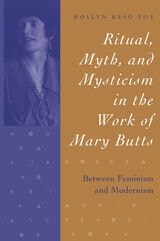
Ritual, Myth, and Mysticism in the Work of Mary Butts
Between Feminism and ModernismFOY ROSLYN
University of Arkansas Press, 2000
Mary Butts wrote and lived among notable modernist writers such as T.S. Eliot, Ford Madox Ford, Jean Cocteau, H.D., and Ezra Pound, and was on her way to becoming one of the most respected British female writers of the twentieth century. Yet, after her death in 1937 at the age of forty-six, her reputation suffered a decline. Butt's idiosyncratic spirituality did not lend itself to easy critical examination, modernism was generally considered a masculine endeavor, and her papers were not made public for over fifty years. The recent acquisition of those papers by the Beinecke Library at Yale University, however, has brought about a resurgence of interest in her unique writings. Mary Butts confronts and reinterprets reality in extraordinary ways, and her modernist vision recalls the natural origins and powers of the female divine. Her intense dedication to ancient rites and myth, and her dabbling in the occult, became embedded in her fiction and led to her own brand of mysticism. Indeed, the Butts heroine is at once, healer, sacred priestess, earth goddess, lover, and daimon/demon. In presenting her characters this way, Butts valorizes what she calls "the soul living at its fullest capacity." Roslyn Reso Foy gives us the first sustained critical study of Butts, exploring the signficance of feminism, mysticism, and magic in her life and writings. Foy's thoughtful analysis, combining scholarship with straightforward discussion, will serve as an introduction to, and foundation for, further critical studies of this remarkable female modernist whose work coincides with contemporary concerns and who can no longer be ignored.
[more]
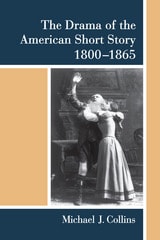
The Drama of the American Short Story, 1800-1865
Michael J. Collins
University of Michigan Press, 2016
The Drama of the American Short Story, 1800–1865 argues that to truly understand the short story form, one must look at how it was shaped by the lively, chaotic, and deeply politicized world of 19th-century transatlantic theater and performance culture. By resurrecting long-neglected theatrical influences on representative works of short fiction, Michael J. Collins demonstrates that it was the unruly culture of the stage that first energized this most significant of American art forms. Whether it was Washington Irving’s first job as theater critic, Melville’s politically controversial love of British drama, Alcott’s thwarted dreams of stage stardom, Poe and Lippard’s dramatizations of peculiarly bloodthirsty fraternity hazings, or Hawthorne’s fascination with automata, theater was a key imaginative site for the major pioneers of the American short story.
The book shows how perspectives from theater studies, anthropology, and performance studies can enrich readings of the short-story form. Moving beyond arbitrary distinctions between performance and text, it suggests that this literature had a social life and was engaged with questions of circumatlantic and transnational culture. It suggests that the short story itself was never conceived as a nationalist literary form, but worked by mobilizing cosmopolitan connections and meanings. In so doing, the book resurrects a neglected history of American Federalism and its connections to British literary forms.
The book shows how perspectives from theater studies, anthropology, and performance studies can enrich readings of the short-story form. Moving beyond arbitrary distinctions between performance and text, it suggests that this literature had a social life and was engaged with questions of circumatlantic and transnational culture. It suggests that the short story itself was never conceived as a nationalist literary form, but worked by mobilizing cosmopolitan connections and meanings. In so doing, the book resurrects a neglected history of American Federalism and its connections to British literary forms.
[more]
The Home Plot
Women, Writing, and Domestic RitualAnn Romines
University of Massachusetts Press, 1992
In this finely crafted study, Ann Romines builds on twenty years of feminist scholarship to show how domestic ritual--the practice and tradition of housekeeping--has helped shape the substance and tone of some of the best fiction by American women. Examining works by Harriet Beecher Stowe, Sarah Orne Jewett, Mary Wilkins Freeman, Willa Cather, and Eudora Welty, Romines argues that one cannot fully appreciate this writing unless one understands the domestic codes in which it is inscribed.
By reading domestic ritual as a gendered language, Romines seeks to reclaim one of the oldest female traditions--housekeeping--from trivialization and devaluation. In the process, she brings fresh insight to the work of five important American novelists.
By reading domestic ritual as a gendered language, Romines seeks to reclaim one of the oldest female traditions--housekeeping--from trivialization and devaluation. In the process, she brings fresh insight to the work of five important American novelists.
[more]