Results by title
11 books match the query 'Roman'
Christian and Pagan in the Roman Empire
Robert Sider
Catholic University of America Press, 2001
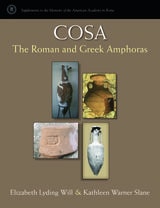
Cosa
The Roman and Greek AmphorasElizabeth Lyding Will and Kathleen Warner Slane
University of Michigan Press, 2019
At the time of Will’s death, her manuscript consisted of a typed catalogue of the amphora stamps from Cosa and an equal number of unstamped vessels, but was missing important elements. On the basis of extensive notes and photographs, Kathleen Warner Slane has reviewed and updated the manuscript, adding type descriptions and footnotes to materials that have appeared since Will’s death as well as a framing introduction and conclusions. Appendices highlight an Augustan amphora dump on the Arx and add a catalogue of the Greek amphora stamps found at Cosa.
Cosa: The Roman and Greek Amphoras will be of interest to scholars and students of Rome and its system of colonies, and also to those interested in Greek and Roman archaeology and trade in the ancient world.
Dionysus, Christ, and the Death of God, Volume 1
The Great Mediations of the Classical WorldGiuseppe Fornari
Michigan State University Press, 2020
Dionysus, Christ, and the Death of God, Volume 2
Christianity and ModernityGiuseppe Fornari
Michigan State University Press, 2020
Drudgery Divine
On the Comparison of Early Christianities and the Religions of Late AntiquityJonathan Z. Smith
University of Chicago Press, 1990
"An important book, and certainly one of the most significant in the career of Jonathan Z. Smith, whom one may venture to call the greatest pathologist in the history of religions. As in many precedent cases, Smith follows a standard procedure: he carefully selects his victim, and then dissects with artistic finesse and unequaled acumen. The operation is always necessary, and a deconstructor of Smith's caliber is hard to find."—Ioan P. Coulianu, Journal of Religion
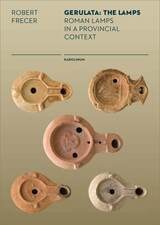
Gerulata
The Lamps: A Survey of Roman Lamps in PannoniaRobert Frecer
Karolinum Press, 2015
This catalog brings together for the first time the 210 ancient lamps excavated since 1949 in Bratislava-Rusovce, a suburb of the capital of Slovakia and the site of the ancient Roman settlement of Gerulata. What may appear at first glance as a standard panoply of Roman lamps is comprehensively examined to uncover signs of wear and use, unique personal inscriptions, and exceptional forms. This book reveals the stunning wealth of knowledge that can be gained from the study of lighting devices in this liminal settlement on the tough northern frontier of the Roman Empire.
Religious Competition in the Greco-Roman World
Nathaniel P. DesRosiers
SBL Press, 2016
Essays that broaden the historical scope and sharpen the parameters of competitive discourses
Scholars in the fields of late antique Christianity, neoplatonism, New Testament, art history, and rabbinics examine issues related to authority, identity, and change in religious and philosophical traditions of late antiquity. The specific focus of the volume is the examination of cultural producers and their particular viewpoints and agendas in an attempt to shed new light on the religious thinkers, texts, and material remains of late antiquity. The essays explore the major creative movements of the era, examining the strategies used to develop and designate orthodoxies and orthopraxies. This collection of essays reinterprets dialogues between individuals and groups, illuminating the mutual competition and influence among these ancient thinkers and communities.
Features:
- Essays feature competitive discourse as the central organizing theme
- Articles present unique theoretical models that are adaptable to different contexts and highly applicable to religious discourses before and after the Late Antique Period
- Scholars cover a much wider range of traditions including Judaism, Christianity, paganism, and philosophy in order to provide the most complete portrait of the religious landscape
Roman and European Mythologies
Edited by Yves Bonnefoy
University of Chicago Press, 1992
early Christian and later European literature. Ninety-five entries
by leading scholars cover subjects such as sacrificial cults and rites
in pre-Roman Italy, Roman religion and its origins, the mythologies of
paganism, the survival of the ancient gods in the Middle Ages and the
Renaissance, gypsy myths and rituals, romanticism and myth in Blake,
Nerval, and Balzac, and myth in twentieth-century English literature.
Mythologies offers illuminating examples of the workings of
myth in the structure of societies past and present—how we create,
use, and are guided by systems of myth to answer fundamental questions
about ourselves and our world.
Many of the sections in Mythologies, originally published as a
two-volume cloth set, will soon be available in four paperback volumes
(two are announced here; two more are scheduled for 1993). These
volumes will reproduce the articles, introductory essays, and
illustrations as they appeared in the full Mythologies set.
The Hellenistic, Roman, and Medieval Glass from Cosa
David Frederick Grose (R. T. Scott, editor)
University of Michigan Press, 2017
The research and analysis presented here are the work of the late David Frederick Grose, who began this project when no other city site excavations in Italy focused on ancient glass. He confirmed that the Roman glass industry began to emerge in the Julio-Claudian era, beginning in the principate of Augustus. His study traces the evolution of manufacturing techniques from core-formed vessels to free blown glass, and it documents changes in taste and style that were characteristic of the western glass industry throughout its long history.
At the time of Grose’s unexpected passing, his study was complete but not yet published. Nevertheless, the reputation of his work in this area has done much to establish the value and importance of excavating and researching Cosa’s glass. This volume, arranged and edited by R. T. Scott, makes Grose’s essential scholarship on the subject available for the first time.
The Power of Sacrifice
Roman and Christian Discourses in ConflictGeorge Heyman
Catholic University of America Press, 2007
Treason in Roman and Germanic Law
Collected PapersBy Floyd Seyward Lear
University of Texas Press, 1965
"Treason" is a word with many connotations, a word applied to a host of varied offenses throughout the history of humanity. These essays by Floyd Seyward Lear analyze the development of the political theory of treason from its beginning in Roman Law to its transformation in the Germanic custom of the early Middle Ages.
The author has presented treason as a political idea, possessing historical continuity, though varying from age to age as it follows the evolution of political authority itself. These studies trace the shifting emphasis in crimes against the state from acts directed against a central absolutist authority to acts involving the personal relationship of a pledged troth and individual fealty. This is a shift from the concept of majesty in Roman law to the concept of fidelity in Germanic law with the corollary shift from allegiance as an act of deference to allegiance as a token of mutual fidelity.
These ideas are examined chronologically across an interval extending from archaic Roman law to incipiently feudal forms, from which modern theories of treason, allegiance, and sovereignty derive. Contemporary concepts in these political areas can hardly be understood apart from their historical origins. Broadly considered, this work is intended as a contribution to intellectual history.
Further, this collection represents the synthesis of material widely scattered in the primary sources and relevant secondary works. The two concluding bibliographical essays are intended as a general survey of the literature relevant to these studies in Roman and Germanic public law. Descriptive and interpretive works which deal with treason and its allied aspects of political and legal theory are not numerous in the English language.