Results by title
21 books match the query 'Romans'
Ambrosiaster's Commentary on the Pauline Epistles
RomansTheodore S. de Bruyn
SBL Press, 2017
A new translation for scholars and students of biblical interpretation and ancient Christianity
The ancient writer dubbed Ambrosiaster was a pioneer in the revival of interest in the Pauline Epistles in the later fourth century. He was read by Latin writers, including Pelagius and Augustine, and his writings, passed on pseudonymously, had a long afterlife in the biblical commentaries, theological treatises, and canonical literature of the medieval and the early modern periods. In addition to his importance as an interpreter of scripture, Ambrosiaster provides unique perspectives on many facets of Christian life in Rome, from the emergence of clerical celibacy to the development of liturgical practices to the subordination of women.
Features
- An up-to-date overview of what is known about Ambrosiaster, the transmission of his commentary on the Pauline Epistles, his exegetical method, his theological orientation, and aspects of Christianity in Rome in the fourth century
- A scholarly translation of the final version of the commentary, along with notes that identify significant variants from prior versions of the commentary
- Bibliography thatincludes a comprehensive list of the scholarly literature on Ambrosiaster
Antony and Cleopatra
William Shakespeare
Arizona Center for Medieval and Renaissance Studies, 2023
In Antony and Cleopatra, Christopher Chen tackles the sweeping epic of love and betrayal at the center of the story of the rulers Antony of Rome and Cleopatra of Egypt. In this contemporary translation of the play, Chen brings the political intrigue and historical storytelling of Shakespeare to modern audiences while preserving the poetic foundation of the play’s language.
This translation of Antony and Cleopatra was written as part of the Oregon Shakespeare Festival’s Play On! project, which commissioned new translations of thirty-nine Shakespeare plays. These translations present the work of “The Bard” in language accessible to modern audiences while never losing the beauty of Shakespeare’s verse. Enlisting the talents of a diverse group of contemporary playwrights, screenwriters, and dramaturges from diverse backgrounds, this project reenvisions Shakespeare for the twenty-first century. These volumes make these works available for the first time in print—a new First Folio for a new era.
Cetamura del Chianti
By Nancy Thomson de Grummond
University of Texas Press, 2020
Expanding the study of Etruscan habitation sites to include not only traditional cities but also smaller Etruscan communities, Cetamura del Chianti examines a settlement that flourished during an exceptional time period, amid wars with the Romans in the fourth to first centuries BCE.
Situated in an ideal hilltop location that was easy to defend and had access to fresh water, clay, and timber, the community never grew to the size of a city, and no known references to it survive in ancient writings; its ancient name isn’t even known. Because no cities were ever built on top of the site, excavation is unusually unimpeded. Intriguing features described in Cetamura del Chianti include an artisans’ zone with an adjoining sanctuary, which fostered the cult worship of Lur and Leinth, two relatively little known Etruscan deities, and ancient wells that reveal the cultural development and natural environment, including the vineyards and oak forests of Chianti, over a period of some six hundred years. Deeply enhancing our understanding of an intriguing economic, political, and cultural environment, this is a compelling portrait of a singular society.
Commentary on the Epistle to the Romans
Peter Abelard
Catholic University of America Press, 2011
Commentary on the Epistle to the Romans, Books 1-5
Catholic University of America Press, 2001
Commentary on the Epistle to the Romans, Books 6-10
Catholic University of America Press, 2002
Feminism, Queerness, Affect, and Romans
Under God?Jimmy Hoke
SBL Press, 2021
"This is a book about submission and subversion, injustice and justice, heroes and villains."
In Feminism, Queerness, Affect, and Romans: Under God? Jimmy Hoke reads Romans with an innovative, intersectional approach that produces distinctive meanings for passages that probe how queer wo/men who first encountered Paul's letter could have engaged with it. Though Paul's letter to the Romans arguably contains the Bible’s strongest condemnation of queer wo/men (1:26–27), that is not the letter's full story. Hoke turns a feminist and queer gaze toward Paul’s conception of faith and ethics, making explicit how Paul's theology throughout Romans has been affectively motivated by imperial notions of gender, race, and sexuality. Moving beyond Paul's singular voice, Hoke engages with a feminist and queer praxis of assemblage to generate plausible ways wo/men of Rome interacted with this epistle. By engaging affect theory, Hoke brings to life not only ideas and words but the feelings and sensations that moved in-between some of the earliest Christ-followers, revealing how queer wo/men were there among them and what that means for queer wo/men today. Hoke includes a reader's guide with key terms used throughout the book, making this an excellent option for both students and scholars beginning to engage not only Paul's letters but also the complex worlds of feminist, queer, and affect theories.
Ireland and the Classical World
By Philip Freeman
University of Texas Press, 2000
On the boundary of what the ancient Greeks and Romans considered the habitable world, Ireland was a land of myth and mystery in classical times. Classical authors frequently portrayed its people as savages—even as cannibals and devotees of incest—and evinced occasional uncertainty as to the island's shape, size, and actual location. Unlike neighboring Britain, Ireland never knew Roman occupation, yet literary and archaeological evidence prove that Iuverna was more than simply terra incognita in classical antiquity.
In this book, Philip Freeman explores the relations between ancient Ireland and the classical world through a comprehensive survey of all Greek and Latin literary sources that mention Ireland. He analyzes passages (given in both the original language and English) from over thirty authors, including Julius Caesar, Strabo, Tacitus, Ptolemy, and St. Jerome. To amplify the literary sources, he also briefly reviews the archaeological and linguistic evidence for contact between Ireland and the Mediterranean world.
Freeman's analysis of all these sources reveals that Ireland was known to the Greeks and Romans for hundreds of years and that Mediterranean goods and even travelers found their way to Ireland, while the Irish at least occasionally visited, traded, and raided in Roman lands. Everyone interested in ancient Irish history or Classics, whether scholar or enthusiast, will learn much from this pioneering book.
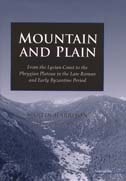
Mountain and Plain
From the Lycian Coast to the Phrygian Plateau in the Late Roman and Early Byzantine PeriodMartin Harrison
University of Michigan Press, 2001
The present study is the fruit of years of excavation and research by the author. The manuscript was largely sketched out when Martin Harrison unexpectedly passed away, and the volume has been finished and prepared for press by his long-time assistant Wendy Young, with further guidance from friends and colleagues with whom he had discussed the project.
The resulting volume explores Martin Harrison's belief that the coastal cities of Lycia declined after the fifth century C.E., and that smaller settlements (monasteries, villages, and towns) appeared in the mountains and further inland. In addition he considered that there was a demographic shift of masons and sculptors from the cities to serve these new settlements. This beautifully illustrated study provides convincing evidence from architecture, sculpture, and inscriptional sources to support this theory. It also contains a description of Amorium in Phrygia, as revealed in survey and excavation seasons from 1987 until the author's untimely death half a dozen years later. The volume includes a preface by Stephen Hill and an appendix by Michael Ballance and Charlotte Roueché on three special inscriptions from Ovacik.
The volume will be of interest to historians of the Near East and classical antiquity, to archaeologists, and to students of architectural history.
Martin Harrison was Professor of Archaeology, University of Oxford. Wendy Young was Research Assistant to the author until his death.
Reading Paul's Letter to the Romans
Jerry L. Sumney
SBL Press, 2012
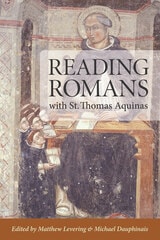
Reading Romans with St. Thomas Aquinas
Matthew Levering
Catholic University of America Press, 2012
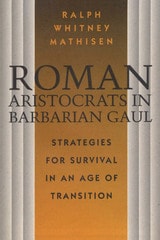
Roman Aristocrats in Barbarian Gaul
Strategies for Survival in an Age of TransitionBy Ralph W. Mathisen
University of Texas Press, 1992
Skin-clad barbarians ransacking Rome remains a popular image of the "decline and fall" of the Roman Empire, but why, when, and how the Empire actually fell are still matters of debate among students of classical history. In this pioneering study, Ralph W. Mathisen examines the "fall" in one part of the western Empire, Gaul, to better understand the shift from Roman to Germanic power that occurred in the region during the fifth century AD.
Mathisen uncovers two apparently contradictory trends. First, he finds that barbarian settlement did provoke significant changes in Gaul, including the disappearance of most secular offices under the Roman imperial administration, the appropriation of land and social influence by the barbarians, and a rise in the overall level of violence. Yet he also shows that the Roman aristocrats proved remarkably adept at retaining their rank and status. How did the aristocracy hold on?
Mathisen rejects traditional explanations and demonstrates that rather than simply opposing the barbarians, or passively accepting them, the Roman aristocrats directly responded to them in various ways. Some left Gaul. Others tried to ignore the changes wrought by the newcomers. Still others directly collaborated with the barbarians, looking to them as patrons and holding office in barbarian governments. Most significantly, however, many were willing to change the criteria that determined membership in the aristocracy. Two new characteristics of the Roman aristocracy in fifth-century Gaul were careers in the church and greater emphasis on classical literary culture.
These findings shed new light on an age in transition. Mathisen's theory that barbarian integration into Roman society was a collaborative process rather than a conquest is sure to provoke much thought and debate. All historians who study the process of power transfer from native to alien elites will want to consult this work.
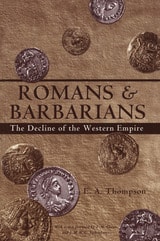
Romans and Barbarians
The Decline of the Western EmpireE. A. Thompson
University of Wisconsin Press, 2002
Available for the first time in paperback, this classic work by renowned historian E.A. Thompson examines the fall of the Roman Empire in the West from the barbarian perspective and experience. Standard interpretations of the decline of the Roman Empire in the West view the barbarian invaders as destroyers. Thompson, however, argues that the relationship between the invaders and the invaded was far more complex than the common interpretation would suggest. This edition includes a new foreword by F.M. Clover and J.H.W.G. Liebeschuetz.
Romans and the Power of the Believer
Richard J. Britton
SBL Press, 2022
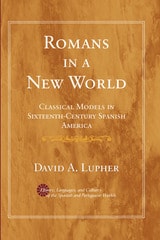
Romans in a New World
Classical Models in Sixteenth-Century Spanish AmericaDavid A. Lupher
University of Michigan Press, 2006
In the course of this debate, many Spaniards were inspired to think more deeply on their own ethnic ancestry and identity, as Spanish treatment of the New World natives awakened the slumbering memory of Roman treatment of the Iberian tribes whom modern Spaniards were now embracing as their truest ancestors. At the same time, growing awareness of the cultural practices--especially the religious rituals--of the American natives framed a new perspective on both the pre-Christian ancestors of modern Europeans and even on the survival of "pagan" customs among modern Europeans themselves. In this incisive study, David A. Lupher addresses the increasingly debated question of the impact the discovery of the New World had upon Europeans' perceptions of their identity and place in history.
Romans in a New World holds much to interest both classicists and students of the history and culture of early modern Europe--especially, though not exclusively, historians of Spain. David A. Lupher's concern with the ideology of imperialism and colonization and with cross-cultural negotiations will be useful to students of cultural studies, as well.
David A. Lupher is Professor of Classics, University of Puget Sound.
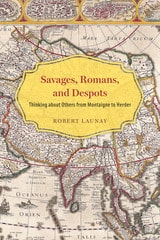
Savages, Romans, and Despots
Thinking about Others from Montaigne to HerderRobert Launay
University of Chicago Press, 2018
Beginning with Mandeville and Montaigne, and working through Montesquieu, Diderot, Gibbon, Herder, and others, Launay traces how Europeans both admired and disdained unfamiliar societies in their attempts to work through the inner conflicts of their own social worlds. Some of these writers drew caricatures of “savages,” “Oriental despots,” and “ancient” Greeks and Romans. Others earnestly attempted to understand them. But, throughout this history, comparative thinking opened a space for critical reflection. At its worst, such space could give rise to a sense of European superiority. At its best, however, it could prompt awareness of the value of other ways of being in the world. Launay’s masterful survey of some of the Western tradition’s finest minds offers a keen exploration of the genesis of the notion of “civilization,” as well as an engaging portrait of the promises and perils of cross-cultural comparison.
Textual Signposts in the Argument of Romans
A Relevance-Theory ApproachSarah H. Casson
SBL Press, 2019
A fresh look at the development of Paul’s argument in Romans
The Greek word gar occurs 144 times in Romans and 1,041 times in the entire New Testament. However, many instances of this connective defy easy definition, and the English translation for is often inadequate, obscuring the clue that gar gives to the direction of the communicator’s thought. In this ground-breaking work, Sarah H. Casson argues that gar offers vital guidance to the coherence of Romans. The book applies the cognitive approach of relevance theory to show how garfunctions as an indispensable guide for tracing the significant points of Paul’s argument, helping resolve questions about the coherence of sections, as well as smaller-scale exegetical problems. The work engages with key debates regarding the purpose of Romans and challenges some recent influential interpretations.
Features:
- An exegetically useful understanding of the connective gar
- A new method for determining Paul’s audience and reason for writing
- A challenge to recent key debates and influential interpretations of the purpose of Romans
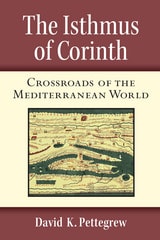
The Isthmus of Corinth
Crossroads of the Mediterranean WorldDavid K. Pettegrew
University of Michigan Press, 2016
David Pettegrew’s book offers a new history of the Isthmus of Corinth from the Romans’ initial presence in Greece during the Hellenistic era to the epic transformations of the Empire in late antiquity. A new interpretation of the extensive literary evidence outlines how the Isthmus became the most famous land bridge of the ancient world, central to maritime interests of Corinth, and a medium for Rome’s conquest, annexation, and administration in the Greek east. A fresh synthesis of archaeological evidence and the results of a recent intensive survey on the Isthmus describe the physical development of fortifications, settlements, harbors, roads, and sanctuaries in the region. The author includes chapters on the classical background of the concept isthmos, the sacking of Corinth and the defeat of the Achaean League, colonization in the Late Roman Republic, the Emperor Nero’s canal project and its failure, the growth of Roman settlement in the territory, and the end of athletic contests at Isthmia. The Isthmus of Corinth offers a powerful case study in the ways that shifting Mediterranean worlds transformed a culturally significant landscape over the course of a millennium.
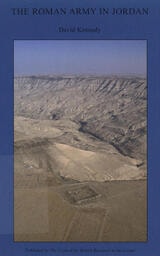
The Roman Army in Jordan
David Kennedy
Council for British Research in the Levant, 2004
The Romans
Edited by Andrea Giardina
University of Chicago Press, 1993
Synthesizing a wealth of current research, The Romans surveys the most complex society ever to exist prior to the Industrial Age. Searching out the identity of the ancient Roman, the contributors describe an urbane figure at odds with his rustic peers, known for his warlike nature and his love of virtue, his magnanimity to foreigners and his predilection for cutting off his enemies' heads. Most important, perhaps, of the themes explored throughout this volume are those of freedom and slavery, of citizenship and humanitas.
What results from the depictions Roman society through time and across its many constituent cultures is the variety of Roman identity in all its richness and depth. These masterful essays will engage the general reader as well as the specialist in history and culture.
The Time Has Grown Short
René Girard, or the Last LawBenoît Chantre
Michigan State University Press, 2022