Results by title
8 books match the query 'Russell, Herbert K.'
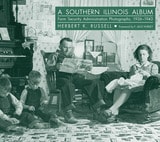
A Southern Illinois Album
Farm Security Administration Photographs, 1936-1943Herbert K. Russell. Foreword by F. Jack Hurley
Southern Illinois University Press, 1990

Edgar Lee Masters
A BIOGRAPHYHerbert K. Russell
University of Illinois Press, 2001
Fluorspar Mining
Photos from Illinois and Kentucky, 1905-1995Herbert K. Russell
Southern Illinois University Press, 2019
This first-ever pictorial record of the people and methods of the Illinois-Kentucky Fluorspar District from the 1900s to the 1990s covers early and modern means of extracting, hoisting, processing, and transporting the mineral from mine mouth to end user. Nearly one hundred images carefully selected by author Herbert K. Russell show early pick-and-shovel extraction and open-flame lighting as well as primitive drilling methods and transportation by barrels, buckets, barges, mule teams, and trams, in addition to the use of modern equipment and sophisticated refinement procedures such as froth flotation. Russell also provides an overview of the many industrial uses of fluorspar, from metal work by ancient Romans to the processing of uranium by scientists seeking to perfect the atomic bomb. Preserving what is known about the industry by miners, managers, and museums, this detailed and fascinating pictorial history looks both above and below ground at fluorspar mining.
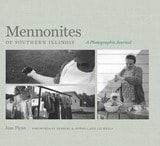
Mennonites of Southern Illinois
A Photographic JournalJane Flynn, with forewords by Herbert K. Russell and Liz Wells
Southern Illinois University Press, 2024
WINNER, Certificate of Excellence in “Publications – Other” from the Illinois State Historical Society’s 2025 Best of Illinois History Awards!
“In the World But Not of It”
Offering a glimpse into a world largely misunderstood by mainstream society, this book documents the period of eight years that Jane Flynn practiced with Mennonites in two different Southern Illinois communities: Stonefort, and Mount Pleasant in Anna. Despite her status as an outsider, Flynn was welcomed and allowed to photograph the Mennonites in their homes, making applesauce, farming, and beekeeping.
Escaping persecution from the Catholic Church in Europe, the Mennonites arrived in America in 1683, settling in what is now Pennsylvania. Today, they live in almost all 50 states, Canada, and South America. To reflect the Mennonites’ manual-labor lifestyle, Flynn processed her black-and-white photographs by hand and hand-printed them in a dark room. The imagery explores the Mennonites’ labors, leisure, and faith by documenting their homes, places of work and worship, and the Illinois Ozark landscape they inhabit.
Similar to the Amish and the Quakers, Mennonites consider the Bible the supreme authority and insist on a separation between church and state. To enact that separation, they distinguish themselves from society in speech, dress, business, recreation, education, pacifism, and by refusing to participate in politics. They believe in nonconformity to the world, discipleship, and being born again through adult baptism. With Mennonites of Southern Illinois, Jane Flynn provides representation for these closed communities and illustrates the Mennonites’ struggle to find and maintain balance between rustic and modern life while remaining faithful to their religious beliefs.
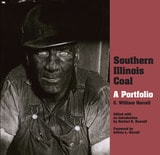
Southern Illinois Coal
A PortfolioC. William Horrell. Edited with an Introduction by Herbert K. Russell. Foreword by Jeffrey L. Horrell
Southern Illinois University Press, 1995
The coal mining photographs of C. William Horrell, taken across the southern Illinois Coal Belt over a twenty-year period from 1966 to 1986, are extraordinary examples of documentary photography—so stark and striking that captions often seem superfluous.
Horrell’s photographs capture the varied phenomena of twentieth-century coal mining technology: the awesome scale of surface mining machines and their impact on the land; massive machines forced into narrow passageways with inches to spare as they carry coal from the face to conveyer belts; and, more significant, the advent of continuous miners, machines that can handle four previously separate processes and which have been a fixture in underground or “deep” mines since the mid-1960s.
Horrell was also intrigued by the related activities of mining, including coal’s processing, cleaning, and transportation, as well as the daily, behind-the-scenes operations that keep mines and miners working. His photographs reflect the beauty of the commonplace—the clothes of the miners, their dinner pails, and their tools—and reveal the picturesque remnants of closed mines: the weathered boards of company houses, the imposing iron beauty of an ancient tipple, and an abandoned building against the lowering sky of an approaching storm. Finally, his portraits of coal minersshow the strength, dignity, and enduring spirit of the men and women who work the southern Illinois coal mines.

The Boy of Battle Ford and the Man
W. S. Blackman
Southern Illinois University Press, 2012
A classic story of a young man’s journey to adulthood, The Boy of Battle Ford covers Blackman’s years growing up in early post-settlement Illinois, where he gave in to temptations such as drinking, gambling, and the lure of prostitutes before joining the army, finding God and becoming a preacher. Blackman, who notes that he is determined to “write facts” in this book, peppers his story with the sordid details of the sinful times of his life as well as with discussions of faith and of struggling to understand his God and his beliefs.

The Flag on the Hilltop
Mary Tracy Earle
Southern Illinois University Press, 1989
Early in the Civil War, two young brothers boldly flew the Union flag from a tree atop a hill between Makanda and Cobden. This was a towering act of courage in an area teeming with Copperheads.
Theodore and Al Thompson, 18 and 20 years old at the time, raised the flag in defiance of the Knights of the Golden Circle, a secessionist group that operated throughout the Midwest. Controlling its membership through terror, this secret society condemned betrayers to death by torture. The Knights, whose goals included capturing a Union prison and liberating the rebels, triggered the Civil War riot in Charleston, instigated anti-draft movements, and aided Northern deserters.
Theodore Thompson, who later owned much of Makanda, Giant City, and the land that became Southern Illinois University describes the tree as a "tall tulip poplar between 3 and 4 feet in diameter at the trunk and some 60 feet to the first limbs. This noted tree could be seen in some directions 15 or 20 miles away."
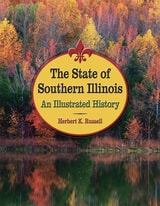
The State of Southern Illinois
An Illustrated HistoryHerbert K. Russell
Southern Illinois University Press, 2012
Superior Achievement, Illinois State Historical Society, 2013
In The State of Southern Illinois: An Illustrated History, Herbert K. Russell offers fresh interpretations of a number of important aspects of Southern Illinois history. Focusing on the area known as “Egypt,” the region south of U.S. Route 50 from Salem south to Cairo, he begins his book with the earliest geologic formations and follows Southern Illinois’s history into the twenty-first century. The volume is richly illustrated with maps and photographs, mostly in color, that highlight the informative and straightforward text.
Perhaps most notable is the author’s use of dozens of heretofore neglected sources to dispel the myth that Southern Illinois is merely an extension of Dixie. He corrects the popular impressions that slavery was introduced by early settlers from the South and that a majority of Southern Illinoisans wished to secede. Furthermore, he presents the first in-depth discussion of twelve pre–Civil War, free black communities located in the region. He also identifies the roles coal mining, labor violence, gangsters, and the media played in establishing the area’s image. He concludes optimistically, unveiling a twenty-first-century Southern Illinois filled with myriad attractions and opportunities for citizens and tourists alike.
The State of Southern Illinois is the most accurate all-encompassing volume of history on this unique area that often regards itself as a state within a state. It offers an entirely new perspective on race relations, provides insightful information on the cultural divide between north and south in Illinois, and pays tribute to an often neglected and misunderstood region of this multidimensional state, all against a stunning visual backdrop.