Results by title
9 books match the query 'Sacred books'
Books and Readers in the Premodern World
Essays in Honor of Harry GambleKarl Shuve
SBL Press, 2018
A book about the role of books in shaping the ancient religious landscape
This collection of essays by leading scholars from a variety of academic disciplines explores the ongoing relevance of Harry Gamble’s Books and Readers in the Early Church (1995) for the study of premodern book cultures. Contributors expand the conversation of book culture to examine the role the Hebrew Bible, the New Testament, and the Qur’an played in shaping the Jewish, Christian, and Muslim religions in the ancient and medieval world. By considering books as material objects rather than as repositories for stories and texts, the essays examine how new technologies, new materials, and new cultural encounters contributed to these holy books spreading throughout territories, becoming authoritative, and profoundly shaping three global religions.
Features:
- Comparative analysis of book culture in Roman, Jewish, Christian, and Islamic contexts
- Art-historical, papyrological, philological, and historical modes of analysis
- Essays that demonstrate the vibrant, ongoing legacy of Gamble’s seminal work
Envisioning Scripture
Joseph Smith’s Revelations in Their Early American ContextsColby Townsend
Signature Books, 2022
Contributors include Catherine A. Brekus, William Davis, Elizabeth Fenton, Kathleen Flake, Paul Gutjahr, Jared Hickman, Susan Juster, Seth Perry, Laura Thiemann Scales, and Roberto A. Valdeón.
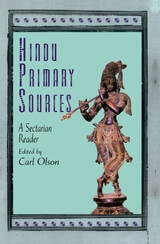
Hindu Primary Sources
A Sectarian ReaderOlson, Carl
Rutgers University Press, 2007
The volume is divided into two major parts. The first section presents selections that explore major themes in classical Sanskrit traditions, including those in the Vedic, Upanisadic, and Dharma literatures, as well as the classical philosophical-religious schools. The second part includes selections that highlight the sectarian and devotional movements related to major deities such as Vishnu, Shiva, Krishna, Rama, Sant, Tantra, and the goddess figures.
In addition to a general introductory chapter on Indian literature, each major section is introduced by an essay that places the selections within the context of Hindu history. This comprehensive reader stands on its own as an indispensable anthology of original textual sources for courses in Hinduism, while also serving as a companion volume to the text The Many Colors of Hinduism: A Thematic-Historical Introduction.
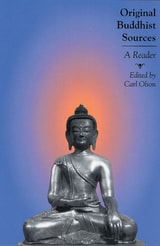
Original Buddhist Sources
A ReaderOlson, Carl
Rutgers University Press, 2005
Bringing together essential materials on the origins and development of Buddhist traditions from India, Sri Lanka, Tibet, China, and Japan, this anthology provides the broadest selection of primary source Buddhist literature available to date.
The volume is divided into two major parts: Theravada and Mahayana forms of Buddhism. The first section presents selections that explore major themes in Buddhist thought such as causality, Four Noble Truths, the doctrine of non-self, nibbana, meditation, and ethics, as well as literature about monastic life and regulations, women, and hagiography.
The second part includes selections from so-called wisdom literature and texts that represent the three major schools of Mahayana Buddhism: Pure Land, Madhyamika, and Yogacara. Selections also include sources from some of the major Chinese Buddhist schools such as Hua-yen, T'ien T'ai, Pure Land, and Ch'an. Readings by thinkers such as Tantric Buddhist reformer Tsong Khapa, Pure Land leaders Honen, Shinran, and Nichiren, as well as Zen Buddhists Dogen and Hakuin provide a perspective on regional and national traditions.
In addition to the general introduction, each major section is introduced by an essay that places the selections within the context of Buddhist history. This comprehensive reader stands on its own as an indispensable anthology of original textual sources for courses in Buddhism, while also serving as a companion volume to the text The Different Paths of Buddhism: A Narrative-Historical Introduction.
Textual Sources for the Study of Hinduism
Edited by Wendy Doniger O'Flaherty
University of Chicago Press, 1990
Textual Sources for the Study of Sikhism
Edited by W.H. McLeod
University of Chicago Press, 1990
The Mahabharata, Volume 2
Book 2: The Book of Assembly; Book 3: The Book of the ForestEdited by J. A. B. van Buitenen
University of Chicago Press, 1975
The Testimony of Two Nations
How the Book of Mormon Reads, and Rereads, the BibleMichael Austin
University of Illinois Press, 2024
Like the Hebrew Bible and the Christian Bible, the Book of Mormon uses narratives to develop ideas and present instruction. Michael Austin reveals how the Book of Mormon connects itself to narratives in the Christian Bible with many of the same tools that the New Testament used to connect itself to the Hebrew Bible to create the Christian Bible. As Austin shows, the canonical context for interpreting the Book of Mormon includes the Christian Bible, the Book of Mormon itself, and other writings and revelations that hold scriptural status in most Restoration denominations. Austin pays particular attention to how the Book of Mormon connects itself to the Christian Bible both to form a new canon and to use the canonical relationship to reframe and reinterpret biblical narratives. This canonical context provides an important and fruitful method for interpreting the Book of Mormon.
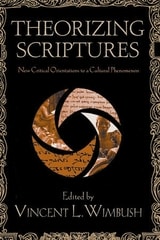
Theorizing Scriptures
New Critical Orientations to a Cultural PhenomenonWimbush, Vincent
Rutgers University Press, 2008
Historically, religious scriptures are defined as holy texts that are considered to be beyond the abilities of the layperson to interpret. Their content is most frequently analyzed by clerics who do not question the underlying political or social implications of the text, but use the writing to convey messages to their congregations about how to live a holy existence. In Western society, moreover, what counts as scripture is generally confined to the Judeo-Christian Bible, leaving the voices of minorities, as well as the holy texts of faiths from Africa and Asia, for example, unheard.
In this innovative collection of essays that aims to turn the traditional bible-study definition of scriptures on its head, Vincent L. Wimbush leads an in-depth look at the social, cultural, and racial meanings invested in these texts. Contributors hail from a wide array of academic fields and geographic locations and include such noted academics as Susan Harding, Elisabeth Shüssler Fiorenza, and William L. Andrews.
Purposefully transgressing disciplinary boundaries, this ambitious book opens the door to different interpretations and critical orientations, and in doing so, allows an ultimately humanist definition of scriptures to emerge.