Results by title
33 books match the query 'Safety measures'
After Grenfell
Violence, Resistance and ResponseEdited by Dan Bulley, Jenny Edkins and Nadine El-Enany
Pluto Press, 2019

Aviation Weather Surveillance Systems
Advanced radar and surface sensors for flight safety and air traffic managementPravas Mahapatra
The Institution of Engineering and Technology, 1999
Chemical Heroes
Pharmacological Supersoldiers in the US MilitaryAndrew Bickford
Duke University Press, 2020
Code of Practice for Electrical Safety Management
The Institution of Engineering and Technology
The Institution of Engineering and Technology, 2013
Code of Practice for Electrical Safety Management
The Institution of Engineering and Technology
The Institution of Engineering and Technology, 2023

Comprehensive Guide To Emergency And Disaster Prepar
Frances Wilkinson
Assoc of College & Research Libraries, 2010

Disaster Response and Planning for Libraries
Miriam B. Kahn
American Library Association, 2012
Disaster Response and Planning for Libraries
American Library Association, 2003
Electrical Safety
A guide to the causes and prevention of electrical hazardsJ. Maxwell Adams
The Institution of Engineering and Technology, 1994
Environmental Safety of Genetically Engineered Crops
Rebecca Grumet
Michigan State University Press, 2010
Guidance Note 4
Protection Against FireThe Institution of Engineering and Technology
The Institution of Engineering and Technology, 2015
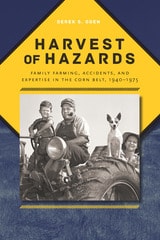
Harvest of Hazards
Family Farming, Accidents, and Expertise in the Corn Belt, 1940-1975Derek S. Oden
University of Iowa Press, 2017
In this study of the farm safety movement in the Corn Belt, historian Derek Oden examines why agriculture was so dangerous and why improvements were so difficult to achieve. Because farmers were self-employed business owners whose employees were mainly family members; because they lived far from aid such as hospitals and fire stations; and because they had to manage such a diverse array of new technologies, they could not easily adopt the workplace safety and public health reforms designed for factories and urban settings. In response, beginning in the 1940s, farmers and a new breed of farm safety specialists relied upon an increasingly elaborate educational campaign to lessen injuries and illnesses on the farm.
Several government, business, and nonprofit organizations—from the US Department of Agriculture to the National Safety Council and 4-H and the Future Farmers of America—worked together to publicize both the dangers of farming and the information farmers needed to stay safe while driving tractors, applying anhydrous ammonia, or repairing machinery. By the 1960s, however, the partnership began to break down, and by the 1970s the safety movement became increasingly contested as professional and policy divisions emerged. This groundbreaking study incorporates agriculture into the histories of occupational safety and public health.

Horsing Around in New Jersey
The Horse Lover's Guide to Everything EquineZatz, Arline
Rutgers University Press, 2004
Arline Zatz has writtenthe first guidebook to everything equine in the Garden State: Horsing Around in New Jersey. This accessible, easy-to-use volume is essential reading for the novice who yearns to go horseback riding but doesn't know how or where to begin; for the experienced equestrian seeking new trails and campsites; for anyone wishing to attend an equestrian event; and for those seeking a job in the equestrian field, which already employs nearly 6,000 New Jerseyans. The industry generates more than 650 million dollars in annual revenue. Millions of people attend equine events in New Jersey each year. The U.S. Equestrian team makes its home there, and New Jersey's state animal is the horse.
Zatz tells readers--including those with disabilities--where they can take lessons, rent a horse, and prepare for riding. She includes safety and first aid tips. Horse history and breeds common to New Jersey are discussed, as are health concerns, including diseases, preventative medicine, and emergency care. The book showcases New Jersey's eighty-five equestrian trails and covers information on where to obtain riding permits and their accompanying rules and regulations. There is advice for both new horse owners and renters, including recommendations on tack and clothing, stable management, and horse adoption.
The book acquaints readers with year-round equine entertainment opportunities, and offers dozens of suggestions on where to watch or participate in sports on horseback. Zatz lists equine education programs for all ages, and outlines numerous employment opportunities within the equine industry. The book concludes with a glossary of common horse industry terminology, a listing of national equine associations and breed registries, equipment sources, and equine publications for further reading.
Hostages of Each Other
The Transformation of Nuclear Safety since Three Mile IslandJoseph V. Rees
University of Chicago Press, 1996
Library Security
Better Communication, Safer FacilitiesSteve Albrecht
American Library Association, 2015
Library work is really all about people. And the inclusive, welcoming nature of the library means that all kinds of people pass through its doors. Not all difficult patrons are dangerous, but some frighten staff and other library users, which can lead to situations that are distracting, troubling, and fraught with liability. For more than a decade, Albrecht, a 15-year police veteran, has presented workshops for libraries on dealing with challenging patrons. His no-nonsense advice will empower library staff in their personal security and give them the tools to confidently communicate with their colleagues, patrons, and members of law enforcement regarding inappropriate behavior. In this book he addresses security issues important to all libraries, including
- Specific guidance for common situations, such as unruly teens, unwanted sexual advances, chronically homeless substance abusers, and more
- The elements of an effective Code of Conduct and how to enforce it
- Tips on how to manage internet usage to minimize potential problems
- How to align with patrons and use language that defuses the conflict
- Forming partnerships with service organizations, homeless shelters, mental health advocacy groups, and other community resources
- How to know when it's time to call the police, plus ideas for increasing law enforcement support
- Ways to make the library more secure through changes to facilities
Library as Safe Haven
Disaster Planning, Response, and Recovery; A How-To-Do-It Manual for LibrariansDeborah D. Halsted
American Library Association, 2014
Library’s Crisis Communications Planner
A PR Guide for Handling Every EmergencyJan Thenell
American Library Association, 2004

Living with Earthquakes in California
Robert S. Yeats
Oregon State University Press, 2001
Living with Earthquakes in the Pacific Northwest
Robert S. Yeats
Oregon State University Press, 1998
Living with Earthquakes in the Pacific Northwest
A Survivor's Guide, Second Edition, Revised and ExpandedRobert S. Yeats
Oregon State University Press, 2004
Multiple Exposures
Chronicles of the Radiation AgeCatherine Caufield
University of Chicago Press, 1990
the history behind the safety standards limiting the effects of high energy
radiation on human beings. . . . Provides an immense amount of information
in a very readable form."—W. Alan Runciman, Prometheus
"From fallout and radon to radioactive smoke detectors and dental X-rays,
Caufield traces the proliferation of the uses of radiation in medicine,
industry and the military, and in generating energy. An intelligent,
non-alarmist history."—Publishers Weekly
Pedaling Revolution
How Cyclists Are Changing American CitiesJeff Mapes
Oregon State University Press, 2009
In a world of increasing traffic congestion, a grassroots movement is carving out a niche for bicycles on city streets. Pedaling Revolution explores the growing bike culture that is changing the look and feel of cities, suburbs, and small towns across North America.
From traffic-dodging bike messengers to tattooed teenagers on battered bikes, from riders in spandex to well-dressed executives, ordinary citizens are becoming transportation revolutionaries. Jeff Mapes traces the growth of bicycle advocacy and explores the environmental, safety, and health aspects of bicycling. He rides with bicycle advocates who are taming the streets of New York City, joins the street circus that is Critical Mass in San Francisco, and gets inspired by the every-day folk pedaling in Amsterdam, the nirvana of American bike activists. Chapters focused on big cities, college towns, and America’s most successful bike city, Portland, show how cyclists, with the encouragement of local officials, are claiming a share of the valuable streetscape.
“A growing number of Americans, mounted on their bicycles like some new kind of urban cowboy, are mixing it up with swift, two-ton motor vehicles as they create a new society on the streets. They’re finding physical fitness, low-cost transportation, environmental purity—and, still all too often, Wild West risks of sudden death or injury.” —from the introduction

Perspectives on Food-Safety Issues of Animal-Derived Foods
Steven C. Ricke
University of Arkansas Press, 2010
Residues
Thinking Through Chemical EnvironmentsSoraya Boudia
Rutgers University Press, 2022
Winner of the 2023 Merton Award from the Science, Knowledge, and Technology section of the American Sociological Association
Residues offers readers a new approach for conceptualizing the environmental impacts of chemicals production, consumption, disposal, and regulation. Environmental protection regimes tend to be highly segmented according to place, media, substance, and effect; academic scholarship often reflects this same segmented approach. Yet, in chemical substances we encounter phenomena that are at once voluminous and miniscule, singular and ubiquitous, regulated yet unruly. Inspired by recent studies of materiality and infrastructures, we introduce “residual materialism” as a framework for attending to the socio-material properties of chemicals and their world-making powers. Tracking residues through time, space, and understanding helps us see how the past has been built into our present chemical environments and future-oriented regulatory systems, why contaminants seem to always evade control, and why the Anthropocene is as inextricably harnessed to the synthesis of carbon into new molecules as it is driven by carbon’s combustion.
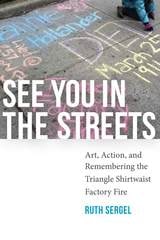
See You in the Streets
Art, Action, and Remembering the Triangle Shirtwaist Factory FireRuth Sergel
University of Iowa Press, 2016
In 1911, a fire at the Triangle Shirtwaist Factory in New York City took the lives of 146 workers, most of them young immigrant women and girls. Their deaths galvanized a movement for social and economic justice then, but today’s laborers continue to battle dire working conditions. How can we bring the lessons of the Triangle fire back into practice today? For artist Ruth Sergel, the answer was to fuse art, activism, and collective memory to create a large-scale public commemoration that invites broad participation and incites civic engagement. See You in the Streets showcases her work.
It all began modestly in 2004 with Chalk, an invitation to all New Yorkers to remember the 146 victims of the fire by inscribing their names and ages in chalk in front of their former homes. This project inspired Sergel to found the Remember the Triangle Fire Coalition, a broad alliance of artists and activists, universities and unions—more than 250 partners nationwide—to mark the 2011 centennial of the infamous blaze. Putting the coalition together and figuring what to do and how to do it were not easy. This book provides a lively account of the unexpected partnerships, false steps, joyous collective actions, and sustainability of such large public works. Much more than an object lesson from the past, See You in the Streets offers an exuberant perspective on building a social art practice and doing public history through argument and agitation, creativity and celebration with an engaged public.
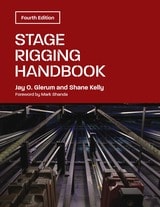
Stage Rigging Handbook, Fourth Edition
Jay O. Glerum and Shane Kelly with a foreword by Mark Shanda
Southern Illinois University Press, 2024
Updating the industry standard stage rigging text for a new generation
First published in 1987 and revised in 1997 and 2007, Stage Rigging Handbook remains the only book in any language that covers the design, operation, and maintenance of stage rigging equipment. Though often unnoticed, these systems are critical in both easing the workload of stage technicians and creating storytelling magic for the audience. This landmark text imparts the foundations for understanding and implementing rigging systems, such that upon completion of the book, the reader is ready to begin hands-on training and practice.
Organized into four sections, the handbook combines research and practical experience to guide riggers through their work. It begins by explaining the construction and care of basic lifting media. Part two analyzes types of rigging systems; then the handbook details the forces that impact rigging, from Newtonian physics to calculating expansive modern systems. Finally, it presents day-to-day best safety practices, including brand new sections on risk assessment and fall protection.
This reorganized and greatly expanded fourth edition of Jay O. Glerum’s industry standard text updates much of the information in the previous editions with the addition of chapters on truss (the framework that supports lighting, screens, and other accessories), motorized chain hoists, hardware, and job safety, including fall protection systems. Award-winning production manager Shane Kelly preserves Glerum’s voice while bringing fresh information to a new generation of riggers, supplementing the text with updated versions of earlier photographs and drawings as well as an additional one hundred illustrations. The handbook facilitates the development of a rigging practice rooted in safety, precision, and professionalism.
Stage Rigging Handbook, Third Edition
Jay O. Glerum
Southern Illinois University Press, 2007
Technology Disaster Response and Recovery Planning
A LITA GuideMary Mallery
American Library Association, 2015
The Black Belt Librarian
Real-World Safety & SecurityWarren Graham
American Library Association, 2011
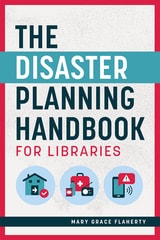
The Disaster Planning Handbook for Libraries
Mary Grace Flaherty
American Library Association, 2021
Your library is a vital information hub and resource provider every single day, and that’s doubly true when calamity strikes. In fact, your library’s role as an “essential community function” during disasters is now encoded in U.S. law. Engaging as a partner in planning and preparedness will build much-needed community support should disaster strike, and even a basic plan will also save you time and stress later on. No matter where your library is in the disaster planning cycle, this handbook will make the process clearer and less daunting. You’ll get tools, activities, easy-to-adapt templates, and hands-on guidance on such topics as
- the six phases of disaster response;
- 15 first-hand accounts of library disaster planning or responses, helping you identify the library services most needed during a disaster;
- three essential factors that will shape the form of your disaster plan;
- preparing for hurricanes, tornadoes, fires, floods, and earthquakes;
- ideas for connecting with your community’s emergency response teams;
- federal government planning resources;
- pointers on working with state and local governments;
- a sample Memorandum of Understanding to outline mutual support for a speedier recovery;
- recommended courses and training, many of which are free;
- targeted advice for archives and special collections;
- sample building inspection checklists; and
- recommended games to help children and families prepare.
The Library Security and Safety Guide to Prevention, Planning, and Response
Miriam B. Kahn
American Library Association, 2008
Transparency for Robots and Autonomous Systems
Fundamentals, technologies and applicationsRobert H. Wortham
The Institution of Engineering and Technology, 2020
We Live with the Sea
Ecologizing Safety in Post-Tsunami JapanAndrew Littlejohn
Duke University Press, 2026