Results by title
7 books match the query 'Saint Petersburg (Russia)'
Beyond the Siege of Leningrad
One Woman’s Life during and after the Occupation: The Recollections of Evdokiia Vasil’evna Baskakova-BogachevaPavel Gavrilov
Central European University Press, 2024
This memoir about the experiences of German occupation during the siege of Leningrad (now Saint Petersburg) was written by Moscow-born Evdokiia Vasil’evna Baskakova-Bogacheva (1888–1976), an émigré in Australia, at the age of eighty-one. The text had been forgotten in the Museum of Russian Culture in San Francisco since 1970 until the editors of this volume discovered it.
In the memoirs, after accounting on her youth spent against the background of the First World War and of the two Russian revolutions of 1917, Evdokiia describes the inferno of the Nazi occupation as experienced in a suburb of Leningrad in 1941-43. She survived for nearly two years almost on the front line, within a few kilometers of the blockade ring. As a medical practitioner, she became useful for the occupational authorities and the ever-shrinking town population, until her family was evacuated to the west in October 1943. Besides hunger, discord, disease, the hunt for food and firewood, along with violence and death, Evdokiia’s account deals with various forms of cooperation between Soviet citizens and the new authorities.
All the events she recalls can be confirmed through other sources. The introduction and the detailed notes to the text help the reader to locate Evdokiia’s recollections in time and place, and situate them in their historical context.
Citizen Countess
Sofia Panina and the Fate of Revolutionary RussiaAdele Lindenmeyr
University of Wisconsin Press, 2019
Based on Adele Lindenmeyr's detailed research in dozens of archival collections, Citizen Countess establishes Sofia Panina as an astute eyewitness to and passionate participant in the historical events that shaped her life. Her experiences shed light on the evolution of the European nobility, women's emancipation and political influence of the time, and the fate of Russian liberalism.
Petersburg/Petersburg
Novel and City, 1900–1921Olga Matich
University of Wisconsin Press, 2010
Since its founding three hundred years ago, the city of Saint Petersburg has captured the imaginations of the most celebrated Russian writers, whose characters map the city by navigating its streets from the aristocratic center to the gritty outskirts. While Tsar Peter the Great planned the streetscapes of Russia’s northern capital as a contrast to the muddy and crooked streets of Moscow, Andrei Bely’s novel Petersburg (1916), a cornerstone of Russian modernism and the culmination of the “Petersburg myth” in Russian culture, takes issue with the city’s premeditated and supposedly rational character in the early twentieth century.
“Petersburg”/Petersburg studies the book and the city against and through each other. It begins with new readings of the novel—as a detective story inspired by bomb-throwing terrorists, as a representation of the aversive emotion of disgust, and as a painterly avant-garde text—stressing the novel’s phantasmagoric and apocalyptic vision of the city. Taking a cue from Petersburg’s narrator, the rest of this volume (and the companion Web site, stpetersburg.berkeley.edu/) explores the city from vantage points that have not been considered before—from its streetcars and iconic art-nouveau office buildings to the slaughterhouse on the city fringes. From poetry and terrorist memoirs, photographs and artwork, maps and guidebooks of that period, the city emerges as a living organism, a dreamworld in flux, and a junction of modernity and modernism.
Petersburg
The Physiology of a CityThomas Gaiton Marullo
Northwestern University Press, 2009
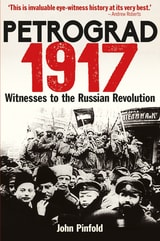
Petrograd, 1917
Witnesses to the Russian RevolutionJohn Pinfold
Bodleian Library Publishing, 2017
Assembling extracts from letters, journals, diaries, and memoirs from a remarkably diverse cast of both Russians and foreign nationals who were there when the revolution broke, Petrograd, 1917 is a strikingly close-up account of these world-shaking events. Each entry is supplemented with a short introductory note that sets it in context, and the book is rounded out with more than seventy illustrations, including photographs of the Romanovs and the violence in the streets as well as propaganda posters, postcards to loved ones, and more. In these pages, the drama and terror of those days comes to life once more, a century on.
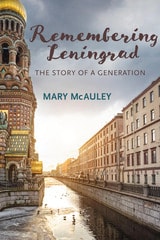
Remembering Leningrad
The Story of a GenerationMary McAuley
University of Wisconsin Press, 2019
Remembering Leningrad captures the story of a beautiful city and lifelong friendships. We follow McAuley as she walks through the streets downtown and examines politics in the 1960s, describes the hazards of furnishing an apartment in the 1990s, and learns about the challenges her friends have faced during these turbulent years. By weaving history and anecdotes to create a picture of Russia’s cultural center, McAuley underscores the impact of time and place on the Russian intelligentsia who lived through the transition from Soviet to post-Soviet life. The result is a remarkable group portrait of a generation.
The Writer in Petrograd and the House of Arts
Martha Weitzel Hickey
Northwestern University Press, 2009