Results by title
3 books match the query 'Salmond, John A.'
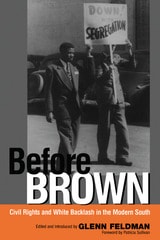
Before Brown
Civil Rights and White Backlash in the Modern SouthGlenn Feldman
University of Alabama Press, 2004
Details the ferment in civil rights that took place across the South before the momentous Brown vs. Board of Education decision in 1954
This collection refutes the notion that the movement began with the Supreme Court decision, and suggests, rather, that the movement originated in the 1930s and earlier, spurred by the Great Depression and, later, World War II—events that would radically shape the course of politics in the South and the nation into the next century.
This work explores the growth of the movement through its various manifestations—the activities of politicians, civil rights leaders, religious figures, labor unionists, and grass-roots activists—throughout the 1940s and 1950s. It discusses the critical leadership roles played by women and offers a new perspective on the relationship between the NAACP and the Communist Party.
Before Brown shows clearly that, as the drive toward racial equality advanced and national political attitudes shifted, the validity of white supremacy came increasingly into question. Institutionalized racism in the South had always offered white citizens material advantages by preserving their economic superiority and making them feel part of a privileged class. When these rewards were threatened by the civil rights movement, a white backlash occurred.
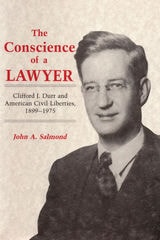
The Conscience of a Lawyer
Clifford J. Durr and American Civil Liberties, 1899–1975John A. Salmond
University of Alabama Press, 1990
A powerful portrait of principle and protest in the life of a Southern lawyer who stood for civil liberties.
Clifford Judkins Durr was an Alabama lawyer who played an important role in defending activists and other accused of disloyalty during the New Deal and McCarthy eras. His uncompromising commitment to civil liberties and civic decency caused him to often take unpopular positions.
In 1933, Durr moved to Washington to work as a lawyer for the Reconstruction Finance Corporation, a creation of Roosevelt’s new Democratic administration, becoming a dedicated New Dealer in the process. He was then appointed by President Franklin D. Roosevelt to the Federal Communications Commission (FCC), a politically sensitive position as FDR sought to counter the increasing power and concentration of broadcasters, many of whom were opponents of the New Deal. Durr resigned from the FCC in 1948 and after brief employment with the National Farmers Union in Colorado, the Durrs eventually returned to Montgomery, Alabama in the hope of returning to a more prosperous, less controversial life.
Durr continued to practice in Montgomery as counsel for black citizens whose rights had been violated and ultimately, in December, 1955, when police arrested Rosa Parks for refusing to give her bus seat to a white man he stepped in and lent his extensive legal prowess to her case and the continuing quest for civil rights. Closing his firm in 1964 Durr began to lecture in the United States and abroad. He died at his grandfather's farm in 1975.
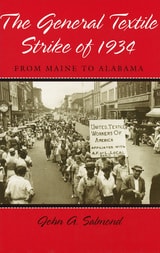
The General Textile Strike of 1934
From Maine to AlabamaJohn A. Salmond
University of Missouri Press, 2002