Results by title
4 books match the query 'Samuel Johnson'
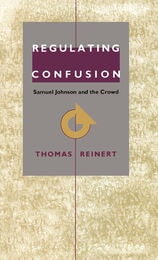
Regulating Confusion
Samuel Johnson and the CrowdThomas Reinert
Duke University Press, 1996
Ambivalent about the disruption, confusion, perplexity, and boundless variety apparent in the London of his day, Johnson was committed to the conventions of moral reflection but also troubled by the pressure to adopt the perspective of the crowd and the language of social theory. Regulating Confusion explores the consequences of his ambivalence and his attempt to order the chaos. It discusses his critique of moral generalizations, concept of moral reflection as a symbolic gesture, and account of what happens to the notion of character when individuals, having lost the support of moral convention, become faces in a crowd. Reflecting generally on the relationship between skepticism and political ideology, Reinert also discusses Johnson’s political skepticism and the forms of speculation and action it authorized.
Challenging prevalent psychologizing and humanistic interpretations, Regulating Confusion leaves behind the re-emergent view of Johnson as a reactionary ideologue and presents him in a theoretically sophisticated context. It offers his style of skepticism as a model of poise in the face of confusion about the nature of political truth and personal responsibility and demonstrates his value as a resource for students of culture struggling with contemporary debates about the relationship between literature and politics.
Samuel Johnson and Moral Discipline
Paul Kent Alkon
Northwestern University Press, 1967

Samuel Johnson
A Survey and Bibliography of Critical StudiesJames L. Clifford and Donald J. Greene
University of Minnesota Press, 1970
Samuel Johnson was first published in 1970. Minnesota Archive Editions uses digital technology to make long-unavailable books once again accessible, and are published unaltered from the original University of Minnesota Press editions.
For anyone interested in the work of Samuel Johnson and his place in eighteenth-century studies, this bibliography will be of great value, for it includes virtually everything of importance that has been written about Johnson from his own lifetime to the present. In addition, Professors Clifford and Greene, in an introductory essay, survey and evaluate the changing attitudes toward Johnson through the entire period covered in the bibliography.
This volume is a revision and enlargement of Professor Clifford's earlier work Johnsonian Studies, 1887–1950: A Survey and Bibliography,long recognized as an indispensable tool for the study of Samuel Johnson, his circle, and his times, and now out of print. The present volume contains nearly four thousand bibliographical entries, grouped under twenty-five subject headings, and arranged chronologically within each classification. This arrangement enables the student to trace the development of the scholarship of the various aspects of Johnson's life and work. A detailed author and subject index to the whole volume makes it easy for him to find the description of the particular book or article for which he is searching.
The Religious Thought of Samuel Johnson
Chester F. Chapin
University of Michigan Press, 1968