Results by title
11 books match the query 'San Antonio (Tex.)'
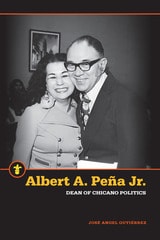
Albert A. Peña Jr.
Dean of Chicano PoliticsJosé Angel Gutiérrez
Michigan State University Press, 2017
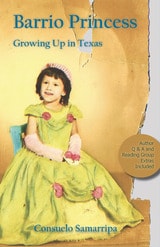
Barrio Princess
Growing Up in TexasConsuelo Samarripa
Parkhurst Brothers, Inc., 2014
"Made in Mexico, born in America," Barrio Princess shares heartwarming family stories, cultural tradition stories, learning English by total immersion, socialization as a minority, education, stories of her mother as a single parent, and women’s stories from a minority point of view.
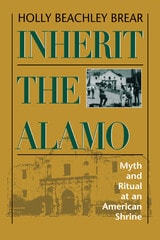
Inherit the Alamo
Myth and Ritual at an American ShrineBy Holly Beachley Brear
University of Texas Press, 1994
Long overshadowed by the towering buildings of downtown San Antonio, the modest little Alamo still evokes tremendous feeling among Texans and, indeed, many other Americans. For Anglo Texans, the Alamo is the "Cradle of Texas Liberty" and a symbolic confirmation of Manifest Destiny. For Hispanic Texans, however, the Alamo has increasingly become a stolen symbol, its origin as a Spanish mission forgotten, its famous defeat used to exclude Hispanics from an honorable place in Texas history.
In this important new book, Holly Beachley Brear explores in fascinating detail what the Alamo means to the numerous groups that lay claim to its heritage. She shows how Alamo myths often diverge from the historical facts—and why. She decodes the agendas of various groups, including the Daughters of the Republic of Texas (who maintain the Alamo buildings and grounds), the Order of the Alamo, the Texas Cavaliers, and LULAC. And she probes attempts by individuals and groups to rewrite the Alamo myth to include more positive roles for themselves, as she explains the value in laying claim to the Alamo's past.
With new perspectives on all the sacred icons of the Alamo and the Fiesta that celebrates (one version of) its history each year, Inherit the Alamo is guaranteed to challenge stereotypes and offer new understanding of the Alamo's ongoing role in shaping Texas and American history and mythology. It will be of interest to a wide popular and scholarly audience.
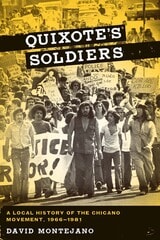
Quixote's Soldiers
A Local History of the Chicano Movement, 1966–1981By David Montejano
University of Texas Press, 2010
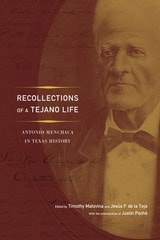
Recollections of a Tejano Life
Antonio Menchaca in Texas HistoryEdited by Timothy Matovina and Jesús F. de la Teja
University of Texas Press, 2013
San Antonio native, military veteran, merchant, and mayor pro tem José Antonio Menchaca (1800–1879) was one of only a few Tejano leaders to leave behind an extensive manuscript of recollections. Portions of the document were published in 1907, followed by a “corrected” edition in 1937, but the complete work could not be published without painstaking reconstruction. At last available in its entirety, Menchaca’s book of reminiscences captures the social life, people, and events that shaped the history of Texas’s tumultuous transformation during his lifetime. Highlighting not only Menchaca’s acclaimed military service but also his vigorous defense of Tejanos’ rights, dignity, and heritage, Recollections of a Tejano Life charts a remarkable legacy while incorporating scholarly commentary to separate fact from fiction.
Revealing how Tejanos perceived themselves and the revolutionary events that defined them, this wonderfully edited volume presents Menchaca’s remembrances of such diverse figures as Antonio López de Santa Anna, Jim Bowie, Davy Crockett, Sam Houston, General Adrián Woll, Comanche chief “Casamiro,” and Texas Ranger Jack Hays. Menchaca and his fellow Tejanos were actively engaged in local struggles as Mexico won her independence from Spain; later many joined the fight to establish the Republic of Texas, only to see it annexed to the United States nine years after the Battle of San Jacinto. This first-person account corrects important misconceptions and brings previously unspoken truths vividly to life.
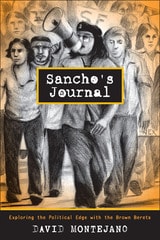
Sancho's Journal
Exploring the Political Edge with the Brown BeretsBy David Montejano
University of Texas Press, 2012
How do people acquire political consciousness, and how does that consciousness transform their behavior? This question launched the scholarly career of David Montejano, whose masterful explorations of the Mexican American experience produced the award-winning books Anglos and Mexicans in the Making of Texas, 1836–1986, a sweeping outline of the changing relations between the two peoples, and Quixote’s Soldiers: A Local History of the Chicano Movement, 1966–1981, a concentrated look at how a social movement “from below” began to sweep away the last vestiges of the segregated social-political order in San Antonio and South Texas. Now in Sancho’s Journal, Montejano revisits the experience that set him on his scholarly quest—“hanging out” as a participant-observer with the South Side Berets of San Antonio as the chapter formed in 1974.
Sancho’s Journal presents a rich ethnography of daily life among the “batos locos” (crazy guys) as they joined the Brown Berets and became associated with the greater Chicano movement. Montejano describes the motivations that brought young men into the group and shows how they learned to link their individual troubles with the larger issues of social inequality and discrimination that the movement sought to redress. He also recounts his own journey as a scholar who came to realize that, before he could tell this street-level story, he had to understand the larger history of Mexican Americans and their struggle for a place in U.S. society. Sancho’s Journal completes that epic story.
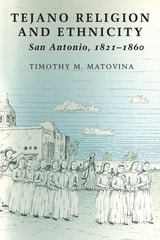
Tejano Religion and Ethnicity
San Antonio, 1821-1860By Timothy M. Matovina
University of Texas Press, 1995
While the flags of Spain, Mexico, the Republic of Texas, and the United States successively flew over San Antonio, its Tejano community (Texans of Spanish or Mexican descent) formed a distinct ethnic identity that persisted despite rapid social and cultural changes. In this pioneering study, Timothy Matovina explores the central role of Tejano Catholicism in forging this unique identity and in binding the community together.
The first book-length treatment of the historical role of religion in a Mexican-origin community in the United States, this study covers three distinct periods in the emergence of Tejano religious and ethnic identity: the Mexican period (1821-1836), the Texas Republic (1836-1845), and the first decade and a half after annexation into the United States (1845-1860). Matovina's research demonstrates how theories of unilateral assimilation are inadequate for understanding the Tejano community, especially in comparison with the experiences of European immigrants to the United States.
As residents of the southwestern United States continue to sort out the legacy of U.S. territorial expansion in the nineteenth century, studies like this one offer crucial understanding of the survival and resilience of Latino cultures in the United States. Tejano Religion and Ethnicity will be of interest to a broad popular and scholarly audience.
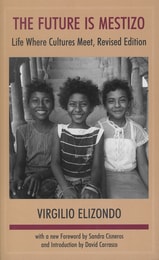
The Future is Mestizo
Life Where Culture Meet, Revised EditionVirgilio Elizondo
University Press of Colorado, 2000
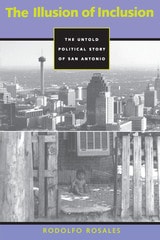
The Illusion of Inclusion
The Untold Political Story of San AntonioBy Rodolfo Rosales
University of Texas Press, 2000
To many observers, the 1981 election of Henry Cisneros as mayor of San Antonio, Texas, represented the culminating victory in the Chicano community's decades-long struggle for inclusion in the city's political life. Yet, nearly twenty years later, inclusion is still largely an illusion for many working-class and poor Chicanas and Chicanos, since business interests continue to set the city's political and economic priorities.
In this book, Rodolfo Rosales offers the first in-depth history of the Chicano community's struggle for inclusion in the political life of San Antonio during the years 1951 to 1991, drawn from interviews with key participants as well as archival research. He focuses on the political and organizational activities of the Chicano middle class in the context of post-World War II municipal reform and how it led ultimately to independent political representation for the Chicano community. Of special interest is his extended discussion of the role of Chicana middle-class women as they gained greater political visibility in the 1980s.
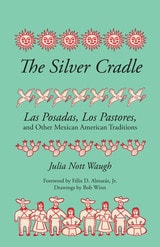
The Silver Cradle
Las Posadas, Los Pastores, and Other Mexican American TraditionsBy Julia Nott Waugh
University of Texas Press, 1955
Originally published in 1955, The Silver Cradle is the story of a year in the life of the Mexican American people of San Antonio, Texas. During the 1950s, Julia Nott Waugh recorded the performances of such seasonal and religious traditions as Las Posadas, Los Pastores, Las Calaveras, the Blessing of the Animals, the liturgical observances of Holy Week, and festivities of el diez y seis de septiembre (Mexican Independence Day), among others.
Although years have passed and many of the details of observances have changed, the festival calendar and the joy and sincerity of the Mexican American people in honoring its customs and obligations have not disappeared. Now, in fact, a much wider population shares and appreciates the pageantry preserved for us by people like Graciana Reyes, in whose prized silver cradle the Christ Child slept every year at Christmas, and like Doroteo Domínguez, whose annual devotion to presenting a thousand-year-old pastoral epic in his back yard was legendary.
Waugh has done much more than just open a window onto a charming past. She has captured for us one of the true gifts of our Mexican American heritage—the willingness to ritually celebrate the passage of time and to embellish the occasions with sensitivity and fervor. This book will appeal to the general reader as well as to those interested in folk traditions and Mexican American culture.
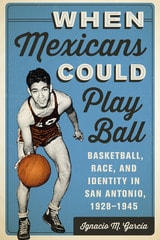
When Mexicans Could Play Ball
Basketball, Race, and Identity in San Antonio, 1928–1945By Ignacio M. García
University of Texas Press, 2014
Winner, Al Lowman Memorial Prize, Texas State Historical Association, 2014
In 1939, a team of short, scrappy kids from a vocational school established specifically for Mexican Americans became the high school basketball champions of San Antonio, Texas. Their win, and the ensuing riot it caused, took place against a backdrop of shifting and conflicted attitudes toward Mexican Americans and American nationalism in the WWII era. “Only when the Mexicans went from perennial runners-up to champs,” García writes, “did the emotions boil over.”
The first sports book to look at Mexican American basketball specifically, When Mexicans Could Play Ball is also a revealing study of racism and cultural identity formation in Texas. Using personal interviews, newspaper articles, and game statistics to create a compelling narrative, as well as drawing on his experience as a sports writer, García takes us into the world of San Antonio’s Sidney Lanier High School basketball team, the Voks, which became a two-time state championship team under head coach William Carson “Nemo” Herrera. An alumnus of the school himself, García investigates the school administrators’ project to Americanize the students, Herrera’s skillful coaching, and the team’s rise to victory despite discrimination and violence from other teams and the world outside of the school. Ultimately, García argues, through their participation and success in basketball at Lanier, the Voks players not only learned how to be American but also taught their white counterparts to question long-held assumptions about Mexican Americans.