Results by title

10 books match the query 'Sanitation'
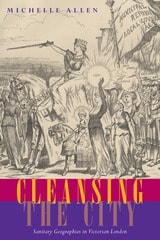
cover of Cleansing the City: Sanitary Geographies in Victorian London

Cleansing the City

Sanitary Geographies in Victorian London

Michelle Allen

Ohio University Press, 2008

Cleansing the City: Sanitary Geographies in Victorian London explores not only the challenges faced by reformers as they strove to clean up an increasingly filthy city but the resistance to their efforts. Beginning in the 1830s, reform-minded citizens, under the banner of sanitary improvement, plunged into London’s dark and dirty spaces and returned with the material they needed to promote public health legislation and magnificent projects of sanitary engineering. Sanitary reform, however, was not always met with unqualified enthusiasm. While some improvements, such as slum clearances, the development of sewerage, and the embankment of the Thames, may have made London a cleaner place to live, these projects also destroyed and reshaped the built environment, and in doing so, altered the meanings and experiences of the city.

From the novels of Charles Dickens and George Gissing to anonymous magazine articles and pamphlets, resistance to reform found expression in the nostalgic appreciation of a threatened urban landscape and anxiety about domestic autonomy in an era of networked sanitary services. Cleansing the City emphasizes the disruptions and disorientation occasioned by purification—a process we are generally inclined to see as positive. By recovering these sometimes oppositional, sometimes ambivalent responses, Michelle Allen elevates a significant undercurrent of Victorian thought into the mainstream and thus provides insight into the contested nature of sanitary modernization.
[more]
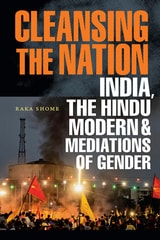
cover of Cleansing the Nation: India, the Hindu Modern, and Mediations of Gender

Cleansing the Nation

India, the Hindu Modern, and Mediations of Gender

Raka Shome

Duke University Press, 2025

In Cleansing the Nation, Raka Shome explores the logics of governmentality of contemporary Hindu nationalism in India by advancing the concept of the “Hindu modern.” Analyzing a national cleanliness program and other development projects, Shome shows how the Hindu modern—a form of national governmentality that disciplines and regulates individual subjects to create desirable “clean” citizens—inscribes Hindu nationalism in India. Focused on security, progress, and development while celebrating and protecting the figure of the upper-caste Hindu woman, the Hindu modern works toward a religious and casteist cleansing of the nation that rewrites Indian modernity as a purified and cleansed Hindu modernity. It shores up caste and religious inequalities around who is authentically Indian, reproducing historical violence against and exclusions of caste, gender, and religion, especially toward Muslims, Dalits, and Adivasis. By outlining how the Hindu modern sutures Hindu-ness to the contemporary Indian national project of modernity, Shome helps us further understand projects of national purification and cleanliness within global populist authoritarian movements.
[more]
cover of Filth: Dirt, Digust, and Modern Life

Filth

Dirt, Digust, and Modern Life

William A. Cohen

University of Minnesota Press, 2004

From floating barges of urban refuse to dung-encrusted works of art, from toxic landfills to dirty movies, filth has become a major presence and a point of volatile contention in modern life. This book explores the question of what filth has to do with culture: what critical role the lost, the rejected, the abject, and the dirty play in social management and identity formation. It suggests the ongoing power of culturally mandated categories of exclusion and repression.Focusing on filth in literary and cultural materials from London, Paris, and their colonial outposts in the nineteenth and early twentieth centuries, the essays in Filth, all but one previously unpublished, range over topics as diverse as the building of sewers in nineteenth-century European metropolises, the link between interior design and bourgeois sanitary phobias, fictional representations of laboring women and foreigners as polluting, and relations among disease, disorder, and sexual-racial disharmony. Filth provides the first sustained consideration, both theoretical and historical, of a subject whose power to horrify, fascinate, and repel is as old as civilization itself.Contributors: David S. Barnes, U of Pennsylvania; Neil Blackadder, Knox College; Joseph Bristow, U of California, Los Angeles; Joseph W. Childers, U of California, Riverside; Eileen Cleere, Southwestern U; Natalka Freeland, U of California, Irvine; Pamela K. Gilbert, U of Florida; Christopher Hamlin, U of Notre Dame; William Kupinse, U of Puget Sound; Benjamin Lazier, U of Chicago; David L. Pike, American U; David Trotter, U of Cambridge.William A. Cohen is associate professor of English at the University of Maryland and the author of Sex Scandal: The Private Parts of Victorian Fiction.Ryan Johnson is completing his Ph.D. in the Department of English at Stanford University, where he has served as general editor of the Stanford Humanities Review.
[more]
cover of Genius Belabored: Childbed Fever and the Tragic Life of Ignaz Semmelweis

Genius Belabored

Childbed Fever and the Tragic Life of Ignaz Semmelweis

Theodore G. Obenchain

University of Alabama Press, 2016

The fascinating story of Ignaz Semmelweis, a nineteenth-century obstetrician ostracized for his strident advocacy of disinfection as a way to prevent childbed fever.

In Genius Belabored: Childbed Fever and the Tragic Life of Ignaz Semmelweis, Theodore G. Obenchain traces the life story of a nineteenth-century Hungarian obstetrician who was shunned and marginalized by the medical establishment for advancing a far-sighted but unorthodox solution to the appalling mortality rates that plagued new mothers of the day.

In engrossing detail, Obenchain recreates for readers the sights, smells, and activities within a hospital of that day. In an era before the acceptance of modern germ science, physicians saw little need for cleanliness or hygiene. As a consequence, antiseptic measures were lax and rudimentary. Especially vulnerable to contamination were new mothers, who frequently contracted and died from childbed fever (puerperal fever). Genius Belabored follows Semmelweis’s awakening to the insight that many of these deaths could be avoided with basic antiseptic measures like hand washing.

The medical establishment, intellectually unprepared for Semmelweis’s prescient hypothesis, rejected it for a number of reasons. It was unorthodox and went against the lingering Christian tradition that the dangers of childbirth were inherent to the lives of women. Complicating matters, colleagues did not consider Semmelweis an easy physician to work with. His peers described him as strange and eccentric. Obenchain offers an empathetic and insightful argument that Semmelweis suffered from bipolar disorder and illuminates how his colleagues, however dedicated to empirical science they might have been, misjudged Semmelweis’s methods based upon ignorance and their emotional discomfort with him.

In Genius Belabored, Obenchain identifies Semmelweis’s rightful place in the pantheon of scientists and physicians whose discoveries have saved the lives of millions. Obenchain’s biography of Semmelweis offers unique insights into the practice of medicine and the mindsets of physicians working in the premodern era. This fascinating study offers much of interest to general readers as well as those interested in germ theory, the history of medicine and obstetrics, or anyone wishing to better understand the trajectory of modern medicine.
[more]
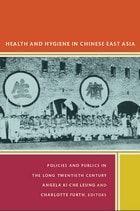
cover of Health and Hygiene in Chinese East Asia: Policies and Publics in the Long Twentieth Century

Health and Hygiene in Chinese East Asia

Policies and Publics in the Long Twentieth Century

Angela Ki Che Leung and Charlotte Furth, eds.

Duke University Press, 2010

This collection expands the history of colonial medicine and public health by exploring efforts to overcome disease and improve human health in Chinese regions of East Asia from the late nineteenth century to the present. The contributors consider the science and politics of public health policymaking and implementation in Taiwan, Manchuria, Hong Kong, and the Yangzi River delta, focusing mostly on towns and villages rather than cities. Whether discussing the resistance of lay midwives in colonial Taiwan to the Japanese campaign to replace them with experts in “scientific motherhood” or the reaction of British colonists in Shanghai to Chinese diet and health regimes, they illuminate the effects of foreign interventions and influences on particular situations and localities. They discuss responses to epidemics from the plague in early-twentieth-century Manchuria to SARS in southern China, Singapore, and Taiwan, but they also emphasize that public health is not just about epidemic crises. As essays on marsh drainage in Taiwan, the enforcement of sanitary ordinances in Shanghai, and vaccination drives in Manchuria show, throughout the twentieth century public health bureaucracies have primarily been engaged in the mundane activities of education, prevention, and monitoring.

Contributors. Warwick Anderson, Charlotte Furth, Marta E. Hanson, Sean Hsiang-lin Lei, Angela Ki Che Leung, Shang-Jen Li, Yushang Li, Yi-Ping Lin, Shiyung Liu, Ruth Rogaski, Yen-Fen Tseng, Chia-ling Wu, Xinzhong Yu
[more]
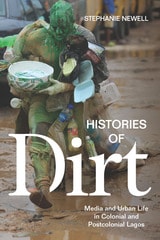
cover of Histories of Dirt: Media and Urban Life in Colonial and Postcolonial Lagos

Histories of Dirt

Media and Urban Life in Colonial and Postcolonial Lagos

Stephanie Newell

Duke University Press, 2020

In Histories of Dirt Stephanie Newell traces the ways in which urban spaces and urban dwellers come to be regarded as dirty, as exemplified in colonial and postcolonial Lagos. Newell conceives dirt as an interpretive category that facilitates moral, sanitary, economic, and aesthetic evaluations of other cultures under the rubric of uncleanliness. She examines a number of texts ranging from newspaper articles by elite Lagosians to colonial travel writing, public health films, and urban planning to show how understandings of dirt came to structure colonial governance. Seeing Lagosians as sources of contagion and dirt, British colonizers used racist ideologies and discourses of dirt to justify racial segregation and public health policies. Newell also explores possibilities for non-Eurocentric methods for identifying African urbanites’ own values and opinions by foregrounding the voices of contemporary Lagosians through interviews and focus groups in which their responses to public health issues reflect local aesthetic tastes and values. In excavating the shifting role of dirt in structuring social and political life in Lagos, Newell provides new understandings of colonial and postcolonial urban history in West Africa.
[more]
cover of The Sanitary Arts: Aesthetic Culture and the Victorian Cleanliness Campaigns

The Sanitary Arts

Aesthetic Culture and the Victorian Cleanliness Campaigns

Eileen Cleere

The Ohio State University Press, 2014

Eileen Cleere argues in this interdisciplinary study that mid-century discoveries about hygiene and cleanliness not only influenced public health, civic planning, and medical practice but also powerfully reshaped the aesthetic values of the British middle class. By focusing on paintings, domestic architecture, and interior design, The Sanitary Arts: Aesthetic Culture and the Victorian Cleanliness Campaigns shows that the “sanitary aesthetic” significantly transformed the taste of the British public over the nineteenth century by equating robust health and cleanliness with new definitions of beauty and new experiences of aisthesis. Covering everything from connoisseurs to custodians, Cleere demonstrates that Victorian art critics, engineers, and architects—and even novelists from George Eliot to Charles Dickens, Charlotte Mary Young to Sarah Grand—all participated in a vital cultural debate over hygiene, cleanliness, and aesthetic enlightenment.
 
The Sanitary Arts covers the mid-forties controversy over cleaning the dirt from the pictures in the National Gallery, the debate over decorative “dust traps” in the overstuffed Victorian home, and the late-century proliferation of hygienic breeding principles as a program of aesthetic perfectibility, to demonstrate the unintentionally collaborative work of seemingly unrelated events and discourses. Bringing figures like Edwin Chadwick and John Ruskin into close conversation about the sanitary status of beauty in a variety of forms and environments, Cleere forcefully demonstrates that aesthetic development and scientific discovery can no longer be understood as separate or discrete forces of cultural change.
[more]
cover of The Sanitation of Brazil: Nation, State, and Public Health, 1889-1930

The Sanitation of Brazil

Nation, State, and Public Health, 1889-1930

Gilberto Hochman

University of Illinois Press, 2016
Celebrated as a major work since its original publication, The Sanitation of Brazil traces how rural health and sanitation policies influenced the formation of Brazil's national public health system. Gilberto Hochman's pioneering study examines the ideological, social and political forces that approached questions of health and government action. The era from 1910 to 1930 offered unique opportunities for public health reform, and Hochman examines its successes and failures. He looks at how health became a state concern, tying the emergence of public health policies to a nationalistic movement and to a convergence of the elites' social consciousness with their political and material interests. Politicians weighed the costs and benefits of state-run public health versus the burdens imposed by disease. Physicians and intellectuals, meanwhile, swayed them with warnings that endemic disease and official neglect might affect everyone--rich and poor, rural and urban, interior and coastal--if left unchecked. The book shows how disease and health were and are associated with nation-state building in Brazil.
[more]
cover of Urban Saniscapes: Slums, Housing and Everyday Sanitation in  Accra and Nairobi, 1908–1963

Urban Saniscapes

Slums, Housing and Everyday Sanitation in Accra and Nairobi, 1908–1963

Waseem-Ahmed Bin-Kasim

Michigan State University Press, 2025

In this comparative study, Bin-Kasim examines environmental sanitation in the historical development of Accra and Nairobi, the capitals of the Gold Coast (Ghana) and Kenya. This book traces the approaches to sanitation during colonial rule and urban growth throughout the first half of the twentieth century and beyond. From the consolidation of the colonial regimes to the Great Depression, urbanization waves, and postwar development, sanitation was both a cause and a consequence of the built environment. Bin-Kasim characterizes this complex relationship between sanitation and urban growth over time as the 'saniscape.' The saniscape is the confluence of public health, planning interventions, and various urban constituencies, and includes an array of influences like colonial expertise and African industry, which shaped the two cities regardless of their power dynamics and land tenure. Attention to the saniscape validates how Africans called out colonial discrimination and inefficiencies to intervene and shape cities. This volume highlights the shared histories of Accra and Nairobi and upends conventional narratives that attach too much difference to non-settler and settler colonialism.
[more]
cover of Waste Works: Vital Politics in Urban Ghana

Waste Works

Vital Politics in Urban Ghana

Brenda Chalfin

Duke University Press, 2023

In Waste Works, Brenda Chalfin examines Ghana’s planned city of Tema, theorizing about the formative role of waste infrastructure in urban politics and public life. Chalfin argues that at Tema’s midcentury founding, a prime objective of governing authorities was to cultivate self-contained citizens by means of tightly orchestrated domestic infrastructure and centralized control of bodily excrement to both develop and depoliticize the new nation. Comparing infrastructural innovations across the city, Chalfin excavates how Tema residents pursue novel approaches to urban waste and sanitation built on the ruins of the inherited order, profoundly altering the urban public sphere. Once decreed a private matter to be guaranteed by state authorities, excrement becomes a public issue, collectively managed by private persons. Pushing self-care into public space and extending domestic responsibility for public well-being and bodily outputs, popularly devised waste infrastructures are a decisive arena to make claims, build coalitions, and cultivate status. Confounding high-modernist ideals, excremental infrastructures unlock bodily waste’s diverse political potentials.
[more]