Results by title
6 books match the query 'Saudi Arabia'
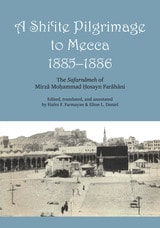
A Shi'ite Pilgrimage to Mecca, 1885-1886
The Safarnâmeh of Mirzâ Mo?ammad ?osayn FarâhâniBy Mirzâ Farâhâni
University of Texas Press, 1990
Western accounts of the Hajj, the ritual Muslim pilgrimage to Mecca, are rare, since access to Mecca is forbidden to non-Muslims. In the Muslim world, however, pilgrimage literature is a well-established genre, dating back to the earliest centuries of the Islamic era. A Shiʿite Pilgrimage to Mecca is taken from the original nineteenth-century Persian manuscript of the Safarnâmeh of Mirzâ Moḥammad Ḥosayn Farâhâni, a well-educated, keenly observant, Iranian Shiʿite gentleman.
This memoir holds a wealth of social and economic information about Czarist Russia, the Ottoman Empire, Egypt, Northern Iran, and Arabia. The author is a meticulous observer, recording details of distances, currencies, accommodations, modes of travel, and so on. He records the experiences encountered by pilgrims of his day: physical hardships, disease, generosity and compassion, banditry, hospitality, comradeship, and exaltation. And, without prejudice, he discusses the tensions between the Shiʿites and the Sunnites in the holy places—tensions that still exist and have erupted in bloody clashes during recent pilgrimages.
A Shiʿite Pilgrimage to Mecca will appeal to a wide audience of general readers, Middle Eastern scholars, anthropologists, and historians.

Hend and the Soldiers
By Badriah Albeshr, translated by Sanna Dhahir
University of Texas Press, 2017
Hend is a young Saudi Arabian woman struggling to challenge her conservative society, which is represented by various soldiers, real and metaphorical, in her life. After a failed arranged marriage to an army officer, she is determined to establish herself as a writer and make her own choices in love. Her mother, a firm supporter of their society’s traditional norms, works to block her efforts. As Hend engages with her mother, stories of her past and those of other female relatives reveal the extent of the suffering previous generations of women have endured while living in such a patriarchal society. Hend also comes to understand how such traditions have adversely affected the men in her family, including one brother who flees to the West and another who finds comradeship among the members of al-Qaeda.
Badriah Albeshr represents a growing number of women writers from the Arabian Peninsula who refuse to shy away from the taboo topics of religion and sexuality, which makes Hend and the Soldiers a valuable read for those seeking insights into the complexities surrounding these issues.
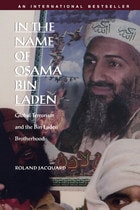
In the Name of Osama Bin Laden
Global Terrorism and the Bin Laden BrotherhoodRoland Jacquard
Duke University Press, 2002
International terrorism expert Roland Jacquard’s In the Name of Osama bin Laden presents a dramatic portrait of the world's most wanted terrorist and his extensive brotherhood--the network of people who operate “in his name.” Published originally in France the very week of September 11, as events in the United States shook the world, the book has become an international bestseller.
Jacquard details how bin Laden became an international emblem of fundamentalist, pan-Islamic, anti-U.S. fervor and the leader of a brotherhood so passionate that devotees who have never met him will act autonomously in his name. The author explains the global character of bin Laden’s organization, elaborating the extent of his sphere of influence in Europe and Asia. Jacquard reveals the construction of bin Laden’s networks—including a profile of his inner circle—and their collaboration with overlapping webs of banking, drug trafficking, religious, and terrorist organizations. He considers the brotherhood’s access to biological, chemical, and nuclear weapons and warns that, with or without bin Laden, this global terrorist force will remain a threat.
Now in English, this edition has been substantially updated in light of recent world events and expanded to include previously unpublished materials, featuring a new introduction and afterword. New documents include an April 2001 interview by the author with bin Laden; a September 24 proclamation by bin Laden to Muslims in Pakistan; and a key page from Dr. Ayman al-Zawahiri’s book justifying eternal jihad, which was smuggled out of Afghanistan in October 2001.
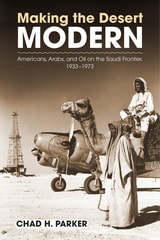
Making the Desert Modern
Americans, Arabs, and Oil on the Saudi Frontier, 1933–1973Chad Parker
University of Massachusetts Press, 2015
In 1933 American oilmen representing what later became the Arabian American Oil Company (Aramco) signed a concession agreement with the Saudi Arabian king granting the company sole proprietorship over the oil reserves in the country's largest province. As drilling commenced and wells proliferated, Aramco soon became a major presence in the region. In this book Chad H. Parker tells Aramco's story, showing how an American company seeking resources and profits not only contributed to Saudi “nation building” but helped define U.S. foreign policy during the early Cold War.
In the years following World War II, as Aramco expanded its role in Saudi Arabia, the idea of “modernization” emerged as a central component of American foreign policy toward newly independent states. Although the company engaged in practices supportive of U.S. goals, its own modernizing efforts tended to be pragmatic rather than policy-driven, more consistent with furthering its business interests than with validating abstract theories. Aramco built the infrastructure necessary to extract oil and also carved an American suburb out of the Arabian desert, with all the air-conditioned comforts of Western modern life. At the same time, executives cultivated powerful relationships with Saudi government officials and, to the annoyance of U.S. officials, even served the monarchy in diplomatic disputes. Before long the company became the principal American diplomatic, political, and cultural agent in the country, a role it would continue to play until 1973, when the Saudi government took over its operation.
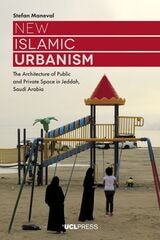
New Islamic Urbanism
The Architecture of Public and Private Space in Jeddah, Saudi ArabiaStefan Maneval
University College London, 2019
Combining Michael Warner’s concepts of publics and counterpublics with theories of space and sociological approaches to architecture, Stefan Maneval explores the concept of New Islamic Urbanism in Saudi Arabia, arguing that this architectural trend, which is characterized by an emphasis on privacy protection through high enclosures, gates, blinds, and tinted windows, constitutes for some an important element of piety. At the same time, it enables different conceptions of privacy, banned social practices, as well as the formation of publics and counterpublics.
Based on rich ethnographic data collected by the author, New Islamic Urbanism challenges normative assumptions on gender segregation in Muslim societies and provides a nuanced account of the meaning of publicness and privacy in Muslim contexts in general. It will be of particular interest to an academic readership in Middle East and Islamic studies, as well as in architecture, urban planning and anthropology.

The Islamic Utopia
The Illusion of Reform in Saudi ArabiaAndrew Hammond
Pluto Press, 2012
Will Saudi Arabia join the democratic wave in the Middle East? The uprisings and revolutions of 2011 do not, yet, seem to have affected the stability of the House of Saud, which remains secretive, highly repressive and propped up by the West.
The Islamic Utopia uses a range of sources including first-hand reporting and recently released WikiLeaks documents to examine Saudi Arabia in the decade after the 9/11 attacks, when King Abdullah’s 'reform' agenda took centre stage in public debate. It considers Saudi claims of 'exemption' from the democratic demands of the Arab Spring.
Andrew Hammond argues that for too long Western media and governments have accepted Saudi leaders' claims to be a buttress against jihadist Islam and that a new policy is needed towards the House of Saud.