Results by title
16 books match the query 'Scandal'

Blood Ties
Sex, Scandal, and Serial Murder at the Turn of the Twentieth CenturyHarold Schechter
University of Iowa Press, 2027
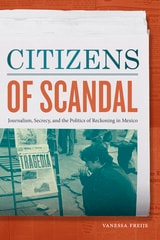
Citizens of Scandal
Journalism, Secrecy, and the Politics of Reckoning in MexicoVanessa Freije
Duke University Press, 2020
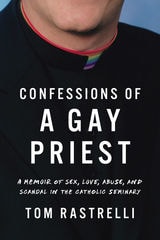
Confessions of a Gay Priest
A Memoir of Sex, Love, Abuse, and Scandal in the Catholic SeminaryTom Rastrelli
University of Iowa Press, 2020
Tom Rastrelli is a survivor of clergy-perpetrated sexual abuse who then became a priest in the early days of the Catholic Church’s ongoing scandals. Confessions of a Gay Priest divulges the clandestine inner workings of the seminary, providing an intimate and unapologetic look into the psychosexual and spiritual dynamics of celibacy and lays bare the “formation” system that perpetuates the cycle of abuse and cover-up that continues today.
Under the guidance of a charismatic college campus minister, Rastrelli sought to reconcile his homosexuality and childhood sexual abuse. When he felt called to the priesthood, Rastrelli began the process of “priestly discernment.” Priests welcomed him into a confusing clerical culture where public displays of piety, celibacy, and homophobia masked a closeted underworld in which elder priests preyed upon young recruits.
From there he ventured deeper into the seminary system seeking healing, hoping to help others, and striving not to live a double life. Trained to treat sexuality like an addiction, he and his brother seminarians lived in a world of cliques, competition, self-loathing, alcohol, hidden crushes, and closeted sex. Ultimately, the “formation” intended to make Rastrelli a compliant priest helped to liberate him.
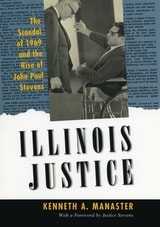
Illinois Justice
The Scandal of 1969 and the Rise of John Paul StevensKenneth A. Manaster
University of Chicago Press, 2001
In 1969, citizen gadfly Sherman Skolnick accused two Illinois Supreme Court justices of accepting valuable bank stock from an influential Chicago lawyer in exchange for deciding an important case in the lawyer’s favor. The resulting feverish media coverage prompted the state supreme court to appoint a special commission to investigate. Within six weeks and on a shoestring budget, the commission mobilized a small volunteer staff to reveal the facts. Stevens, then a relatively unknown Chicago lawyer, served as chief counsel. His work on this investigation would launch him into the public spotlight and onto the bench.
Manaster, who served on the commission, tells the real story of the investigation, detailing the dead ends, tactics, and triumphs. Manaster expertly traces Stevens’s masterful courtroom strategies and vividly portrays the high-profile personalities involved, as well as the subtleties of judicial corruption. A reflective foreword by Justice Stevens himself looks back at the case and how it influenced his career.
Now the subject of the documentary Unexpected Justice: The Rise of John Paul Stevens, Manaster’s book is both a fascinating chapter of political history and a revealing portrait of the early career of a Supreme Court justice.
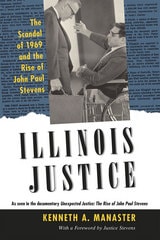
Illinois Justice
The Scandal of 1969 and the Rise of John Paul StevensKenneth A. Manaster
University of Chicago Press, 2001
In 1969, citizen gadfly Sherman Skolnick accused two Illinois Supreme Court justices of accepting valuable bank stock from an influential Chicago lawyer in exchange for deciding an important case in the lawyer’s favor. The resulting feverish media coverage prompted the state supreme court to appoint a special commission to investigate. Within six weeks and on a shoestring budget, the commission mobilized a small volunteer staff to reveal the facts. Stevens, then a relatively unknown Chicago lawyer, served as chief counsel. His work on this investigation would launch him into the public spotlight and onto the bench.
Manaster, who served on the commission, tells the real story of the investigation, detailing the dead ends, tactics, and triumphs. Manaster expertly traces Stevens’s masterful courtroom strategies and vividly portrays the high-profile personalities involved, as well as the subtleties of judicial corruption. A reflective foreword by Justice Stevens himself looks back at the case and how it influenced his career.
Now the subject of the documentary Unexpected Justice: The Rise of John Paul Stevens, Manaster’s book is both a fascinating chapter of political history and a revealing portrait of the early career of a Supreme Court justice.

Interrogating Integration
Sport, Celebrity, and Scandal in the Making of New GermanyKate Zambon
University of Michigan Press, 2025
Using touchstones of public memory, including events surrounding men’s World Cup soccer and the record-breaking success of a book blaming Muslims for Germany’s decline, Zambon examines persistent problems in European conceptions of race, where racializing projects take place under an “ideology of racelessness” and the atrocities of historical and transnational racisms are used to deny current local forms of racism.
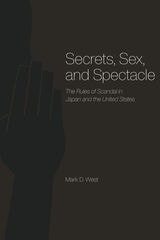
Secrets, Sex, and Spectacle
The Rules of Scandal in Japan and the United StatesMark D. West
University of Chicago Press, 2006
A leader of a global superpower is betrayed by his mistress, who makes public the sordid details of their secret affair. His wife stands by as he denies the charges. Debates over definitions of moral leadership ensue. Sound familiar? If you guessed Clinton and Lewinsky, try again. This incident involved former Japanese prime minister Sosuke Uno and a geisha.
In Secrets, Sex, and Spectacle, Mark D. West organizes the seemingly random worlds of Japanese and American scandal—from corporate fraud to baseball cheaters, political corruption to celebrity sexcapades—to explore well-ingrained similarities and contrasts in law and society. In Japan and the United States, legal and organizational rules tell us what kind of behavior is considered scandalous. When Japanese and American scandal stories differ, those rules—rules that define what’s public and what’s private, rules that protect injuries to dignity and honor, and rules about sex, to name a few—often help explain the differences. In the cases of Clinton and Uno, the rules help explain why the media didn’t cover Uno’s affair, why Uno’s wife apologized on her husband’s behalf, and why Uno—and not Clinton—resigned.
Secrets, Sex, and Spectacle offers a novel approach to viewing the phenomenon of scandal—one that will be applauded by anyone who has obsessed over (or ridiculed) these public episodes.
Sex Trafficking, Scandal, and the Transformation of Journalism, 1885-1917
Gretchen Soderlund
University of Chicago Press, 2013
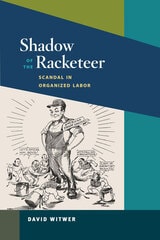
Shadow of the Racketeer
Scandal in Organized LaborDavid Witwer
University of Illinois Press, 2008
From a behind-the-scenes perspective, David Witwer describes how Pegler and his publisher, the politically powerful Roy W. Howard, shaped the news coverage of this scandal in ways that obscured the corrupt ties between employers and the mob while emphasizing the perceived menace of union leaders empowered by New Deal legislation that had legitimized organized labor. Pegler, Howard, and the rest of the mainstream press pointedly ignored evidence of the active role that business leaders took in the corruption, which badly tarnished the newly reborn labor movement.
Because he was more concerned with pursuing political gains for the conservative movement, Pegler's investigative journalism did little to reform union governance or organized crime's influence on labor unions. The union corruption scandal only undercut the labor movement. Pegler's continuing campaign against labor corruption framed the issue in ways that set the stage for postwar political defeats, culminating with the 1947 Taft-Hartley Act, which greatly limited the power of labor unions in the United States.
Demonstrating clearly and convincingly how journalism is wielded as a political weapon, Witwer studies a broad range of forces at play in the labor union scandal and its impact, including the influence of the press, organized crime, political corruption, and businessmen following their own economic imperatives.
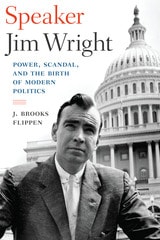
Speaker Jim Wright
Power, Scandal, and the Birth of Modern PoliticsBy J. Brooks Flippen
University of Texas Press, 2018
Honorable Mention, Ramirez Family Award for Most Significant Scholarly Book, Texas Institute of Letters, 2019
Jim Wright made his mark on virtually every major public policy issue in the later twentieth century—energy, education, taxes, transportation, environmental protection, civil rights, criminal justice, and foreign relations, among them. He played a significant role in peace initiatives in Central America and in the Camp David Accords, and he was the first American politician to speak live on Soviet television. A Democrat representing Texas’s twelfth district (Fort Worth), Wright served in the US House of Representatives from the Eisenhower administration to the presidency of George H. W. Bush, including twelve years (1977–1989) as majority leader and speaker. His long congressional ascension and sudden fall in a highly partisan ethics scandal spearheaded by Newt Gingrich mirrored the evolution of Congress as an institution.
Speaker Jim Wright traces the congressman’s long life and career in a highly readable narrative grounded in extensive interviews with Wright and access to his personal diaries. A skilled connector who bridged the conservative and liberal wings of the Democratic party while forging alliances with Republicans to pass legislation, Wright ultimately fell victim to a new era of political infighting, as well as to his own hubris and mistakes. J. Brooks Flippen shows how Wright’s career shaped the political culture of Congress, from its internal rules and power structure to its growing partisanship, even as those new dynamics eventually contributed to his political demise. To understand Jim Wright in all his complexity is to understand the story of modern American politics.
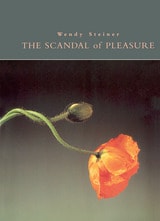
The Scandal of Pleasure
Art in an Age of FundamentalismWendy Steiner
University of Chicago Press, 1995
"Stimulating. . . . A splendid rebuttal of those on the left and right who think that the pleasures induced by art are trivial or dangerous. . . . One of the most powerful defenses of the potentiality of art."—Andrew Delbanco, New York Times Book Review
"A concise and . . . readable account of recent contretemps that have galvanized the debate over the role and purposes of art. . . . [Steiner] writes passionately about what she believes in."—Michiko Kakutani, New York Times
"This is one of the few works of cultural criticism that is actually intelligible to the nonspecialist reader. . . . Steiner's perspective is fresh and her perceptions invariably shrewd, far-ranging, and reasonable. A welcome association of sense and sensibility."—Kirkus Reviews, starred review
"Steiner has succeeded so well in [the] task she has undertaken. The Scandal of Pleasure is itself characterized by many of the qualities Steiner demans of art, among them, complexity, tolerance and the pleasures of unfettered thought."—Eleanor Heartly, Art in America
"Steiner . . . provides the best and clearest short presentation of each of [the] debates."—Alexander Nehamas, Boston Book Review
"Steiner has done a fine job as a historian/reporter and as a writer of sophisticated, very clear, cultural criticism. Her reportage alone would be enough to make this a distinguished book."—Mark Edmundson, Lingua Franca
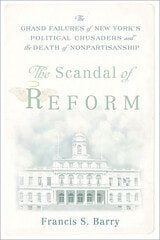
The Scandal of Reform
The Grand Failures of New York's Political Crusaders and the Death of NonpartisanshipBarry, Francis S
Rutgers University Press, 2009
The Scandal of Reform pulls the curtain back on New York's reformers past and present, revealing the bonds they have always shared with the bosses they disdain, the policy failures they still refuse to recognize, and the transition they have made from nonpartisan outsiders to ideological insiders.
Francis S. Barry examines the evolution of political reform from the frontlines of New York City's recent reform wars. He offers an insider's account and analysis of the controversial 2003 referendum debate on nonpartisan elections, and he challenges reformersùand members of both partiesùto reconsider their faith in reforms that are no longer serving the public interest.

The Scandal of the Fabliaux
R. Howard Bloch
University of Chicago Press, 1986
By showing how the medieval poet's obsession with the outrageous, the low, and the lewd was intimately bound to poetry, Bloch forces a revision of traditional approaches to Old French literature. His final chapter, on castration anxiety, fetishism, and the comic, links the fabliaux with the development of modern notions of the self and makes a case for the medieval roots of our own sense of humor.
The Scandal of the State
Women, Law, and Citizenship in Postcolonial IndiaRajeswari Sunder Rajan
Duke University Press, 2003
The Scandal of the State develops through a series of compelling case studies, each of which centers around an incident exposing the contradictory position of the Indian state vis-à-vis its female citizens and, ultimately, the inadequacy of its commitment to women’s rights. Sunder Rajan focuses on the custody battle over a Muslim child bride, the compulsory sterilization of mentally retarded women in state institutional care, female infanticide in Tamilnadu, prostitution as labor rather than crime, and the surrender of the female outlaw Phoolan Devi. She also looks at the ways the Uniform Civil Code presented many women with a stark choice between allegiance to their religion and community or the secular assertion of individual rights. Rich with theoretical acumen and activist passion, The Scandal of the State is a powerful critique of the mutual dependence of women and the state on one another in the specific context of a postcolonial modernity.
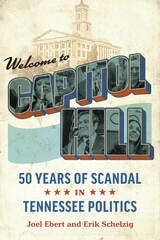
Welcome to Capitol Hill
Fifty Years of Scandal in Tennessee PoliticsJoel Ebert and Erik Schelzig
Vanderbilt University Press, 2023
Veteran political reporters Joel Ebert and Erik Schelzig draw from interviews, archival documents, and never-before-seen federal investigative files to provide readers with a handy resource about the wrongdoings of our elected officials.

Welcome to Capitol Hill
Fifty Years of Scandal in Tennessee PoliticsJoel Ebert and Erik Schelzig
Vanderbilt University Press, 2024
Veteran political reporters Joel Ebert and Erik Schelzig draw from interviews, archival documents, and never-before-seen federal investigative files to provide readers with a handy resource about the wrongdoings of our elected officials.