Results by title
4 books match the query 'Schlegel, Rob'
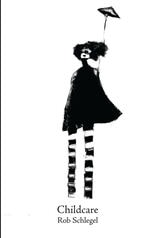
Childcare
Rob Schlegel
Four Way Books, 2023
Crackling with the hypervigilance of parenthood, Childcare explores the paradox at the root of raising kids: the joy of new life accompanies an awareness of potential loss. Rob Schlegel’s fourth collection observes the tangled emotions of fatherhood; even as he wonders at the strange intelligence of youth, he elegizes the present moment. The longitudinal wisdom of this collection appears in the choreography of its leaps — how it moves from the aside “[My son] needs my love the most when he least deserves it / Is something I read” to the reflection that “Death / Names my shape. I keep my clothes / From dust and ghosts and time. / I’m angry at my father for aging.” From Schlegel’s relentless curiosity and keen observations, the artistic crisis driving the book emerges: does poetry memorialize the ephemeral moment, saving something for us, or does it remove us from experience? The duality of language’s role — that it, ultimately, has the capacity to do both — doubles the significance of “childcare” in this collection, which comes to represent not just the work of child rearing but the dutiful care by adult children for their parents. Perhaps nothing can convey the scope and quality of family life like the concatenated dependencies of “(Un)conditional,” which terminate here: “If the cut draws blood / If life ends in desire // If it begins in love.”
In the Tree Where the Double Sex Sleeps
Rob Schlegel
University of Iowa Press, 2019
Inventory
Rob Schlegel
University of Chicago Press, 0
A book-length poem serving as a son’s elegy for his late father, an artist and forest steward.
Rob Schlegel’s long poem Inventory emerges from three discrete inventories the poet must catalog in the aftermath of a sudden loss: a selection of his father’s art to be organized for a posthumous exhibition, two hundred acres of trees in a forest stewarded by his father in western Oregon, and his own emotional landscape in the aftermath of his father’s death. As Schlegel moves through these collections of objects and emotions, he learns how to navigate grief. His father’s paintings act as an inventory of the poet’s own life, with each landscape recalling a moment in time, each sketch holding a story. Celebrating a close relationship while mourning its loss, Schlegel reflects on the ties between art and grief, parents and children, people and trees.
At the time of his father’s death, an extreme heatwave was moving across the region, broadening the scope of grief from the personal and familial to encompass tragedies on a larger scale. Social disintegration and climate disaster weave through the lives of a family in mourning as they navigate the complexity of how to sit with loss, change, love, and art. Through quiet, measured verse and arresting simplicity, Inventory extends the ekphrastic tradition into a contemporary elegy rich in both profound sadness and optimism for the future.
The Lesser Fields
Rob Schlegel
University Press of Colorado, 2009
Published by the Center for Literary Publishing at Colorado State University