Results by title
16 books match the query 'Scholarly publishing'
Becoming an Expert Writer
A Holistic Guide to Writing for PublicationDana Lynn Driscoll
University Press of Colorado, 2026
In Becoming an Expert Writer, Dana Lynn Driscoll explores the core concepts that create publication expertise. Informed by groundbreaking studies of successful emerging and expert writers as they seek to publish their work, this research-based guide illuminates the often-invisible dimensions of writing for publication. Driscoll describes strategies that move beyond conventional advice, allowing writers to craft a holistic process and relationship with their work. Each chapter integrates empirical research with reflective and practical activities, guiding writers from idea generation and flow to identity development and mentoring. The result is a transformative resource for developing sustainable, meaningful, and expert writing practices.
Behind the Curtain of Scholarly Publishing
Editors in Writing StudiesGreg Giberson
Utah State University Press, 2022
Each chapter in the collection examines the unique experiences and individual contributions of its authors during their time as editors, offering advice to scholars and potential editors on how to navigate the publication process and understand editorial roles. The contributors provide multiple perspectives on the growth, transformation, and, in some cases, founding of some of the most influential publishing venues in writing studies.
The personal and historical narratives, along with the unique perspectives and insightful analyses of the individual authors in Behind the Curtain of Scholarly Publishing, offer needed transparency and context to what has historically been an opaque, yet inevitable and consequential, part of academic life. This volume will help researchers in the field understand the publishing process.
Contributors: Cheryl Ball, David Bartholomae, Charles Bazerman, Jean Ferguson Carr, Douglas Eyman, Muriel Harris, Byron Hawk, Alice Horning, Paul Kei Matsuda, Laura Micciche, Mike Palmquist, Michael Pemberton, Malea Powell, Kelly Ritter, Victor Villanueva, Victor Vitanza, Kathleen Blake Yancey
Beyond Productivity
Embodied, Situated, and (Un)Balanced Faculty Writing ProcessesKim Hensley Owens
Utah State University Press, 2023
This collection positions scholarly writers' ways of writing as a form of flexible, evolving knowledge. By exhibiting what is lost and gained through successive rounds of transformation and adaptation over time, the contributors offer a sustainable understanding and practice of process—one that looks beyond productivity as the primary measure of success. Each presents a fluid understanding of the writing process, illustrating its deeply personal nature and revealing how fragmented and disjointed methods and experiences can highlight what is precious about writing.
Beyond Productivity determines anew the use and value of scholarly writing and the processes that produce it, both within and beyond the context of the losses, constraints, and adaptations associated with the COVID-19 pandemic.

Common Ground At The Nexus Of Information Literacy And
Merinda Hensley
Assoc of College & Research Libraries, 2013
Disciplinary Discourses, Michigan Classics Ed.
Social Interactions in Academic WritingKen Hyland
University of Michigan Press, 2004
As issues of linguistic and rhetorical expression of disciplinary conventions are becoming more central to teachers, students, and researchers, the careful analysis and straightforward style of Disciplinary Discourses make it a remarkable asset.
The Michigan Classics Edition features a new preface by the author and a new foreword by John M. Swales.
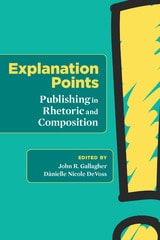
Explanation Points
Publishing in Rhetoric and CompositionJohn R Gallagher
Utah State University Press, 2019
Rhetoric and composition is a uniquely democratic field, made of a group of scholars who, rather than competing with one another, lift each other up and work together to move the field forward. This lively, engaging, story-anchored book offers advice from a range of authors—including emeritus faculty, prolific authors, and early career researchers. Organized by various stages in the writing and publishing process, Explanation Points presents the advice shared between colleagues, passed along from professor to student, or offered online in abbreviated tweets and updates.
The best advice book on writing and publishing in the field, Explanation Points is a useful resource for rhetoric and composition scholars including faculty, graduate students, and advanced undergraduate students; writing center administrators, staff, and consultants; graduate pratica and seminars; writing workshop classes; and editors, associate editors, assistant editors, and other academic journal staff.
Contributors:
Tim Amidon, Chris Anson, Nancy G. Barron, Ellen Barton, Michael Baumann, Steve Bernhardt, Kristine L. Blair, David Blakesley, Lynn Z. Bloom, Marcia Bost, James Brown, Amber Buck, Rebecca Burnett, Joyce Carter, Kate Comer, Janice Cools, Marilyn Cooper, Craig Cotich, Ellen Cushman, Gabriel Cutrufello, Courtney Danforth, Sid Dobrin, William Duffy, Norbert Elliot, Jessica Enoch, Doug Eyman, Michael Faris, Jenn Fishman, Linda Flower, Brenda Glasscot, Laura Gonzales, Jeffrey T. Grabill, Laurie Gries, Bump Halbritter, Joseph Harris, Byron Hawk, Douglas Hesse, Troy Hicks, Bruce Horner, Asao Inoue, Darin L. Jensen, Erin Jensen, Johndan Johnson-Eilola, Gesa E. Kirsch, Sarah Kornfield, Ashanka Kumari, Christina M. LaVecchia, Donna LeCourt, Barbara L’Eplattenier, Heather Lettner-Rust, Justin Lewis, Julie Lindquist, Tara Lockhart, Andrea Abernethy Lunsford, Katie Manthey, Lisa Mastrangelo, Ben McCorkle, Heidi McKee, Cruz Medina, Laura R. Micciche, Holly Middleton, Lilian Mina, Janine Morris, Joan Mullin, Kim Hensley Owens, Jason Palmeri, Mike Palmquist, Steve Parks, Juli Parrish, Staci Perryman-Clark, Mya Poe, Jacqueline Rhodes, Jeff Rice, Jim Ridolfo, Shirley K Rose, Stuart A. Selber, Jody Shipka, Naomi Silver, Ryan Skinnell, Trixie Long Smith, Kyle Stedman, Patrick Sullivan, Carrie Strand Tebeau, Christie Toth, John Trimbur, Chris Warnick, Kathleen Blake Yancey
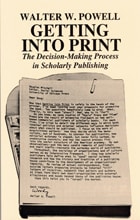
Getting into Print
The Decision-Making Process in Scholarly PublishingWalter W. Powell
University of Chicago Press, 1985
Throughout, the sociology of organizations and of culture serves as Powell's interpretive framework. Powell shows how scholarly publishers help define what is "good" social science research and how the history and tradition of a publishing house contribute to the development of an organizational identity. Powell's review of actual correspondence, from outside letters proposing projects to internal "kill" letters of rejection, suggests that editors and authors at times form their own quasi-organization with external allegiances and bonds beyond those of the publishing house.
"This is a welcome addition to the literature on the life of the organizations that produce our science and our culture. Powell's intimate look at two scholarly publishing companies has an insider's appreciation of the book business and an outsider's eye for questions the editors are not asking themselves."—Michael Schudson, University of California at San Diego
"Getting Into Print will long be the book about how academic editors choose the titles they sponsor. Even experienced editors and authors will find new insights here and revealing comparisons with decision-making in other kinds of organizations."—Edward Tenner, Los Angeles Times Book Review
"Getting Into Print is an unusually outstanding ethnographic study in that it reflects the evocative richness of detail associated with the ethnographic approach while simultaneously maintaining a clear-headed, analytical distance from the subject that allows for a meaningful theoretical contribution. Powell is an astute ethnographer who presents a vital and compelling 'insider's view' of the decision-making process in scholarly publishing, making this book fascinating reading for all those involved in the 'publish-or-perish' syndrome."—Barbara Levitt, American Journal of Sociology
Meaningful Metrics
A 21St Century Librarian's Guide ToRobin Chin Roemer
Assoc of College & Research Libraries, 2015
Meaningful Metrics
A 21St Century Librarian's Guide to Bibliometrics, Altmetrics, and Research ImpactRobin Chin Roemer
Assoc of College & Research Libraries, 2015
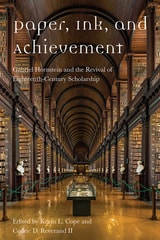
Paper, Ink, and Achievement
Gabriel Hornstein and the Revival of Eighteenth-Century ScholarshipKevin L. Cope
Bucknell University Press, 2021
Published by Bucknell University Press. Distributed worldwide by Rutgers University Press.
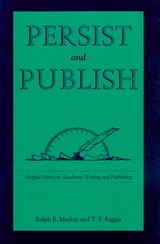
Persist and Publish
Helpful Hints for Academic Writing and PublishingRalph Matkin
University Press of Colorado, 2002
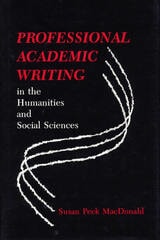
Professional Academic Writing in the Humanities and Social Sciences
Susan Peck MacDonald
Southern Illinois University Press, 1994
In Professional Academic Writing in the Humanities and Social Sciences, Susan Peck MacDonald tackles important and often controversial contemporary questions regarding the rhetoric of inquiry, the social construction of knowledge, and the professionalization of the academy. MacDonald argues that the academy has devoted more effort to analyzing theory and method than to analyzing its own texts. Professional texts need further attention because they not only create but are also shaped by the knowledge that is special to each discipline. Her assumption is that knowledge-making is the distinctive activity of the academy at the professional level; for that reason, it is important to examine differences in the ways the professional texts of subdisciplinary communities focus on and consolidate knowledge within their fields.
Throughout the book, MacDonald stresses her conviction that academics need to do a better job of explaining their text-making axioms, clarifying their expectations of students at all levels, and monitoring their own professional practices. MacDonald’s proposals for both textual and sentence-level analysis will help academic professionals better understand how they might improve communication within their professional communities and with their students.
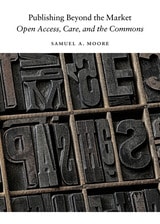
Publishing Beyond the Market
Open Access, Care, and the CommonsSamuel A. Moore
University of Michigan Press, 2025
Going forward, Publishing Beyond the Market explores the importance of collectivity and democratic governance within the transition to open access publishing. It suggests that developing a commons-based, scholar-led publishing landscape through a series of presses that are each managed by working academics could offer a productive counterpoint to marketised systems of open access and subscription publishing. In weaving themselves together in order to “scale small” these publishing initiatives would act as a counter-hegemonic project based on mutual reliance and care. By illustrating how these projects build toward a commons-based publishing future, and how they may complement other approaches to publishing within university presses and libraries, the book culminates in an argument for the infrastructures, policies, and forms of governance needed to nurture such a collective vision.
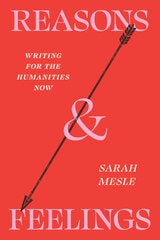
Reasons and Feelings
Writing for the Humanities NowSarah Mesle
University of Chicago Press, 2025
Humanities experts today are embattled. In a world of crises undermining higher education at every turn, what can still motivate humanists to write? Galvanizing, imaginative, and unrepentantly nerdy, Sarah Mesle’s Reasons and Feeling offers practical writing and publishing advice alongside a forcefully affirmative account of why humanities writing matters.
Mesle proposes that writing can help envision sustainable community, but only when we recognize that humanist authority comes from both our reasons and our feelings. Alongside everyday compositional advice—including strategies for addressing different audiences, pitching publications, and managing writing anxiety—readers will find an account of how such craft practices connect to both their intellectual commitments and their historical conditions. Mesle shows how university-trained writers at all levels benefit from embracing a broader range of styles and affects. Doing so helps them harness their writing’s community-building potential and makes them better able to value their own expertise, whether they write for the classroom, in public venues, or for the specialized scholarly communities that share their niche, weird, or beloved, objects of study.
Reasons and Feelings draws on Mesle’s expertise as a professor of writing and her work as an editor helping academics shift between writing for scholarly venues and journalistic ones. In a voice that’s honest, warm, accessible, and bracingly funny, Reasons and Feelings gives humanists a path toward bolder fantasies of the worlds their writing can make.
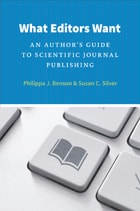
What Editors Want
An Author's Guide to Scientific Journal PublishingPhilippa J. Benson and Susan C. Silver
University of Chicago Press, 2012
Research publications have always been key to building a successful career in science, yet little if any formal guidance is offered to young scientists on how to get research papers peer reviewed, accepted, and published by leading scientific journals. With What Editors Want, Philippa J. Benson and Susan C. Silver, two well-respected editors from the science publishing community, remedy that situation with a clear, straightforward guide that will be of use to all scientists.
Benson and Silver instruct readers on how to identify the journals that are most likely to publish a given paper, how to write an effective cover letter, how to avoid common pitfalls of the submission process, and how to effectively navigate the all-important peer review process, including dealing with revisions and rejection. With supplemental advice from more than a dozen experts, this book will equip scientists with the knowledge they need to usher their papers through publication.
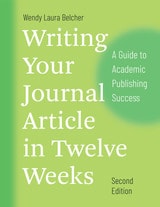
Writing Your Journal Article in Twelve Weeks, Second Edition
A Guide to Academic Publishing SuccessWendy Laura Belcher
University of Chicago Press, 2019
With this new edition, Belcher expands her advice to reach beginning scholars in even more disciplines. She builds on feedback from professors and graduate students who have successfully used the workbook to complete their articles. A new chapter addresses scholars who are writing from scratch. This edition also includes more targeted exercises and checklists, as well as the latest research on productivity and scholarly writing.
Writing Your Journal Article in Twelve Weeks is the only reference to combine expert guidance with a step-by-step workbook. Each week, readers learn a feature of strong articles and work on revising theirs accordingly. Every day is mapped out, taking the guesswork and worry out of writing. There are tasks, templates, and reminders. At the end of twelve weeks, graduate students, recent PhDs, postdoctoral fellows, adjunct instructors, junior faculty, and international faculty will feel confident they know that the rules of academic publishing and have the tools they need to succeed.