Results by title
11 books match the query 'School choice'
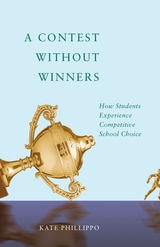
A Contest without Winners
How Students Experience Competitive School ChoiceKate Phillippo
University of Minnesota Press, 2019
Seeing the consequences of competitive school choice policy through students’ eyes
While policymakers often justify school choice as a means to alleviate opportunity and achievement gaps, an unanticipated effect is increased competition over access to coveted, high-performing schools. In A Contest without Winners, Kate Phillippo follows a diverse group of Chicago students through the processes of researching, applying to, and enrolling in public high school. Throughout this journey, students prove themselves powerful policy actors who carry out and redefine competitive choice.
Phillippo’s work amplifies the voices of students—rather than the parents, educators, public intellectuals, and policymakers who so often inform school choice research—and investigates how students interact with and emerge from competitive choice academically, developmentally, and civically. Through students’ experiences, she shows how competitive choice legitimates and exacerbates existing social inequalities; collides with students’ developmental vulnerability to messages about their ability, merit, and potential; and encourages young people’s individualistic actions as they come to feel that they must earn their educational rights. From urban infrastructure to income inequality to racial segregation, Phillippo examines the factors that shape students’ policy enactment and interpretation, as policymakers and educators ask students to compete for access to public resources.
With competitive choice, even the winners—the lucky few admitted to their dream schools—don’t outright win. A Contest without Winners challenges meritocratic and market-driven notions of opportunity creation for young people and raises critical questions about the goals we have for public schooling.
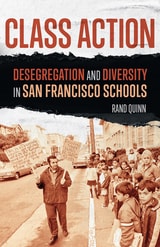
Class Action
Desegregation and Diversity in San Francisco SchoolsRand Quinn
University of Minnesota Press, 2020
A compelling history of school desegregation and activism in San Francisco
The picture of school desegregation in the United States is often painted with broad strokes of generalization and insulated anecdotes. Its true history, however, is remarkably wide ranging. Class Action tells the story of San Francisco’s long struggle over school desegregation in the wake of the 1954 U.S. Supreme Court decision Brown v. Board of Education.
San Francisco’s story provides a critical chapter in the history of American school discrimination and the complicated racial politics that emerged. It was among the first large cities outside the South to face court-ordered desegregation following the Brown rulings, and it experienced the same demographic shifts that transformed other cities throughout the urban West. Rand Quinn argues that the district’s student assignment policies—including busing and other desegregative mechanisms—began as a remedy for state discrimination but transformed into a tool intended to create diversity. Drawing on extensive archival research—from court docket files to school district records—Quinn describes how this transformation was facilitated by the rise of school choice, persistent demand for neighborhood schools, evolving social and legal landscapes, and local community advocacy and activism.
Class Action is the first book to present a comprehensive political history of post-Brown school desegregation in San Francisco. Quinn illuminates the evolving relationship between jurisprudence and community-based activism and brings a deeper understanding to the multiracial politics of urban education reform. He responds to recent calls by scholars to address the connections between ideas and policy change and ultimately provides a fascinating look at race and educational opportunity, school choice, and neighborhood schools in the aftermath of Brown v. Board of Education.
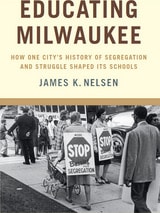
Educating Milwaukee
How One City’s History of Segregation and Struggle Shaped Its SchoolsJames K. Nelsen
Wisconsin Historical Society Press, 2015
"Milwaukee's story is unique in that its struggle for integration and quality education has been so closely tied to [school] choice." --from the Introduction
"Educating Milwaukee: How One City's History of Segregation and Struggle Shaped Its Schools" traces the origins of the modern school choice movement, which is growing in strength throughout the United States. Author James K. Nelsen follows Milwaukee's tumultuous education history through three eras--"no choice," "forced choice," and "school choice." Nelsen details the whole story of Milwaukee's choice movement through to modern times when Milwaukee families have more schooling options than ever--charter schools, open enrollment, state-funded vouchers, neighborhood schools--and yet Milwaukee's impoverished African American students still struggle to succeed and stay in school. "Educating Milwaukee" chronicles how competing visions of equity and excellence have played out in one city's schools in the modern era, offering both a cautionary tale and a "choice" example.
Lost Classroom, Lost Community
Catholic Schools' Importance in Urban AmericaMargaret F. Brinig and Nicole Stelle Garnett
University of Chicago Press, 2014
More than just educational institutions, Catholic schools promote the development of social capital—the social networks and mutual trust that form the foundation of safe and cohesive communities. Drawing on data from the Project on Human Development in Chicago Neighborhoods and crime reports collected at the police beat or census tract level in Chicago, Philadelphia, and Los Angeles, Margaret F. Brinig and Nicole Stelle Garnett demonstrate that the loss of Catholic schools triggers disorder, crime, and an overall decline in community cohesiveness, and suggest that new charter schools fail to fill the gaps left behind.
This book shows that the closing of Catholic schools harms the very communities they were created to bring together and serve, and it will have vital implications for both education and policing policy debates.
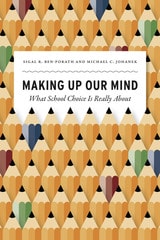
Making Up Our Mind
What School Choice Is Really AboutSigal R. Ben-Porath and Michael C. Johanek
University of Chicago Press, 2019
Those are not only the wrong questions—they’re the wrong premises, argue philosopher Sigal R. Ben-Porath and historian Michael C. Johanek in Making Up Our Mind. Market-driven school choices aren’t new. They predate the republic, and for generations parents have chosen to educate their children through an evolving mix of publicly supported, private, charitable, and entrepreneurial enterprises. The question is not whether to have school choice. It is how we will regulate who has which choices in our mixed market for schooling—and what we, as a nation, hope to accomplish with that mix of choices. Looking beyond the simplistic divide between those who oppose government intervention and those who support public education, the authors make the case for a structured landscape of choice in schooling, one that protects the interests of children and of society, while also identifying key shared values on which a broadly acceptable policy could rest.
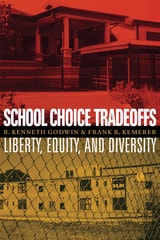
School Choice Tradeoffs
Liberty, Equity, and DiversityBy R. Kenneth Godwin and Frank R. Kemerer
University of Texas Press, 2002
Educational policy in a democracy goes beyond teaching literacy and numeracy. It also supports teaching moral reasoning, political tolerance, respect for diversity, and citizenship. Education policy should encourage liberty and equality of opportunity, hold educational institutions accountable, and be efficient. School Choice Tradeoffs examines the tradeoffs among these goals when government affords parents the means to select the schools their children attend.
Godwin and Kemerer compare current policy that uses family residence to assign students to schools with alternative policies that range from expanding public choice options to school vouchers. They identify the benefits and costs of each policy approach through a review of past empirical literature, the presentation of new empirical work, and legal and philosophic analysis.
The authors offer a balanced perspective that goes beyond rhetoric and ideology to offer policymakers and the public insight into the complex tradeoffs that are inherent in the design and implementation of school choice policies. While all policies create winners and losers, the key questions concern who these individuals are and how much they gain or lose. By placing school choice within a broader context, this book will stimulate reflective thought in all readers.
School Choice and the Future of American Democracy
Scott Franklin Abernathy
University of Michigan Press, 2005
"Scott Abernathy takes up big questions and provides answers grounded in the complex reality of policy and politics. School Choice and the Future of American Democracy is a book written for those who understand that the world does not fit the simple explanations too often put forward."
--Clarence Stone, Professor Emeritus, University of Maryland, and Research Professor, George Washington University
"Will school choice revive or eviscerate democratic processes and institutions? Will it narrow or exacerbate the range of educational inequities? This book takes several differently angled slices into these questions and draws intriguing answers."
--Jeffrey R. Henig, Teachers College, Columbia University, and author of Rethinking School Choice: Limits of the Market Metaphor
"Through extensive research and refreshingly impartial analysis, Scott Abernathy probes how the use of market principles to reform public schools affects democratic citizenship. Treating citizens first and foremost as customers, he finds, threatens civic engagement and the well-being of schools, especially in the nation's neediest communities. This thoughtful and balanced appraisal is must-reading for those concerned about the future of American education and democracy."
--Suzanne Mettler, Alumni Associate Professor, Syracuse University, and author of Soldiers to Citizens: The G.I. Bill and the Making of the Greatest Generation
Scott Franklin Abernathy is Assistant Professor of Political Science, University of Minnesota
Struggle For Control Of Public Education
Michael Engel
Temple University Press, 2000
Seduced by the language of the market economy, those making decisions about education today argue that market strategies promote democratic educational reform, when really they promote market reform of education. Michael Engel argues against this tendency, siding with democratic values -- which encourage openness, creativity, social awareness, and idealism, whereas market values uphold individual achievement, competition, economic growth, and national security.
Behind the facade of progressive rhetoric, advocates of these corporate models have succeeded in imposing their definition of school reform through federal and state policy makers. As a result, communities lose control of their schools, teachers lose control of their work, and students lose control of their schools, teachers lose control of their work, and students lose control of their futures. Engel attacks the increasing dominance of market ideology in educational policy and extends his critique beyond such trends in school reform as vouchers, charter schools, and "contracting out" to include issues such as decentralization, computer technology, and standards.
The debate over privatization amounts to ideological warfare between democratic and market values. The question is not so much about "school choice" as it is about the values Americans want at the root of their society. Unprecedented in its value-based challenge to the threat of market ideology to educational policy, The Struggle for Control of Public Education is a sophisticated call for a return to community-controlled schools and democratic values. This argument offers theoretical and practical models crafted in the contemporary feminist and social reconstructionist tradition. Readers interested in the study of educational policies, philosophy, and policy will find this book engaging.
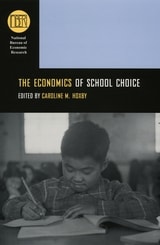
The Economics of School Choice
Edited by Caroline M. Hoxby
University of Chicago Press, 2003
Combining the results of empirical research with analyses of the basic economic forces underlying local education markets, The Economics of School Choice presents evidence concerning the impact of school choice on student achievement, school productivity, teachers, and special education. It also tackles difficult questions such as whether school choice affects where people decide to live and how choice can be integrated into a system of school financing that gives children from different backgrounds equal access to resources. Contributors discuss the latest findings on Florida's school choice program as well as voucher programs and charter schools in several other states.
The resulting volume not only reveals the promise of school choice, but examines its pitfalls as well, showing how programs can be designed that exploit the idea's potential but avoid its worst effects. With school choice programs gradually becoming both more possible and more popular, this book stands out as an essential exploration of the effects such programs will have, and a necessary resource for anyone interested in the idea of school choice.
The Scarcity Loop
How School Choice Reshapes the Rationing of Public Educationjennings
Russell Sage Foundation, 2026
School choice promises to free families from the limits of where they live. The Scarcity Loop asks what happens when that promise is made in school systems where more children seek desirable schools than those schools can serve. Focused on New York City’s high school admissions system, sociologist Jennifer L. Jennings argues that choice becomes another way to ration scarce educational opportunity, shifting where rationing happens, who must manage it, and how families understand the outcomes that follow.
Jennings begins with the admissions process itself. New York City asks every eighth grader to choose from hundreds of options. On paper, the system offers extraordinary possibility. But that possibility still has to be converted into a seat. Someone has to learn the rules, compare schools, manage deadlines, make trips, and decide how much risk a thirteen-year-old can bear. Jennings calls this the work of getting in and shows that the capacity to do that work is not evenly distributed. Some families enter choice systems with the fluency and flexibility to turn options into opportunity. Others confront it with fewer supports and far less room for error. Some teenagers shoulder decisions with little adult help. Counselors translate complicated rules under impossible constraints. Principals are not passive actors. Jennings shows how they recruit and adapt as they try to build schools families will choose while managing demand and reputation.
Jennings contends that reforms meant to expand access can reorganize the very competition they aim to resolve. As one barrier recedes, another becomes more consequential. Residence matters less, but advantage does not disappear; it travels through information, timing, and familiarity with the rules. Inequality persists not because nothing changes, but because advantage finds new points of entry as reforms change rules. As the work of securing opportunity shifts, so do understandings of inequality. Unequal outcomes can come to look less like consequences of how educational opportunities are organized and more like reflections of how families navigate the system.
Drawing on more than 450 interviews, participant observation, administrative data, and archival research, The Scarcity Loop follows students, parents, counselors, and principals as they navigate school choice at scale. Jennings traces who must do the work of making choice real, clarifying what is at stake when public education becomes something families must know how to secure.
The Scarcity Loop skillfully shows the consequences of scarcity in public education on schools and families, and reveals how scarcity reproduces itself, even when reforms are sincere.
JENNIFER L. JENNINGS is the Class of 1988 Professor in Domestic Policy and Professor of Sociology and Public Affairs, Princeton University
Unsettling Choice
Race, Rights, and the Partitioning of Public EducationUjju Aggarwal
University of Minnesota Press, 2024
How the Great Recession revealed a system of school choice built on crisis, precarity, and exclusion
What do universal rights to public goods like education mean when codified as individual, private choices? Is the “problem” of school choice actually not about better choices for all but, rather, about the competition and exclusion that choice engenders—guaranteeing a system of winners and losers? Unsettling Choice addresses such questions through a compelling ethnography that illuminates how one path of neoliberal restructuring in the United States emerged in tandem with, and in response to, the Civil Rights movement.
Drawing on ethnographic research in one New York City school district, Unsettling Choice traces the contestations that surfaced when, in the wake of the 2007–2009 Great Recession, public schools navigated austerity by expanding choice-based programs. Ujju Aggarwal argues that this strategy, positioned as “saving public schools,” mobilized mechanisms rooted in market logics to recruit families with economic capital on their side, thereby solidifying a public sphere that increasingly resembled the private—where contingency was anticipated and rights for some were marked by intensified precarity for poor and working-class Black and Latinx families.
As Unsettling Choice shows, these struggles over public schools—one of the last remaining universal public goods in the United States—were entrapped within neoliberal regimes that exceeded privatization and ensured exclusion even as they were couched in language of equity, diversity, care, and rights. And yet this richly detailed and engaging book also tracks an architecture of expansive rights, care, and belonging built among poor and working-class parents at a Head Start center, whose critique of choice helps us understand how we might struggle for—and reimagine—justice, and a public that remains to be won.
Retail e-book files for this title are screen-reader friendly with images accompanied by short alt text and/or extended descriptions.