Results by title
140 books match the query 'Science Fiction & Fantasy' and 16 start with a
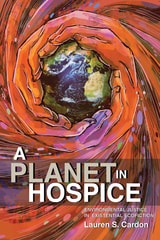
A Planet in Hospice
Environmental Justice in Existential EcofictionLauren S. Cardon
The Ohio State University Press, 2026
How do we continue to love and care for a planet it’s too late to save? In A Planet in Hospice, Lauren S. Cardon analyzes works of “existential ecofiction” that invite us to reflect on our mortality and the many ways that people are already affected by disaster, while also encouraging hope and connection. These texts from authors such as N. K. Jemisin, Paolo Bacigalupi, Darcie Little Badger, Rivers Solomon, Richard Powers, and Margaret Atwood are characterized by themes of ecological crisis, planetary demise, and human extinction, and they center environmental justice and human oppression. Cardon argues that, by invoking the end of the world, these writers directly engage with death anxiety and consequently intervene in current theories of existential psychology and intersectional ecocriticism. They highlight the inextricability of environmental care and social justice and offer visions of a path forward through the global climate crisis humans now face.

A Scanner Darkly
D. Harlan Wilson
University of Texas Press, 0
An in-depth analysis of Richard Linklater’s film adaptation of the semi-autobiographical Philip K. Dick novel, examining the film’s importance in the history of science fiction cinema.
From Blade Runner and Minority Report to The Man in the High Castle, the works of Philip K. Dick have been fertile ground for screen adaptation. Among the most visually and intellectually compelling, however, is the release that has received the least attention: Richard Linklater’s A Scanner Darkly.
In this revelatory work of criticism, scholar-novelist D. Harlan Wilson burrows deep inside Linklater’s meditation on identity and surveillance, addiction and the instability of perception. A Scanner Darkly features groundbreaking use of rotoscopy—filming live-action scenes, then drawing over the footage to animate it. Wilson argues that the technique captures the splintered consciousness of Dick’s protagonist and extends this psychological disintegration beyond the world on screen, inviting viewers into a fractured sense of self. More broadly, Wilson places the film in conversation with Linklater’s oeuvre, the history of science fiction cinema, and contemporary debates about technology, identity, and surveillance. A Scanner Darkly—the novel, the film, and now the critical interpretation—yields powerful insight into the forms of social control that define our era of digital selfhood, algorithmic monitoring, and artificial intelligence.
A Stanislaw Lem Reader
Peter Swirski
Northwestern University Press, 1997
Afro-Future Females
Black Writers Chart Science Fiction's Newest New-Wave TrajectoryMarleen S. Barr
The Ohio State University Press, 2008
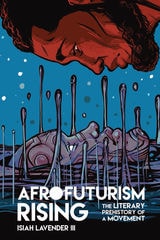
Afrofuturism Rising
The Literary Prehistory of a MovementIsiah Lavender III
The Ohio State University Press, 2019
By engaging with authors as diverse as Phillis Wheatley, David Walker, Frederick Douglass, Harriet Ann Jacobs, Samuel R. Delany Jr., Pauline Hopkins, Zora Neale Hurston, and Richard Wright, Afrofuturism Rising extends existing scholarly conversations about who creates and what is created via science fiction. Through a trans-historical rereading of texts by these authors as science fiction, Lavender highlights the ways black experience in America has always been an experience of spatial and temporal dislocation akin to science fiction. Compelling and ambitious in scope, Afrofuturism Rising redefines both science fiction and literature as a whole.
Afrofuturism and World Order
Reynaldo Anderson
The Ohio State University Press, 2025
Afrofuturisms
Ecology, Humanity, and Francophone Cultural ExpressionsIsaac Vincent Joslin
Ohio University Press, 2023

After Capitalism
Science Fiction and the End of the End of the WorldJo Lindsay Walton
Lever Press, 2027
In After Capitalism, Jo Lindsay Walton uses speculative fiction to tackle some of the largest, most urgent, and strangest political questions of our time. Is climate science itself a speculative practice, even as it conveys some of the hardest facts we know? Does the end of capitalism require the end of money, or might money mutate into something new—a currency based on time, labor or reputation? As AI threatens to take over more aspects of social life, might we think of money itself as a kind of AI, one that could be reprogrammed? Why do ecological forms of calculation—from real world carbon credits to speculative energy currencies—fail to protect the planet that sustains us?
Drawing on the works of Edward Bellamy, Octavia Butler, Samuel R. Delany, Cory Doctorow, Ursula K. Le Guin, Yoon Ha Lee, Karen Lord, Malka Older, Nnedi Okorafor, Marge Piercy, Adam Roberts, Joanna Russ, Wole Talabi, and more, Walton explores whether science fiction can create space for fugitive dreams to thrive, or whether it serves merely as a laboratory for capitalism’s own reinvention.Weaving together literary criticism, critical political economy, and perspectives from the environmental humanities, After Capitalism argues that the worlds beyond capitalism are neither unimaginable nor entirely elsewhere.
Alfred Bester
Jad Smith
University of Illinois Press, 2016
Jad Smith traces the career of the unlikeliest of SF icons. Winner of the first Hugo Award for The Demolished Man, Bester also worked in comics, radio, and TV, and his intermittent SF writing led some critics to brand him a dabbler. In the 1960s, however, New Wave writers championed his work, and his reputation grew. Smith follows Bester's journey from consummate outsider to an artist venerated for foundational works that influenced the New Wave and cyberpunk revolutions. He also explores the little-known roots of a wayward journey fueled by curiosity, disappointment with the SF mainstream, and an artist's determination to go his own way.
Alien Constructions
Science Fiction and Feminist ThoughtBy Patricia Melzer
University of Texas Press, 2006
Though set in other worlds populated by alien beings, science fiction is a site where humans can critique and re-imagine the paradigms that shape this world, from fundamentals such as the sex and gender of the body to global power relations among sexes, races, and nations. Feminist thinkers and writers are increasingly recognizing science fiction's potential to shatter patriarchal and heterosexual norms, while the creators of science fiction are bringing new depth and complexity to the genre by engaging with feminist theories and politics. This book maps the intersection of feminism and science fiction through close readings of science fiction literature by Octavia E. Butler, Richard Calder, and Melissa Scott and the movies The Matrix and the Alien series.
Patricia Melzer analyzes how these authors and films represent debates and concepts in three areas of feminist thought: identity and difference, feminist critiques of science and technology, and the relationship among gender identity, body, and desire, including the new gender politics of queer desires, transgender, and intersexed bodies and identities. She demonstrates that key political elements shape these debates, including global capitalism and exploitative class relations within a growing international system; the impact of computer, industrial, and medical technologies on women's lives and reproductive rights; and posthuman embodiment as expressed through biotechnologies, the body/machine interface, and the commodification of desire. Melzer's investigation makes it clear that feminist writings and readings of science fiction are part of a feminist critique of existing power relations—and that the alien constructions (cyborgs, clones, androids, aliens, and hybrids) that populate postmodern science fiction are as potentially empowering as they are threatening.

Aliens
An Anthropology of Science FictionEdited by George E. Slusser and Eric S. Rabkin
Southern Illinois University Press, 1987
How and when does there come to be an “anthropology of the alien?” This set of essays, written for the eighth J. Lloyd Eaton Conference on Fantasy and Science Fiction, is concerned with the significance of that question. “[Anthropology] is the science that must designate the alien ifit is to redefine a place for itself in the universe,” according to the Introduction.
The idea of the alien is not new. In the Renaissance, Montaigne’s purpose in describing an alien encounter was excorporation—mankind was the “savage” because the artificial devices of nature controlled him. Shakespeare’s version of the alien encounter was incorporation; his character of Caliban is brought to the artificial, political world of man and incorporated into the body politic
“The essays in this volume . . . show, in their general orientation, that the tribe of
This book is divided into three parts: “Searchings: The Quest for the Alien” includes “The Aliens in Our Mind,” by Larry Niven; “Effing the Ineffable,” by Gregory Benford; “Border Patrols,” by Michael Beehler; “Alien Aliens,” by Pascal Ducommun; and “Metamorphoses of the Dragon,” by George E. Slusser.
“Sightings: The Aliens among Us” includes “Discriminating among Friends,” by John Huntington; “Sex, Superman, Sociobiology,” by Joseph D. Miller; “Cowboys and Telepaths,” by Eric S. Rabkin; “Robots,” by Noel Perrin; “Aliens in the Supermarket,” by George R. Guffey; and “Aliens ‘R’ U.S.,” by Zoe Sofia.
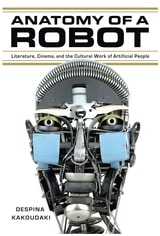
Anatomy of a Robot
Literature, Cinema, and the Cultural Work of Artificial PeopleKakoudaki, Despina
Rutgers University Press, 2014
By analyzing a wide range of literary texts and films (including episodes from Twilight Zone, the fiction of Philip K. Dick, Kazuo Ishiguro’s novel Never Let Me Go, Metropolis, The Golem, Frankenstein, The Terminator, Iron Man, Blade Runner, and I, Robot), and going back to alchemy and to Aristotle’s Physics and De Anima, she tracks four foundational narrative elements in this centuries-old discourse— the fantasy of the artificial birth, the fantasy of the mechanical body, the tendency to represent artificial people as slaves, and the interpretation of artificiality as an existential trope. What unifies these investigations is the return of all four elements to the question of what constitutes the human.
This focused approach to the topic of the artificial, constructed, or mechanical person allows us to reconsider the creation of artificial life. By focusing on their historical provenance and textual versatility, Kakoudaki elucidates artificial people’s main cultural function, which is the political and existential negotiation of what it means to be a person.
Apocalypse Cinema
Stephen Prince
Rutgers University Press, 2021
This book provides a lively overview of apocalypse cinema, including alien invasions, nuclear annihilation, asteroid collisions, climate change, and terrifying plagues. Covering pivotal films from the silent era to the present day, including Metropolis, Invasion of the Body Snatchers, Dr. Strangelove, Contagion, and Avengers: Endgame, Stephen Prince explores how these dark visions are rooted in religious and prophetic traditions, and he considers how our love for apocalypse cinema is tied to fundamental existential questions and anxieties that never go out of fashion.

Arrival
David Roche
University of Texas Press, 2024
A study of Denis Villeneuve’s genre-transcendent film.
In Denis Villeneuve’s Arrival (2016), scientists must decipher the language of and peacefully communicate with aliens who have landed on Earth before the world’s military attacks. In this first book-length study of the film, scholar David Roche argues that it is one of the most important films of this century, and the most brilliant science fiction film since Blade Runner. Roche posits Arrival as a blockbuster with artistic ambitions—an argument supported by the film’s several Academy Award nominations—and looks closely at how the film engages with theoretical questions posed by contemporary film studies and philosophy alike. Each section explores a central aspect of the film: its status as an auteur adaptation; its relation to the science fiction genre; its themes of communication on narrative and meta-narrative levels; its aesthetics of time and space; and the political and ethical questions it raises. Ultimately, Roche declares Arrival a unique, multifaceted experience in the world of hard science fiction films, placing it in context with works like 2001: A Space Odyssey, Close Encounters of the Third Kind, and Contact while also examining how it bridges the gap between genre and art house cinema.
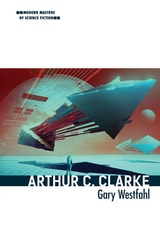
Arthur C. Clarke
Gary Westfahl
University of Illinois Press, 2018
Gary Westfahl closely examines Clarke's remarkable career, ranging from his forgotten juvenilia to the passages he completed for a final novel, The Last Theorem. As Westfahl explains, Clarke’s science fiction offered original perspectives on subjects like new inventions, space travel, humanity’s destiny, alien encounters, the undersea world, and religion. While not inclined to mysticism, Clarke necessarily employed mystical language to describe the fantastic achievements of advanced aliens and future humans. Westfahl also contradicts the common perception that Clarke’s characters were bland and underdeveloped, arguing that these reticent, solitary individuals, who avoid conventional relationships, represent his most significant prediction of the future, as they embody the increasingly common lifestyle of people in the twenty-first century.
Asian Ameritopias
Asian American Speculative FictionsStephen Hong Sohn
Temple University Press, 2026
Asian American writers have long produced literary works of speculative fiction, the supergenre that employs science fictional, fantastical, or supernatural elements. Stephen Hong Sohn’s Asian Ameritopias is the first book-length study to consider how these aesthetically complex and wildly imaginative representations offer writers a way to explore themes of race and identity, as well as alternate futures and other planets.
Sohn examines how various novels and stories enable Asian American writers to engage with and reimagine issues of social justice, revisualize the bounds of social collectives, and create new pathways for precarious subjects. Asian Ameritopias assesses speculative fictions that spotlight supernatural horror and fantasy, such as ghosts and magical objects, to excavate racialized histories of oppression. Moving to science fiction, Sohn shows how Asian American cyborgs employ their technological powers to offer protection for socially marginalized groups, including sex workers, the undocumented, the poor, and the injured. He ends by analyzing three novels featuring extraterrestrials who look like Asian Americans in order to address issues of xenophobia and ostracization.
The speculative fictions Sohn unpacks in Asian Ameritopias provide a ripe opportunity to reflect on and confront our current, turbulent reality.