Results by title
2 books match the query 'Science and psychology'
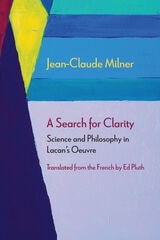
A Search for Clarity
Science and Philosophy in Lacan's OeuvreJean-Claude Milner; Translated from the French by Ed Pluth
Northwestern University Press, 2021
In A Search for Clarity, Jean‑Claude Milner argues that although Jacques Lacan’s writing is notoriously obscure his oeuvre is entirely clear. In a discussion that considers the difference between the esoteric and exoteric works of Plato and Aristotle, Milner argues that Lacan’s oeuvre is to be found in his published writings alone, not his transcribed seminars, and that these published writings contain his official doctrine. Thus, Lacan’s oeuvre is already complete, even though many of his seminars remain unpublished.
According to Milner, Lacan’s fundamental idea is that the subject psychoanalysis works on is the subject of science. Milner suggests that this is a supplement to Alexandre Koyré’s and Alexandre Kojève’s accounts of modern science, for which mathematization and a break from the ancient episteme were key.
A Search for Clarity is the definitive statement on how Lacan viewed the relationship between psychoanalysis and science, and on how Lacan’s thinking evolved as he struggled to draw out the consequences of the equation he posited between psychoanalysis and science. Milner’s work on Lacan has been essential reading in French for decades. This English translation will make his illuminating work accessible to a broader audience.

Psychoanalysis--A Theory in Crisis
Marshall Edelson
University of Chicago Press, 1988