Results by title
14 books match the query 'Scientific expeditions'
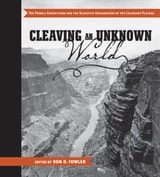
Cleaving an Unknown World
The Powell Expeditions and the Scientific Exploration of the Colorado PlateauDon D Fowler
University of Utah Press, 2011
In 2009 the University of Utah Press and the Utah State Historical Society co-published three volumes of long out-of-print journals, letters, and other documents from John Wesley Powell’s expeditions down the Colorado River. We are proud to announce the fourth and final volume. Cleaving an Unknown World collects Powell’s journal (Smithsonian Journal of History, 1968); Jack Hillers’s diary and photographs, previously published as Photographed All the Best Scenery, edited by Don D. Fowler (University of Utah Press, 1972); original maps from Francis Marion Bishop (Utah Historical Quarterly, 1969); Frederick S. Dellenbaugh’s letters (Utah Historical Quarterly, 1969); and John C. Sumner’s journal from the first Powell expedition (Utah Historical Quarterly, 1969). Roy Webb’s foreword provides the context for these disparate pieces.
This beautifully illustrated book features Hillers’s photographs—long regarded as a remarkable and unique record of the Colorado River and the Grand Canyon. Cleaving an Unknown World belongs in the library of any reader interested in the exploration of the American West.
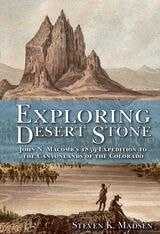
Exploring Desert Stone
John N. Macomb's 1859 Expedition to the Canyonlands of the ColoradoSteven K. Madsen
Utah State University Press, 2022
The soldiers and scientists followed in part the Old Spanish Trail, whose location they documented and verified. Seeking to find the confluence of the Colorado and the Green and looking for alternative routes into Utah, which was of particular interest in the wake of the Utah War, they produced a substantial documentary record, most of which is published for the first time in this volume. Theirs is also the first detailed map of the region, and it is published in Exploring Desert Stone, as well.
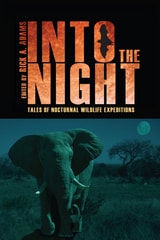
Into the Night
Rick Adams
University Press of Colorado, 2013
Contributors tell of confronting North American bears, cougars, and rattlesnakes; suffering red ctenid spider bites in the tropical rain forest; swimming through layers of feeding-frenzied hammerhead sharks in the Galapagos; evading the wrath of African bull elephants in South Africa; and delighting in the curious and gentle nature of foxes and unconditional acceptance by a family of owls. They describe “fire in the sky” across a treeless tundra, a sea ablaze with bioluminescent algae, nighttime earthquakes on the Pacific Rim, and hurricanes and erupting volcanoes on a Caribbean island.
Into the Night reveals rare and unexpected insights into nocturnal field research, illuminating experiences, discoveries, and challenges faced by intrepid biologists studying nature’s nightly marvels across the globe. This volume will be of interest to scientists and general readers alike.
Measuring the New World
Enlightenment Science and South AmericaNeil Safier
University of Chicago Press, 2008
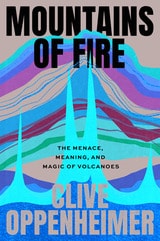
Mountains of Fire
The Menace, Meaning, and Magic of VolcanoesClive Oppenheimer
University of Chicago Press, 2023
In Mountains of Fire, Clive Oppenheimer invites readers to stand with him in the shadow of an active volcano. Whether he is scaling majestic summits, listening to hissing lava at the crater’s edge, or hunting for the far-flung ashes from Earth’s greatest eruptions, Oppenheimer is an ideal guide, offering readers the chance to tag along on the daring, seemingly-impossible journeys of a volcanologist.
In his eventful career as a volcanologist and filmmaker, Oppenheimer has studied volcanoes around the world. He has worked with scientists in North Korea to study Mount Paektu, a volcano name sung in national anthems on both sides of the Demilitarized Zone. He has crossed the Sahara to reach the fabled Tiéroko volcano in the Tibesti Mountains of Chad. He spent months camped atop Antarctica’s most active volcano, Mount Erebus, to record the pulse of its lava lake.
Mountains of Fire reveals how volcanic activity is entangled with our climate and environment, as well as our economy, politics, culture, and beliefs. These adventures and investigations make clear the dual purpose of volcanology—both to understand volcanoes for science’s sake and to serve the communities endangered and entranced by these mountains of fire.
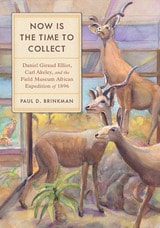
Now Is the Time to Collect
Daniel Giraud Elliot, Carl Akeley, and the Field Museum African Expedition of 1896Paul D. Brinkman
University of Alabama Press, 2024
The rediscovery of a curator’s lost journal illuminates the astonishing African journey that formed the basis of the Chicago Field Museum’s famed collections
“Now” Is the Time to Collect tells the fascinating story of the Chicago Field Museum of Natural History’s zoological expedition to Africa in 1896, the source of many of the museum’s foundational collections and an astounding episode in nineteenth-century science. After the well-publicized extinction of the dodo and Carolina parakeet and the collapse of the American bison population, late nineteenth-century naturalists expected many more vulnerable species to die out with spread of Western-style industrialization. This triggered a race to collect rare species of animals expected soon to be lost forever.
Established in 1893, Chicago’s ambitious Field Museum aimed to become a global center of study. Zoologist Daniel Giraud Elliot persuaded museum patrons to fund an immediate expedition to British Somaliland (contemporary Somalia). There, his team hunted and killed hundreds of animals for the growing collection. On the trip was groundbreaking taxonomist Carl Akeley. Back in Chicago, Akeley created captivating lifelike dioramas of rare animal groups that enhanced the museum’s fame and remain popular to this day.
Enriched with illuminated passages from Elliot’s journal, only recently rediscovered, “Now” Is the Time to Collect is the first book of its kind by an American museum and a case study in what author Paul D. Brinkman calls “salvage zoology”—the practice of aggressively collecting rare animal specimens for preservation just prior to the birth of the modern conservation movement. It is a riveting account of the expedition, the travelers’ experiences in Somalia during its colonial period, and the astonishing origins of one of Chicago’s classic museum experiences.
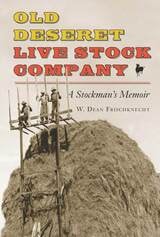
Old Deseret Live Stock Company
A Stockman's MemoirW. Dean Frischknecht
Utah State University Press, 2008
In the high country of the northern Wasatch Mountains, lies what is left of one of the West’s largest ranches. Deseret Live Stock Company was reputed at various times to be the largest private landholder in Utah and the single biggest producer of wool in the world. The ranch began as a sheep operation, but as it found success, it also ran cattle. Incorporated in the 1890s by a number of northern Utah ranchers who pooled their resources, the company was at the height of successful operations in the mid-twentieth century when a young Dean Frischknecht, bearing a recent degree in animal science, landed the job of sheep foreman. In his memoir he recounts in detail how Deseret managed huge herds of livestock, vast lands, and rich wildlife and recalls through lively anecdotes how stockmen and their families lived and worked in the Wasatch Mountains and Skull Valley’s desert wintering grounds.
Route for the Overland Stage
James H. Simpson's 1859 Trail Across the Great BasinJesse G. Petersen
Utah State University Press, 2008
The 1859 exploration of the Great Basin by army topographical engineer James Simpson opened up one of the West's most important transportation and communication corridors, a vital link between the Pacific Coast and the rest of the nation. It became the route of the Pony Express and the Overland Mail and Stage, the line of the Pacific telegraph, a major wagon road for freighters and emigrants, and, later, the first transcontinental auto road, the Lincoln Highway, now Highway 50.
No one has accurately tracked or mapped Simpson's original route, until now. Jesse Petersen shows in words, maps, and photos exactly where the explorer went. Sharing his detective-like reasoning as he walked or drove the entire trail west and Simpson's variant route returning east, Petersen takes readers on a mountain and desert trek through some of America's most remote and striking landscapes.
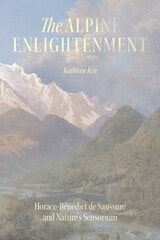
The Alpine Enlightenment
Horace-Bénédict de Saussure and Nature’s SensoriumKathleen Kete
University of Chicago Press, 2024
In The Alpine Enlightenment, historian Kathleen Kete takes us into the world of the Genevan geologist, physicist, inventor, and mountaineer Horace-Bénédict de Saussure. During his prodigious climbs into the upper ranges of the Alps, Saussure focused intensely on the natural phenomena he encountered—glaciers, crevasses, changes in the weather, and shifts in the color of the sky—and he described with great precision what he saw, heard, and touched. Kete uses Saussure’s evocative writings, which emphasized above all physical engagement with the earth, to uncover not just how people during the Enlightenment thought about nature, but how they experienced it. As Kete shows, Saussure thought with and through his body: he harnessed his senses to understand the forces that shaped the world around him. In so doing, he offered a vision of nature as worthy of respect independent of human needs, anticipating present-day concerns about the environment and our shared place within it.
The Anthropology of Expeditions
Travel, Visualities, AfterlivesEdited by Joshua A. Bell and Erin L. Hasinoff
Bard Graduate Center, 2015
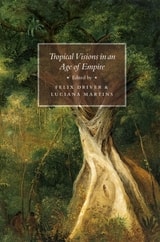
Tropical Visions in an Age of Empire
Edited by Felix Driver and Luciana Martins
University of Chicago Press, 2005
Bringing together a group of distinguished contributors from disciplines across the arts and humanities, this volume contains eleven beautifully illustrated essays—arranged in three sections devoted to voyages, mappings, and sites—that consider the ways that tropical places were encountered, experienced, and represented in visual form. Covering a wide range of tropical sites in the Pacific, South Asia, West Africa, the Caribbean, and Latin America, the book will appeal to a broad readership: scholars of postcolonial studies, art history, literature, imperial history, history of science, geography, and anthropology.

Two Years Below the Horn
Operation Tabarin, Field Science, and Antarctic SovereigntyAndrew Taylor
University of Manitoba Press, 2017
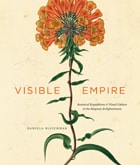
Visible Empire
Botanical Expeditions and Visual Culture in the Hispanic EnlightenmentDaniela Bleichmar
University of Chicago Press, 2012
Between 1777 and 1816, botanical expeditions crisscrossed the vast Spanish empire in an ambitious project to survey the flora of much of the Americas, the Caribbean, and the Philippines. While these voyages produced written texts and compiled collections of specimens, they dedicated an overwhelming proportion of their resources and energy to the creation of visual materials. European and American naturalists and artists collaborated to manufacture a staggering total of more than 12,000 botanical illustrations. Yet these images have remained largely overlooked—until now.
In this lavishly illustrated volume, Daniela Bleichmar gives this archive its due, finding in these botanical images a window into the worlds of Enlightenment science, visual culture, and empire. Through innovative interdisciplinary scholarship that bridges the histories of science, visual culture, and the Hispanic world, Bleichmar uses these images to trace two related histories: the little-known history of scientific expeditions in the Hispanic Enlightenment and the history of visual evidence in both science and administration in the early modern Spanish empire. As Bleichmar shows, in the Spanish empire visual epistemology operated not only in scientific contexts but also as part of an imperial apparatus that had a long-established tradition of deploying visual evidence for administrative purposes.
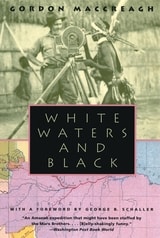
White Waters and Black
Gordon MacCreagh
University of Chicago Press, 2001