Results by title
13 books match the query 'Screenwriters'
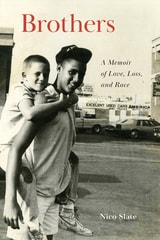
Brothers
A Memoir of Love, Loss, and RaceNico Slate
Temple University Press, 2023
Brothers is Nico Slate’s poignant memoir about Peter Slate, aka XL, a Black rapper and screenwriter whose life was tragically cut short. Nico and Peter shared the same White American mother but had different fathers. Nico’s was White; Peter’s was Black. Growing up in California in the 1980s and 1990s, Nico often forgot about their racial differences until one night in March 1994 when Peter was attacked by a White man in a nightclub in Los Angeles.
Nico began writing Brothers with the hope that investigating the attack would bring him closer to Peter. He could not understand that night, however, without grappling with the many ways race had long separated him from his brother.
This is a memoir of loss—the loss of a life and the loss at the heart of our racial divide—but it is also a memoir of love. The love between Nico and Peter permeates every page of Brothers. This achingly beautiful memoir presents one family’s resilience on the fault lines of race in contemporary America.
Cinema Today
A Conversation with Thirty-nine Filmmakers from around the WorldOumano, Elena
Rutgers University Press, 2011
Can't spare the time from work or class? Travel expense too great? What? You can't even find such a collaborative event?
Then imagine curling up with a good book, maybe a shot of espresso in hand, and becoming engrossed in the exciting and informative conversation that Elena Oumano has ingeniously crafted from her personal and individual interviews with these artists. Straying far from the usual choppy question-and-answer format, Cinema Today saves you from plowing through another tedious read, in which the same topics and issues are directed to each subject, over and over-an experience that is like being trapped in a revolving door.
Oumano stops that revolving door by following a lively symposium-in-print format, with the filmmakers' words and thoughts grouped together under various key cinema topics. It is as though these experts are speaking to each other and you are their audience--collectively they reflect on and explore issues and concerns of modern filmmaking, from the practical to the aesthetic, including the process, cinematic rhythm and structure, and the many aspects of the media: business, the viewer, and cinema's place in society. Whether you are a movie lover, a serious student of cinema, or simply interested in how we communicate in today's global village through films that so profoundly affect the world, Cinema Today is for you.
Filming Difference
Actors, Directors, Producers, and Writers on Gender, Race, and Sexuality in FilmEdited by Daniel Bernardi
University of Texas Press, 2009
Addressing representation and identity in a variety of production styles and genres, including experimental film and documentary, independent and mainstream film, and television drama, Filming Difference poses fundamental questions about the ways in which the art and craft of filmmaking force creative people to confront stereotypes and examine their own identities while representing the complexities of their subjects.
Selections range from C. A. Griffith's "Del Otro Lado: Border Crossings, Disappearing Souls, and Other Transgressions" and Celine Perreñas Shimizu's "Pain and Pleasure in the Flesh of Machiko Saito's Experimental Movies" to Christopher Bradley's "I Saw You Naked: 'Hard' Acting in 'Gay' Movies," along with Kevin Sandler's interview with Paris Barclay, Yuri Makino's interview with Chris Eyre, and many other perspectives on the implications of film production, writing, producing, and acting.
Technical aspects of the craft are considered as well, including how contributors to filmmaking plan and design films and episodic television that feature difference, and how the tools of cinema—such as cinematography and lighting—influence portrayals of gender, race, and sexuality. The struggle between economic pressures and the desire to produce thought-provoking, socially conscious stories forms another core issue raised in Filming Difference. Speaking with critical rigor and creative experience, the contributors to this collection communicate the power of their media.

Hardboiled in Hollywood
Five Black Mask Writers and the MoviesUniversity of Wisconsin Press, 1991
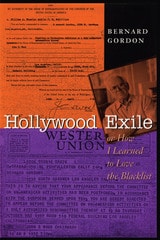
Hollywood Exile, or How I Learned to Love the Blacklist
By Bernard Gordon
University of Texas Press, 2000
The Hollywood blacklist, which began in the late 1940s and ran well into the 1960s, ended or curtailed the careers of hundreds of people accused of having ties to the Communist Party. Bernard Gordon was one of them. In this highly readable memoir, he tells a engrossing insider's story of what it was like to be blacklisted and how he and others continued to work uncredited behind the scenes, writing and producing many box office hits of the era.
Gordon describes how the blacklist cut short his screenwriting career in Hollywood and forced him to work in Europe. Ironically, though, his is a success story that includes the films El Cid, 55 Days at Peking, The Thin Red Line, Krakatoa East of Java, Day of the Triffids, Earth vs. the Flying Saucers, Horror Express, and many others. He recounts the making of many movies for which he was the writer and/or producer, with wonderful anecdotes about stars such as Charlton Heston, David Niven, Sophia Loren, Ava Gardner, and James Mason; directors Nicholas Ray, Frank Capra, and Anthony Mann; and the producer-studio head team of Philip Yordan and Samuel Bronston.
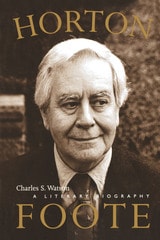
Horton Foote
A Literary BiographyBy Charles S. Watson
University of Texas Press, 2003
Winner of the Pulitzer Prize for Drama for The Young Man from Atlanta and Academy Awards for the screen adaptation of To Kill a Mockingbird and the original screenplay Tender Mercies, as well as the recipient of an Academy Award nomination for the screenplay of The Trip to Bountiful and the William Inge Lifetime Achievement Award, Horton Foote is one of America's most respected writers for stage and screen. The deep compassion he shows for his characters, the moral vision that infuses his social commentary, and the kindness and humanity that Foote himself radiates have also made him one of our most revered artists—the father-figure who understands our longings for home, for human connections, and for certainty in a world largely bereft of these.
This literary biography thoroughly investigates how Horton Foote's life and worldview have shaped his works for stage, television, and film. Tracing the whole trajectory of Foote's career from his small-town Texas upbringing to the present day, Charles Watson demonstrates that Foote has created a fully imagined mythical world from the materials supplied by his own and his family's and friends' lives in Wharton, Texas, in the early twentieth century. Devoting attention to each of Foote's major works in turn, he shows how this world took shape in Foote's writing for the New York stage, Golden Age television, Hollywood films, and in his nine-play masterpiece, The Orphan's Home Cycle. Throughout, Watson's focus on Foote as a master playwright and his extensive use of the dramatist's unpublished correspondence make this literary biography required reading for all who admire the work of Horton Foote.
No One Knows Their Names
Screenwriters in HollywoodJorja Prover
University of Wisconsin Press, 1994
On Story - Screenwriters and Their Craft
Austin Film Festival
University of Texas Press, 2013
Austin Film Festival (AFF) is the first organization of its kind to focus on the writer’s creative contribution to film. Its annual Film Festival and Conference offers screenings, panels, workshops, and roundtable discussions that help new writers and filmmakers connect with mentors and gain advice and insight from masters, as well as refreshing veterans with new ideas. To extend the Festival’s reach, AFF produces On Story, a television series currently airing on PBS-affiliated stations and streaming online that presents footage of high-caliber artists talking candidly and provocatively about the art and craft of screenwriting and filmmaking, often using examples from their own films.
This book distills the advice of renowned, award-winning screenwriters who have appeared on On Story, including John Lee Hancock, Peter Hedges, Lawrence Kasdan, Whit Stillman, Robin Swicord, and Randall Wallace. In their own lively words and stories transcribed from interviews and panel discussions, they cover the entire development of a screenplay, from inspiration, story, process, structure, characters, and dialogue to rewriting and collaboration. Their advice is fresh, practical, and proven—these writers know how to tell a story on screen. Enjoy this collection of ideas and use it to jumpstart your own screenwriting career.
On Story—Screenwriters and Filmmakers on Their Iconic Films
Austin Film Festival, Edited by Barbara Morgan and Maya Perez
University of Texas Press, 2016
“On Story is film school in a box, a lifetime’s worth of filmmaking knowledge squeezed into half-hour packages.”
—Kenneth Turan, film critic for the Los Angeles Times
Austin Film Festival (AFF) is the first organization focused on the writer’s creative contribution to film. Its annual Film Festival and Conference offers screenings, panels, workshops, and roundtable discussions that help new writers and filmmakers connect with mentors and gain advice and insight from masters, as well as refreshing veterans with new ideas. To extend the festival’s reach, AFF produces On Story, a television series currently airing on PBS-affiliated stations and streaming online that presents footage of high-caliber artists talking candidly and provocatively about the art and craft of screenwriting and filmmaking, often using examples from their own films.
On Story—Screenwriters and Filmmakers on Their Iconic Films presents renowned, award-winning screenwriters and filmmakers discussing their careers and the stories behind the production of their iconic films such as L.A. Confidential, Thelma & Louise, Groundhog Day, Guardians of the Galaxy, The Silence of the Lambs, In the Name of the Father, Apollo 13, and more. In their own lively words transcribed from interviews and panel discussions, Ron Howard, Callie Khouri, Jonathan Demme, Ted Tally, Jenny Lumet, Harold Ramis, and others talk about creating stories that resonate with one’s life experiences or topical social issues, as well as how to create appealing characters and bring them to life. Their insights, production tales, and fresh, practical, and proven advice make this book ideal for film lovers, screenwriting students, and filmmakers and screenwriters seeking inspiration.
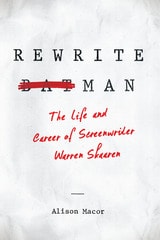
Rewrite Man
The Life and Career of Screenwriter Warren SkaarenBy Alison Macor
University of Texas Press, 2017
In Rewrite Man, Alison Macor tells an engrossing story about the challenges faced by a top screenwriter at the crossroads of mixed and conflicting agendas in Hollywood. Whether writing love scenes for Tom Cruise on the set of Top Gun, running lines with Michael Keaton on Beetlejuice, or crafting Nietzschean dialogue for Jack Nicholson on Batman, Warren Skaaren collaborated with many of New Hollywood’s most powerful stars, producers, and directors. By the time of his premature death in 1990, Skaaren was one of Hollywood’s highest-paid writers, although he rarely left Austin, where he lived and worked. Yet he had to battle for shared screenwriting credit on these films, and his struggles yield a new understanding of the secretive screen credit arbitration process—a process that has only become more intense, more litigious, and more public for screenwriters and their union, the Writers Guild of America, since Skaaren’s time. His story, told through a wealth of archival material, illuminates crucial issues of film authorship that have seldom been explored.
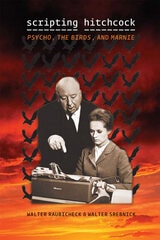
Scripting Hitchcock
Psycho, The Birds, and MarnieWalter Raubicheck and Walter Srebnick
University of Illinois Press, 2011
Hitchcock allowed his writers a great deal of creative freedom, which resulted in dynamic screenplays that expanded traditional narrative and defied earlier conventions. Critically examining the question of authorship in film, Raubicheck and Srebnick argue that Hitchcock did establish visual and narrative priorities for his writers, but his role in the writing process was that of an editor. While the writers and their contributions have generally been underappreciated, this study reveals that all the dialogue and much of the narrative structure of the films were the work of screenwriters Jay Presson Allen, Joseph Stefano, and Evan Hunter. The writers also shaped American cultural themes into material specifically for actors such as Janet Leigh, Tippi Hedren, and Tony Perkins. This volume gives due credit to those writers who gave narrative form to Hitchcock's filmic vision.
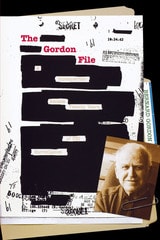
The Gordon File
A Screenwriter Recalls Twenty Years of FBI SurveillanceBy Bernard Gordon
University of Texas Press, 2004
For twenty-six years, the FBI devoted countless hours of staff time and thousands of U.S. taxpayer dollars to the surveillance of an American citizen named Bernard Gordon. Given the lavish use of resources, one might assume this man was a threat to national security or perhaps a kingpin of organized crime—not a Hollywood screenwriter whose most subversive act was joining the Communist Party during the 1940s when we were allied with the USSR in a war against Germany. For this honest act of political dissent, Gordon came to be investigated by the House Committee on Un-American Activities in 1952, blacklisted by the Hollywood film industry, and tailed by the FBI for over two decades.
In The Gordon File, Bernard Gordon tells the compelling, cautionary story of his life under Bureau surveillance. Drawing on his FBI file of over 300 pages, which he obtained under the Freedom of Information Act, he traces how the Bureau followed him from Hollywood to Mexico, Paris, London, Rome, and even aboard a Dutch freighter as he created an unusually successful, albeit uncredited, career as a screenwriter and producer during the blacklist years. Comparing his actual activities during that time to records in the file, he pointedly and often humorously underscores how often the FBI got it wrong, from the smallest details of his life to the main fact of his not being a threat to national security.
Most important, Gordon links his personal experience to the headlines of today, when the FBI is again assuming broad powers to monitor political dissidents it deems a threat to the nation. "Is it possible," he asks, "that books like this will help to move our investigative agencies from the job of blackmailing those who are critical of our imperfect democracy to arresting those who are truly out to destroy us?"
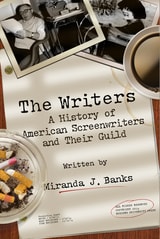
The Writers
A History of American Screenwriters and Their GuildBanks, Miranda J
Rutgers University Press, 2016