Results by title

7 books match the query 'Sea-power'
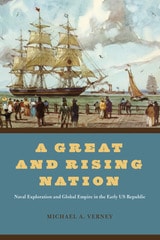
cover of A Great and Rising Nation: Naval Exploration and Global Empire in the Early US Republic

A Great and Rising Nation

Naval Exploration and Global Empire in the Early US Republic

Michael A. Verney

University of Chicago Press, 2022

A Great and Rising Nation illuminates the unexplored early decades of the United States’ imperialist naval aspirations.

Conventional wisdom holds that, until the Spanish-American War of 1898, the United States was a feeble player on the world stage, with an international presence rooted in commerce rather than military might. Michael A. Verney’s A Great and Rising Nation flips this notion on its head, arguing that early US naval expeditions, often characterized as merely scientific, were in fact deeply imperialist. Circling the globe from the Mediterranean to South America and the Arctic, these voyages reflected the diverse imperial aspirations of the new republic, including commercial dominance in the Pacific World, religious empire in the Holy Land, proslavery expansion in South America, and diplomatic prestige in Europe. As Verney makes clear, the United States had global imperial aspirations far earlier than is commonly thought.
[more]
cover of All the Boats on the Ocean: How Government Subsidies Led to Global Overfishing

All the Boats on the Ocean

How Government Subsidies Led to Global Overfishing

Carmel Finley

University of Chicago Press, 2017

Most current fishing practices are neither economically nor biologically sustainable. Every year, the world spends $80 billion buying fish that cost $105 billion to catch, even as heavy fishing places growing pressure on stocks that are already struggling with warmer, more acidic oceans. How have we developed an industry that is so wasteful, and why has it been so difficult to alter the trajectory toward species extinction?

In this transnational, interdisciplinary history, Carmel Finley answers these questions and more as she explores how government subsidies propelled the expansion of fishing from a coastal, in-shore activity into a global industry. While nation states struggling for ocean supremacy have long used fishing as an imperial strategy, the Cold War brought a new emphasis: fishing became a means for nations to make distinct territorial claims. A network of trade policies and tariffs allowed cod from Iceland and tuna canned in Japan into the American market, destabilizing fisheries in New England and Southern California. With the subsequent establishment of tuna canneries in American Samoa and Puerto Rico, Japanese and American tuna boats moved from the Pacific into the Atlantic and Indian Oceans after bluefin. At the same time, government subsidies in nations such as Spain and the Soviet Union fueled fishery expansion on an industrial scale, with the Soviet fleet utterly depleting the stock of rosefish (or Pacific ocean perch) and other groundfish from British Columbia to California. This massive global explosion in fishing power led nations to expand their territorial limits in the 1970s, forever changing the seas.

Looking across politics, economics, and biology, All the Boats on the Ocean casts a wide net to reveal how the subsidy-driven expansion of fisheries in the Pacific during the Cold War led to the growth of fisheries science and the creation of international fisheries management. Nevertheless, the seas are far from calm: in a world where this technologically advanced industry has enabled nations to colonize the oceans, fish literally have no place left to hide, and the future of the seas and their fish stocks is uncertain.
[more]
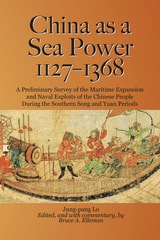
cover of China as a Sea Power, 1127–1368: A Preliminary Survey of the Maritime Expansion and Naval Exploits of the Chinese People During the Southern Song and Yuan Periods

China as a Sea Power, 1127–1368

A Preliminary Survey of the Maritime Expansion and Naval Exploits of the Chinese People During the Southern Song and Yuan Periods

Lo Jung-pang

National University of Singapore Press, 2012

Lo Jung-pang argues that during each of the three periods when imperial China embarked on maritime enterprises (the Qin and Han dynasties, the Sui and early Tang dynasties, and Song, Yuan, and early Ming dynasties), coastal states took the initiative at a time when China was divided, maritime trade and exploration subsequently peaked when China was strong and unified, and declined as Chinese power weakened. At such times, China's people became absorbed by internal affairs, and state policy focused on threats from the north and the west. These cycles of maritime activity, each lasting roughly five hundred years, corresponded with cycles of cohesion and division, strength and weakness, prosperity and impoverishment, expansion and contraction.


In the early 21st century, a strong and outward looking China is again building up its navy and seeking maritime dominance, with important implications for trade, diplomacy and naval affairs. Events will not necessarily follow the same course as in the past, but Lo Jung-pang's analysis suggests useful questions for the study of events as they unfold and decades to come.
[more]
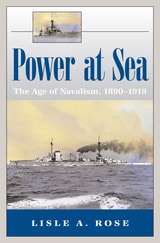
cover of Power at Sea, Volume 1: The Age of Navalism, 1890-1918

Power at Sea, Volume 1

The Age of Navalism, 1890-1918

Lisle A. Rose

University of Missouri Press, 2006
The twentieth century was preeminently an age of warring states and collapsing empires. Industrialism brought not peace but the sword. And the tip of that sword was sea power.
In Power at Sea, Lisle A. Rose gives us an unprecedented narrative assessment of modern sea power, how it emerged from the Age of Fighting Sail, how it was employed in war and peace, and how it has shaped the life of the human community over the past century and a quarter. In this first volume, Rose recalls the early twentieth-century world of emerging, predatory industrial nations engaging in the last major scramble for global markets and empire. In such times, an imposing war fleet was essential to both national security and international prestige. Battleship navies became pawns of power politics, and between 1890 and 1914 four of them--Britain’s Royal Navy, the Imperial German Navy, the Japanese Navy, and the U.S. Navy--set the tone and rhythm of international life.
Employing a global canvas, Rose portrays the increasingly frantic naval race between Britain and Germany that did so much to bring about the First World War; he takes us aboard America’s Great White Fleet as it circumnavigated the world between 1907 and 1909, leaving in its wake both goodwill and jealousy; he details Japan’s growing naval and military power and the hunger for unlimited expansion that resulted.
Important naval battles were fought in those days of ostensible peace, and Rose brings to life the encounters of still young and relatively small industrial fighting fleets at Manila Bay and Tsushima. He also takes us into the huge naval factories where the engines of war were forged. He invites us aboard the imperial battleships and battle cruisers, exploring the dramatically divided worlds of the officers’ lordly wardroom with its clublike atmosphere and the often foul and fetid enlisted men’s quarters.
The Age of Navalism climaxed in the epic First World War Battle of Jutland, in which massive guns and maneuvering dreadnoughts determined that Imperial Germany would become the latest in a line of ambitious naval powers that failed to shake Britannia’s rule of the waves. Germany’s subsequent use of a revolutionary new strategy, unrestricted submarine warfare, nearly brought Britain to its knees, reduced the level of naval combat to barbarism, and brought the United States into the war with its own substantial navy, ultimately turning the tide of battle.
Focusing as much on social issues and technological advances as on combat, Power at Sea: The Age of Navalism tells a compelling story of newfound power that is fascinating in its own right. Yet, it is merely a prologue to more startling accounts contained in the author’s succeeding volumes.
[more]
cover of Power at Sea, Volume 2: The Breaking Storm, 1919-1945

Power at Sea, Volume 2

The Breaking Storm, 1919-1945

Lisle A. Rose

University of Missouri Press, 2006
After 1921, the clouds of suspicion and resentment left by the Great War gradually obscured the strenuous efforts of negotiating statesmen and led to ever greater appetites for power at sea. By the midthirties, worried admiralties around the world were bracing themselves for a new and deadlier round of global violence. In this monumental study, Lisle A. Rose revisits the strategies, battles, ships, planes, weapons, and people of the most destructive war in history to show the decisive influence of sea power upon its outcome.
During the years preceding World War II, Britain’s once dominant Royal Navy, beset by national economic decline and steadily eroding morale within the fleet, pleaded for the appeasement of dictators in Europe and the Far East in an attempt to avoid a three-front maritime war that would surely doom the British Empire. Desperately hoping for time to build a formidable fleet, Hitler’s admirals feverishly tried to rebuild German naval weaponry upon a technological foundation not much improved since 1918. In the end, it was Japan and the United States, facing each other across the broad Pacific, that moved naval history into a new phase by fashioning ultramodern navies based on the integration of sea, air, and amphibious forces.
Rose relates how the strengths and weaknesses of seafaring nations came into play within the crucible of a six-year war during which naval encounters were every bit as critical and frequent as land-based fighting. He recounts the well-known naval battles and operations of World War II from a novel perspective, placing them in the context of daring gambles open to both the Axis and the Allies that were either seized upon or ignored. Once Britain’s survival was assured, and the Allies held on in the North Atlantic and the Pacific, however, the superior industrial culture of the United States doomed the Axis. After 1943, America threw into the deadly battles against the German U-boats and the Japanese fleet more and better ships, more and better citizen sailors, better intelligence, and better strategies than did its antagonists or allies.
Two years later, the United States had not only defeated the Axis, it had also won control of the world’s oceans from its exhausted British ally. In the process, it had begun a revolutionary transition in which power at sea became power from the sea. Whether recounting the heart-stopping action of naval encounters or analyzing the technologies that made victory possible, Rose traces in vigorous, memorable prose the dramatic emergence of a new naval power that would leave all others in its wake.
[more]
cover of Power at Sea, Volume 3: A Violent Peace, 1946-2006

Power at Sea, Volume 3

A Violent Peace, 1946-2006

Lisle A. Rose

University of Missouri Press, 2006
Bringing to a close his epic recounting of naval power in the twentieth century, Lisle Rose describes the virtual disappearance after 1945 of all but one great navy, whose existence and operations over the next sixty years guaranteed a freedom of the seas so complete as to be at once universally acknowledged and ignored.
In the first twenty years after World War II, the U.S. Navy continued the revolutionary transformation of sea power begun in the 1930s with the integration of sea, air, and amphibious capabilities. Between 1946 and 1961, the United States placed on, above, and beneath the world’s oceans the mightiest concentration of military power in history. Supercarriers filled with aircraft capable of long-range nuclear strikes were joined by strategic ballistic missile submarines, even one of whose sixteen nuclear-tipped missiles could devastate most of an enemy’s major urban centers together with its industrial and military infrastructure.
Such a fleet was incredibly costly. No ally or adversary in a world recovering slowly from global war could afford to build and maintain such an awesome entity. Its needs constantly had to be balanced against competing requirements of a broader national defense establishment. But the U.S. Navy ensured an unchallenged Pax Americana, and its warships steamed where they wished throughout the globe in support of a policy to contain the influence and threat represented by the Soviet Union and China.
The 1962 Cuban missile crisis, however, galvanized the Soviet leadership to construct a powerful blue-water fleet that within less than a decade began to challenge the United States for global maritime supremacy, even as its own ballistic missile boats posed a massive threat to U.S. national security. While the Soviets enjoyed the luxury of building exclusively against the U.S. Navy and challenging it at almost every point, America’s sailors were increasingly burdened by a broad array of specific missions: fighting two regional wars in Asia, intervening in Lebanon, protecting Taiwan, aiding in the preservation of Israel, and maintaining close surveillance of Cuba, chief among them. Confronting ever-growing Soviet sea power stretched U.S. capabilities to the limit even as the fleet itself underwent revolutionary changes in its social composition.
The abrupt decline and fall of the Soviet Union after 1989 led to another reappraisal of the importance, even necessity, of navies. But the turbulent Middle East and the struggle against international terrorism after 2001 have demanded a projection of sea-air-amphibious power onto coasts and adjacent areas similar to that which America’s fleets had already undertaken in Korea, Vietnam, and Lebanon.
The U.S. Navy now sails on the front line of defense against terrorism—a threat that confronts strategists with the greatest challenge yet to the ongoing relevance of maritime power. This third volume of Rose’s majestic work offers readers an up-close look at the emergence of America’s naval might and establishes Power at Sea as essential in tracing the emergence of U.S. dominance and understanding the continuing importance of ships and sailors in international power plays.
[more]
cover of Too Far on a Whim: The Limits of High-Steam Propulsion in the US Navy

Too Far on a Whim

The Limits of High-Steam Propulsion in the US Navy

Tyler A. Pitrof

University of Alabama Press, 2024

WINNER OF THE LYMAN BOOK AWARD FOR MARITIME AND NAVAL SCIENCE, TECHNOLOGY, AND ENVIRONMENT

Argues that the US Navy’s commitment to high-steam propulsion for its World War II fleet was a tactical, technological, and bureaucratic failure

In Too Far on a Whim, Tyler A. Pitrof presents a high-spirited revision of the US Navy’s commitment to high-steam propulsion systems, the mainstay of its World War II fleets. Pitrof’s research persuasively demonstrates that in its war against the Imperial Japanese Navy, the US Navy succeeded despite its high-steam propulsion systems rather than because of them.

War with an aggressive Japan and a resurgent Germany loomed in the dark days of the late 1930s. Rear Admiral Harold G. Bowen Sr., head of the US Navy’s Bureau of Engineering, advanced a radical vision: a new fleet based on high-steam propulsion, a novel technology that promised high speeds with smaller engines and better fuel efficiency. High-steam engines had drawbacks—smaller operational ranges and maintenance issues. Nevertheless, trusting its engineers to resolve these issues, the US Navy put high-steam propulsion at the heart of its warship design from 1938 to 1945.

The official record of high-steam technology’s subsequent performance has relied heavily on Bowen’s own memoir, in which he painted high-steam innovation in heroic colors. Pitrof’s empirical review of primary sources such as ship’s maintenance records, however, illuminates the opposite—that the heroism lay in the ability of American seamen to improvise solutions to keep these difficult engines running.

Pitrof artfully explains engineering concepts in layman’s terms and provides an account that extends far beyond technology and into matters of naval hierarchies and bureaucracy, strategic theory, and ego. He offers a cautionary tale—as relevant to any endeavor as it is to military undertakings—about how failures arise when technical experts lack managers who understand their work. Admiral Bowen wielded excessive power because no one else in the US Navy knew enough to countermand him.

Compulsively readable, Too Far on a Whim is a landmark for those interested in naval history and technology but also for readers interested in the interplay between innovation, decision-making, and engineering.
 

[more]