Results by title
10 books match the query 'See'
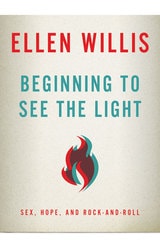
Beginning to See the Light
Sex, Hope, and Rock-and-RollEllen Willis
University of Minnesota Press, 2012
From the New Yorker’s inimitable first pop music critic comes this pioneering collection of essays by a conscientious writer whose political realm is both radical and rational, and whose prime preoccupations are with rock ’n’ roll, sexuality, and above all, freedom. Here Ellen Willis assuredly captures the thrill of music, the disdain of authoritarian culture, and the rebellious spirit of the ’60s and ’70s.

Happy Tails Across New Jersey
Things to See and Do with Your Dog in the Garden StateGoodspeed, Diane
Rutgers University Press, 2006
In this first-of-its-kind guidebook, Diane Goodspeed brings the encouraging news to pet lovers that their furry friends are welcome to many of New Jersey's beaches, trails, parks, swim holes, and even stores. Whether you are hiking in the Kittatinny Mountains, going for a run on the beach, or playing fetch along the Delaware River, you and your dog can explore New Jersey together. From transportation and equipment to basic obedience and fitness conditioning, this guide contains all the information you need to get your dog out the door for exciting adventures in every season.
Organized by county for easy reference, you will find information about county, state, and national parks that will welcome your canine companion. The book also functions as a convenient handbook for shops, covering everything from high-end pet stores and large chains to independently run dog bakeries. Goodspeed identifies training facilities, the most reputable and well-established dog trainers, as well as shelters, rescue centers, and every dog park across the state. Whether you are a long-time dog owner, or new to the canine scene, you will be surprised by how many dog-friendly events, including walk-a-thons, fairs, canine sporting competitions, town festivals, dog parades, and fundraising events for rescue groups occur annually throughout New Jersey.
Finally, with your leash in one hand and this indispensable and all-inclusive guide in the other, you can enjoy the exciting recreational opportunities available in the Garden State with your favorite four-legged friend.
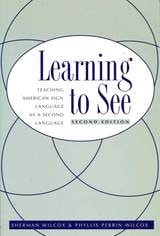
Learning To See
American Sign Language as a Second LanguageSherman Wilcox
Gallaudet University Press, 1997
Learning to See lays solid groundwork for teaching and studying ASL by outlining the structure of this unique visual language. Myths and misconceptions about ASL are laid to rest at the same time that the fascinating, multifaceted elements of Deaf culture are described. Students will be able to study ASL and gain a thorough understanding of the cultural background, which will help them to grasp the language more easily. An explanation of the linguistic basis of ASL follows, leading into the specific, and above all, useful information on teaching techniques.
This practical manual systematically presents the steps necessary to design a curriculum for teaching ASL, including the special features necessary for training interpreters. The new Learning to See again takes its place at the forefront of texts on teaching ASL as a second language, and it will prove to be indispensable to educators and administrators in this special discipline.
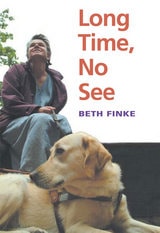
Long Time, No See
Beth Finke
University of Illinois Press, 2003
With unflinching candor and acerbic wit, Finke chronicles the progress of the juvenile diabetes that left her blind at the age of twenty-six as well as the seemingly endless spiral of adversity that followed. First she was forced out of her professional job. Then she bore a multiply handicapped son. But she kept moving forward, confronting marital and financial problems and persevering through a rocky training period with a seeing-eye dog.
Finke’s life story and her commanding knowledge of her situation give readers a clear understanding of diabetes, blindness, and the issues faced by parents of children with significant disabilities. Because she has taken care to include accurate medical information as well as personal memoir, Long Time, No See serves as an excellent resource for others in similar situations and for professionals who deal with disabled adults or children.
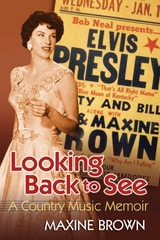
Looking Back to See
A Country Music MemoirMaxine Brown
University of Arkansas Press, 2005
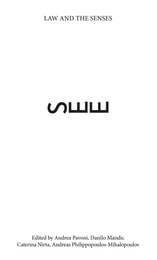
SEE
Andrea Pavoni, Danilo Mandic, Caterina Nirta and Andreas Philippopoulos-Mihalopoulos
University of Westminster Press, 2018
Vision traditionally occupies the height of the sensorial hierarchy. The sense of clarity and purity conveyed by vision, allows it to be explicitly associated with truth and knowledge. The law has always relied on vision and representation, from eye-witnesses to photography, to imagery and emblems. The law and its normative gaze can be understood as that which decrees what is permitted to be and become visible and what is not. Indeed, even if law’s perspectival view is bound to be betrayed by the realities of perception, it is nonetheless productive of real effects on the world.
This first title in the interdisciplinary series ‘Law and the Senses’ asks how we can develop new theoretical approaches to law and seeing that go beyond a simple critique of the legal pretension to truth. This volume aims to understand how law might see and unsee, and how in its turn is seen and unseen. It explores devices and practices of visibility, the evolution of iconology and iconography, and the relation between the gaze of the law and the blindness of justice. The contributions, all radically interdisciplinary, are drawn from photography, legal theory, philosophy, and poetry.
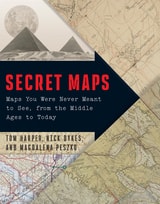
Secret Maps
Maps You Were Never Meant to See, from the Middle Ages to TodayTom Harper, Nick Dykes, and Magdalena Peszko
University of Chicago Press, 2025
An illustrated story of the relationship between mapping and secrecy, charting the role maps played in concealing and revealing knowledge across centuries.
Is there anything more intriguing than a secret map? One that reveals clandestine information or meanings, or a map that is itself a secret? Secret Maps features over one hundred examples of these kinds of maps, connected by their varied relationships to secrecy, and ranging from the twelfth to the twenty-first centuries and across the globe. They include views into state secrecy and power—such as maps used for domestic and military purposes, imperial expansion, espionage, and surveillance as well as those with private or commercial uses, such as charts of private land, trade routes, or the flights of private jets. The maps span widely in their scope and cover issues of broad interest, from old-fashioned spying to contemporary concerns about technology and privacy.
As illuminating as it is thrilling, Secret Maps unearths the once-hidden routes, landscapes, and locations that have covertly shaped our world.
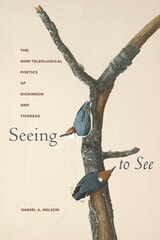
Seeing to See
The Non-Teleological Poetics of Dickinson and ThoreauDaniel A. Nelson
University of Massachusetts Press, 2025
Seeing to See focuses on two American authors who are notoriously hard to classify: Emily Dickinson and Henry David Thoreau. Dickinson proves challenging due to her short and obscure poems and Thoreau due to his insistence on capturing even the most seemingly mundane information. Daniel A. Nelson uncovers evidence that the works of these authors are often intentionally and painstakingly without aim or purpose. He argues that in their texts there is in fact an avoidance of teleological structures of writing and thinking, whereby a thing’s—or a word’s, or a text’s—value hinges on its relation to the world or other contexts.
In Nelson’s reading, Thoreau and Dickinson seem to be able to set aside all thought of distinct personal and professional goals, through which readers typically try to make an overarching sense out of, and to derive some form of profit from, disparate experiences, events, actions, and feelings. Further, both authors seem to be able to get outside of the worldview according to which the value and meaning of something, be it a natural object, a word, or an experience, is a function of its participation in a larger system. Examples of such systems include an ecosystem, taxonomic system, or syntactic system; a writer’s career, or life, or philosophy; even a single poem or journal entry. In the absence of such connections to broader categorical spheres, both writers force readers to contemplate the ineffable, constantly changing relation between words and the natural world. This contemporary reading of two iconic writers reframes their work and how readers think of nature, accepting, as these authors did, the potential freedom of the unknown.
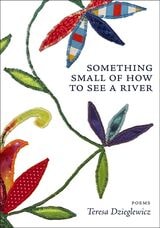
Something Small of How to See a River
Teresa Dzieglewicz
Tupelo Press, 2025
Something Small of How to See a River interrogates the idea of narrative. Who gets to tell a story and what does it mean when the official story, the story told by the governor, the police, or the local media, is a fundamentally dishonest one? The poems collected here meditate on failure: how systems fail us and our environment, how whiteness fails to hold itself accountable, how future generations and the land are being failed—and how, in the face of all this, the Standing Rock movement was not a failure. At the heart of this collection is the strength, care, and radical joy of the movement, which shines through and against the violence.
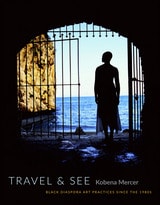
Travel & See
Black Diaspora Art Practices since the 1980sKobena Mercer
Duke University Press, 2016