Results by title
19 books match the query 'Selection and appointment'
A Supreme Court Unlike Any Other
The Deepening Divide Between the Justices and the PeopleKevin J. McMahon
University of Chicago Press, 2024
A data-rich examination of the US Supreme Court's unprecedented detachment from the democratic processes that buttress its legitimacy.
Today’s Supreme Court is unlike any other in American history. This is not just because of its jurisprudence but also because the current Court has a tenuous relationship with the democratic processes that help establish its authority. Historically, this “democracy gap” was not nearly as severe as it is today. Simply put, past Supreme Courts were constructed in a fashion far more in line with the promise of democracy—that the people decide and the majority rules.
Drawing on historical and contemporary data alongside a deep knowledge of court battles during presidencies ranging from FDR to Donald Trump, Kevin J. McMahon charts the developments that brought us here. McMahon offers insight into the altered politics of nominating and confirming justices, the shifting pool of Supreme Court hopefuls, and the increased salience of the Court in elections. A Supreme Court Unlike Any Other is an eye-opening account of today’s Court within the context of US history and the broader structure of contemporary politics.
Administering Justice
Placing the Chief Justice in American State PoliticsRichard L. Vining Jr. and Teena Wilhelm
University of Michigan Press, 2023
Administering Justice examines the leadership role of chief justices in the American states, including how those duties require chief justices to be part of the broader state political environment. Vining and Wilhelm focus extensively on the power of chief justices as public spokespersons, legislative liaisons, and reform leaders. In contrast to much existing research on chief justices in the states, this study weighs their extrajudicial responsibilities rather than intracourt leadership. By assessing the content of State of the Judiciary remarks delivered over a period of sixty years, Vining and Wilhelm are able to analyze the reform agendas advanced by chief justices and determine what factors influence the likelihood of success. These analyses confirm that chief justices engage with state politics in meaningful ways and that reactions to their proposals are influenced by ideological congruence with other political elites and the scope of their requests. Administering Justice also examines the chief justice position as an institution, provides a collective profile of its occupants, and surveys growing diversity among court leaders.

American Architects and the Mechanics of Fame
By Roxanne Kuter Williamson
University of Texas Press, 1991
Why does one talented individual win lasting recognition in a particular field, while another equally talented person does not? While there are many possible reasons, one obvious answer is that something more than talent is requisite to produce fame. The "something more" in the field of architecture, asserts Roxanne Williamson, is the association with a "famous" architect at the moment he or she first receives major publicity or designs the building for which he or she will eventually be celebrated.
In this study of more than six hundred American architects who have achieved a place in architectural histories, Williamson finds that only a small minority do not fit the "right person–right time" pattern. She traces the apprenticeship connection in case studies of Louis Sullivan, Frank Lloyd Wright, Henry Hobson Richardson, the firm of McKim, Mead & White, Latrobe and his descendants, the Bulfinch and Renwick Lines, the European immigrant masters, and Louis Kahn.
Although she acknowledges and discusses the importance of family connections, the right schools, self-promotion, scholarships, design competition awards, and promotion by important journals, Williamson maintains that the apprenticeship connection is the single most important predictor of architectural fame. She offers the intriguing hypothesis that what is transferred in the relationship is not a particular style or approach but rather the courage and self-confidence to be true to one's own vision. Perhaps, she says, this is the case in all the arts.
American Architects and the Mechanics of Fame is sure to provoke thought and comment in architecture and other creative fields.
Choosing State Supreme Court Justices
Merit Selection and the Consequences of Institutional ReformGreg Goelzhauser
Temple University Press, 2016
Since 1940, more than half of all states have switched at least in part from popular election or elite appointment to experiment with merit selection in choosing some or all of their state supreme court justices. Under merit selection, a commission—often comprising some combination of judges, attorneys, and the general public—is tasked with considering applications from candidates vying to fill a judicial vacancy. Ostensibly, the commission forwards the best candidates to the governor, who ultimately appoints them. Presently, numerous states are debating whether to adopt or abolish merit selection.
In his short, sharp book, Choosing State Supreme Court Justices, Greg Goelzhauser utilizes new data on more than 1,500 state supreme court justices seated from 1960 through 2014 to answer the question, Does merit selection produce better types of judges? He traces the rise of merit selection and explores whether certain judicial selection institutions favor candidates who have better qualifications, are more diverse, and have different types of professional experience.
Goelzhauser’s results ultimately contribute to the broader debate concerning comparative institutional performance with respect to state judicial selection.

Controlling Our Destiny
A Board Member’s View of Deaf President NowPhilip W. Bravin
Gallaudet University Press, 2020
Bravin recounts the discussions and decision-making that happened behind the scenes leading up to and following the ill-fated announcement. He reflects on the integrity of the process and the internal conflict he experienced as a deaf person who supported a deaf president yet felt compelled to abide by his duties as a board member. After the protests, his leadership was recognized when he was selected as the first deaf chair of the board. Photographs and documents add depth to Bravin’s account, many of which will be seen by the public for the first time. I. King Jordan, the first deaf president of Gallaudet, provides a foreword in which he shares his own unique insight into these events.
Controlling Our Destiny captures the energy and the urgency of DPN. Readers will understand the complexities of the presidential search process and the cultural and historical contexts that triggered the protest. Bravin’s memoir contemplates power, access, community, and the enduring legacy of a movement that inspired deaf people around the world.

Czars in the White House
The Rise of Policy Czars as Presidential Management ToolsJustin S. Vaughn and José D. Villalobos
University of Michigan Press, 2015

Enhancing Diversity
Educators with DisabilitiesRonald J. Anderson
Gallaudet University Press, 1998

How to Stay Afloat in the Academic Library Job Pool
Teresa Y. Neely
American Library Association, 2011
It's Not Personal
Politics and Policy in Lower Court Confirmation HearingsLogan Dancey, Kjersten R. Nelson, and Eve M. Ringsmuth
University of Michigan Press, 2020
In order to be confirmed to a lifetime appointment on the federal bench, all district and circuit court nominees must appear before the Senate Judiciary Committee for a confirmation hearing. Despite their relatively low profile, these lower court judges make up 99 percent of permanent federal judgeships and decide cases that relate to a wide variety of policy areas. To uncover why senators hold confirmation hearings for lower federal court nominees and the value of these proceedings more generally, the authors analyzed transcripts for all district and circuit court confirmation hearings between 1993 and 2012, the largest systematic analysis of lower court confirmation hearings to date. The book finds that the time-consuming practice of confirmation hearings for district and circuit court nominees provides an important venue for senators to advocate on behalf of their policy preferences and bolster their chances of being re-elected. The wide variation in lower court nominees’ experiences before the Judiciary Committee exists because senators pursue these goals in different ways, depending on the level of controversy surrounding a nominee. Ultimately, the findings inform a (re)assessment of the role hearings play in ensuring quality judges, providing advice and consent, and advancing the democratic values of transparency and accountability.
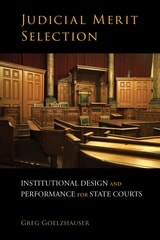
Judicial Merit Selection
Institutional Design and Performance for State CourtsGreg Goelzhauser
Temple University Press, 2019
The judicial selection debate continues. Merit selection is used by a majority of states but remains the least well understood method for choosing judges. Proponents claim that it emphasizes qualifications and diversity over politics, but there is little empirical evidence regarding its performance.
In Judicial Merit Selection, Greg Goelzhauser amasses a wealth of data to examine merit selection’s institutional performance from an internal perspective. While his previous book, Choosing State Supreme Court Justices, compares outcomes across selection mechanisms, here he delves into what makes merit selection unique—its use of nominating commissions to winnow applicants prior to gubernatorial appointment.
Goelzhauser’s analyses include a rich case study from inside a nominating commission’s proceedings as it works to choose nominees; the use of public records to examine which applicants commissions choose and which nominees governors choose; evaluation of which attorneys apply for consideration and which judges apply for promotion; and examination of whether design differences across systems impact performance in the seating of qualified and diverse judges.
The results have critical public policy implications.
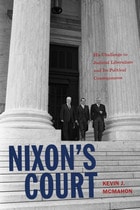
Nixon's Court
His Challenge to Judicial Liberalism and Its Political ConsequencesKevin J. McMahon
University of Chicago Press, 2011
Most analysts have deemed Richard Nixon’s challenge to the judicial liberalism of the Warren Supreme Court a failure—“a counterrevolution that wasn’t.” Nixon’s Court offers an alternative assessment. Kevin J. McMahon reveals a Nixon whose public rhetoric was more conservative than his administration’s actions and whose policy towards the Court was more subtle than previously recognized. Viewing Nixon’s judicial strategy as part political and part legal, McMahon argues that Nixon succeeded substantially on both counts.
Many of the issues dear to social conservatives, such as abortion and school prayer, were not nearly as important to Nixon. Consequently, his nominations for the Supreme Court were chosen primarily to advance his “law and order” and school desegregation agendas—agendas the Court eventually endorsed. But there were also political motivations to Nixon’s approach: he wanted his judicial policy to be conservative enough to attract white southerners and northern white ethnics disgruntled with the Democratic party but not so conservative as to drive away moderates in his own party. In essence, then, he used his criticisms of the Court to speak to members of his “Silent Majority” in hopes of disrupting the long-dominant New Deal Democratic coalition.
For McMahon, Nixon’s judicial strategy succeeded not only in shaping the course of constitutional law in the areas he most desired but also in laying the foundation of an electoral alliance that would dominate presidential politics for a generation.
Pack the Court!
A Defense of Supreme Court ExpansionStephen M. Feldman
Temple University Press, 2021
The United States Supreme Court has numbered nine justices for the past 150 years. But that number is not fixed. With the Democrats controlling the House and Senate during the Biden presidency, they could add justices to the Supreme Court. But would court packing destroy the Court as an apolitical judicial institution? This is the crucial question Stephen Feldman addresses in his provocative book, Pack the Court! He uses a historical, analytical, and political argument to justify court-packing in general and Democratic court-packing more specifically.
Republicans and Democrats alike profess to worry that court-packing will destroy the legitimacy of the Supreme Court as a judicial institution by injecting politics into a purely legal adjudicative process. But as Feldman’s insightful book shows, law and politics are forever connected in judicial interpretation and decision making. Pack the Court! insists that court packing is not the threat to the Supreme Court’s institutional legitimacy that many fear. Given this, Feldman argues that Democrats should pack the Court while they have the opportunity. Doing so might even strengthen the American people’s faith in the Court.
Pursuit of Justices
Presidential Politics and the Selection of Supreme Court NomineesDavid Alistair Yalof
University of Chicago Press, 1999
Yalof draws on the papers of seven modern presidents, from Truman to Reagan, and firsthand interviews with key figures, such as Ramsey Clark, Edwin Meese, and President Gerald Ford. He documents and analyzes the selection criteria these presidents used, the pool of candidates from which they chose, their strategies, and the political pressures affecting their decisions, both successes and failures. Yalof also disputes much conventional wisdom about the selection process, including the widely held view that presidents choose nominees primarily to influence future decisions of the high court. In a substantial epilogue, Yalof offers insightful observations about the selections of Presidents George Bush and Bill Clinton.
By focusing on a neglected area of presidential politics, Yalof offers a fascinating and unprecedented glimpse into the intricate world of executive branch decisionmaking and the Supreme Court appointment process as a whole.
Winner of the 2000 Richard E. Neustadt Award for Best Book on the American Presidency
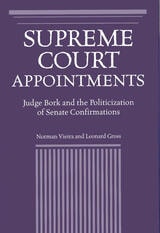
Supreme Court Appointments
Judge Bork and the Politicization of Senate ConfirmationsNorman Vieira and Leonard Gross
Southern Illinois University Press, 1998
Norman Vieira and Leonard Gross provide an in-depth analysis of the political and legal framework surrounding the confirmation process for Supreme Court nominees.
President Ronald Reagan’s nomination of Judge Robert Bork to the Supreme Court met with a fierce opposition that was apparent in his confirmation hearings, which were different in many ways from those of any previous nominee. Lasting longer than any other Supreme Court confirmation battle, the Senate hearings dragged on for eighty-seven hours over a twelve-day period. Bork personally testified for more than thirty hours, outlining his legal philosophy in greater detail than had ever before been required of a Supreme Court nominee. Nor had any previous Supreme Court nominee faced the number of witnesses who testified at the Bork hearings.
Deriving their material from hundreds of in-depth interviews with those who participated in the confirmation hearings, Vieira and Gross present a firsthand account of the behind-the-scenes pressure on senators to oppose Bork. Special-interest groups, they note, attempted to control the confirmation process, with both the media and public-opinion polls playing major roles in the defeat of the nomination. Both liberal and conservative groups used the Bork debate to raise money for political war chests.
This behind-the-scenes view of the politics and personalities involved in the Bork confirmation controversy provides a framework for future debates regarding the confirmation process. To help establish that framework, Vieira and Gross examine the similarities as well as the differences between the Bork confirmation battle and other confirmation proceedings for Supreme Court nominees. They also analyze the Supreme Court nominations made after the Bork hearings, including an extensive examination of the controversial Clarence Thomas nomination.
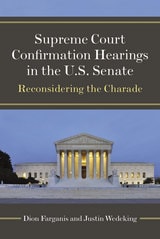
Supreme Court Confirmation Hearings in the U.S. Senate
Reconsidering the CharadeDion Farganis and Justin Wedeking
University of Michigan Press, 2014

The Expert Library
Staffing, Sustaining, And Advancing TheScott Walter
Assoc of College & Research Libraries, 2011
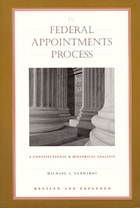
The Federal Appointments Process
A Constitutional and Historical AnalysisMichael J. Gerhardt
Duke University Press, 2003
Michael J. Gerhardt includes each U.S. president’s performance record regarding appointments, accounts of virtually all the major confirmation contests, as well as discussion of significant legal and constitutional questions raised throughout U.S. history. He also analyzes recess appointments, the Vacancies Act, the function of nominees in the appointment process, and the different treatment received by judicial and nonjudicial nominations. While discussing the important roles played by media and technology in federal appointments, Gerhardt not only puts particular controversies in perspective but also identifies important trends in the process, such as how leaders of different institutions attempt to protect—if not expand—their respective prerogatives by exercising their authority over federal appointments. Employing a newly emerging method of inquiry known as “historical institutionalism”—in which the ultimate goal is to examine the development of an institution in its entirety and not particular personalities or periods, this book concludes with suggestions for reforms in light of recent controversies springing from the longest delays in history that many judicial nominees face in the Senate.
Gerhardt’s intensive treatment of the subject will be of interest to students and scholars of political science, government, history, and legal studies.

The Hidden Face of Local Power
Appointed Boards and the Limits of DemocracyMirya R. Holman
Temple University Press, 2025
The Hidden Face of Local Power explicates the purpose, role, and consequences of appointed boards in U.S. cities. Mirya Holman finds cities create strong boards that generate policy, consolidate power, and defend the interests of businesses and wealthy and white residents. In contrast, weak boards pacify agitation from marginalized groups to give the appearance of inclusivity, democratic deliberation, and redistributional policymaking. Cities preserve this strong board/weak board dichotomy through policymaking power, institutional design, and by controlling who serves on the boards.
The Hidden Face of Local Power examines the role of boards in the development of urban political institutions, the allocation of power in local politics, and the persistence of inequality. Holman enhances our understanding of how political institutions have contributed to racism and their impact on how people use and live in urban spaces. In her shrewd analysis of the creation and use of boards as political institutions, Holman proves that neither weak or strong boards achieves the goal they are advertised to achieve. In doing so, she provides a new view of the failures of local democracy along with ideas for improvement.
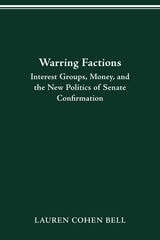
WARRING FACTIONS
INTEREST GROUPS, MONEY, SENATE CONFIRMATIONLAUREN COHEN BELL
The Ohio State University Press, 2002
Warring Factions focuses on the United States Senate’s confirmation process, the constitutional process the Senate uses to approve or reject the president’s choices to fill federal government positions. It is a book about history, the evolution, and, arguably, the decline of the process. Most significantly, it is a book that demonstrates the extent to which interest groups and money have transformed the Senate’s confirmation process into a virtual circus.
Based on in-depth research, including two dozen original interviews with United States senators, former senators and Senate staff members and interest group leaders, this volume demonstrates that today’s confirmation process is nothing more than an extension of the Senate’s legislative work. Changes to internal Senate norms in the 1960s and 1970s, coupled with changes to the external political environment, have allowed interest groups to dominate the Senate confirmation process.