Results by title
32 books match the query 'Self-determination, National'
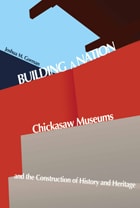
Building a Nation
Chickasaw Museums and the Construction of History and HeritageJoshua M. Gorman
University of Alabama Press, 2011
A groundbreaking study of Indigenous museums and cultural self-representation.
The Chickasaw Nation, an American Indian nation headquartered in southeastern Oklahoma, entered into a period of substantial growth in the late 1980s. Following its successful reorganization and expansion, which was enabled by federal policies for tribal self-determination, the Nation pursued gaming and other industries to affect economic growth. From 1987 to 2009 the Nation’s budget increased exponentially as tribal investments produced increasingly large revenues for a growing Chickasaw population. Coincident to this growth, the Chickasaw Nation began acquiring and creating museums and heritage properties to interpret their own history, heritage, and culture through diverse exhibitionary representations. By 2009, the Chickasaw Nation directed representation of itself at five museum and heritage properties throughout its historic boundaries.
Josh Gorman examines the history of these sites and argues that the Chickasaw Nation is using museums and heritage sites as places to define itself as a coherent and legitimate contemporary Indian nation. In doing so, they are necessarily engaging with the shifting historiographical paradigms as well as changing articulations of how museums function and what they represent. The roles of the Chickasaw Nation’s museums and heritage sites in defining and creating discursive representations of sovereignty are examined within their historicized local contexts. The work describes the museum exhibitions’ dialogue with the historiography of the Chickasaw Nation, the literature of new museum studies, and the indigenous exhibitionary grammars emerging from indigenous museums throughout the United States and the world.

Empire in Denial
The Politics of State-BuildingDavid Chandler
Pluto Press, 2006
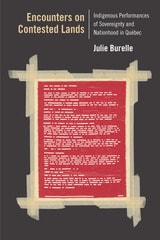
Encounters on Contested Lands
Indigenous Performances of Sovereignty and Nationhood in QuébecJulie Burelle
Northwestern University Press, 2019
Winner, 2020 Ann Saddlemyer Award
Finalist, ATHE Outstanding Book Award for 2020
Mention Spéciale, Société québécoise d'études théâtrale
In Encounters on Contested Lands, Julie Burelle employs a performance studies lens to examine how instances of Indigenous self-representation in Québec challenge the national and identity discourses of the French Québécois de souche—the French-speaking descendants of white European settlers who understand themselves to be settlers no more but rather colonized and rightfully belonging to the territory of Québec.
Analyzing a wide variety of performances, Burelle brings together the theater of Alexis Martin and the film L'Empreinte, which repositions the French Québécois de souche as métis, with protest marches led by Innu activists; the Indigenous company Ondinnok's theater of repatriation; the films of Yves Sioui Durand, Alanis Obomsawin, and the Wapikoni Mobile project; and the visual work of Nadia Myre. These performances, Burelle argues, challenge received definitions of sovereignty and articulate new ones while proposing to the province and, more specifically, to the French Québécois de souche, that there are alternative ways to imagine Québec's future and remember its past.
The performances insist on Québec's contested nature and reframe it as animated by competing sovereignties. Together they reveal how the "colonial present tense" and "tense colonial present" operate in conjunction as they work to imagine an alternative future predicated on decolonization. Encounters on Contested Lands engages with theater and performance studies while making unique and needed contributions to Québec and Canadian studies, as well as to Indigenous and settler-colonial studies.
Equaliberty in the Dutch Caribbean
Ways of Being Non/SovereignYvon van der Pijl
Rutgers University Press, 2022
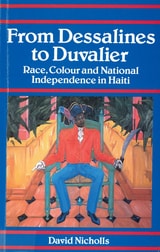
From Dessalines to Duvalier
Race, Colour and National Independence in HaitiNicholls, David
Rutgers University Press, 1996
From Dessalines to Duvalier
Race, Colour and National Independence in HaitiNicholls, David
Rutgers University Press, 1996
Greenland in Arctic Security
(De)securitization Dynamics under Climatic Thaw and Geopolitical FreezeMarc Jacobsen, Ole Wæver, and Ulrik Pram Gad, Editors
University of Michigan Press, 2024
By combining these different analyses, Greenland in Arctic Security provides new, theoretically informed discussions on how security politics can manifest across different scales and territorial borders. At times, these politics can have consequences beyond their original intent. With Greenland geopolitics and securitization theory of current interest to political and academic debates, this book offers timely insights for readers.
Greenlanders, Whales, and Whaling
Sustainability and Self-Determination in the ArcticRichard A. Caulfield
Dartmouth College Press, 2000

High Stakes
Florida Seminole Gaming and SovereigntyJessica R. Cattelino
Duke University Press, 2008
Cattelino presents a vivid ethnographic account of the history and consequences of Seminole gaming. Drawing on research conducted with tribal permission, she describes casino operations, chronicles the everyday life and history of the Seminole Tribe, and shares the insights of individual Seminoles. At the same time, she unravels the complex connections among cultural difference, economic power, and political rights. Through analyses of Seminole housing, museum and language programs, legal disputes, and everyday activities, she shows how Seminoles use gaming revenue to enact their sovereignty. They do so in part, she argues, through relations of interdependency with others. High Stakes compels rethinking of the conditions of indigeneity, the power of money, and the meaning of sovereignty.

Home Rule
National Sovereignty and the Separation of Natives and MigrantsNandita Sharma
Duke University Press, 2020
Huichol Territory and the Mexican Nation
Indigenous Ritual, Land Conflict, and Sovereignty ClaimsPaul M. Liffman
University of Arizona Press, 2011
Liffman writes that “the cultural grounds for territorial claims were what the people I wanted to study wanted me to work on.” Based on six years of collaboration with a land-rights organization, interviews, and participant observation in meetings, ceremonies, and extended stays on remote rancherías, Huichol Territory and the Mexican Nation analyzes the sites where people define Huichol territory. The book’s innovative structure echoes Huichols’ own approach to knowledge and examines the nation and state, not just the community. Liffman’s local, regional, and national perspective informs every chapter and expands the toolkit for researchers working with indigenous communities. By describing Huichols’ ceremonially based placemaking to build a theory of “historical territoriality,” he raises provocative questions about what “place” means for native peoples worldwide.
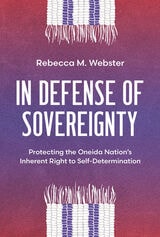
In Defense of Sovereignty
Protecting the Oneida Nation's Inherent Right to Self-DeterminationRebecca M. Webster
University of Wisconsin Press, 2023
As in so many conflicts between Indigenous nations and local municipalities, the media narrative about the Oneida Nation’s battle for sovereignty has been dominated by the local government’s standpoint. In Defense of Sovereignty offers another perspective, that of a nation citizen directly involved in the litigation, augmented by contributions from historians, attorneys, and a retired nation employee. It makes an important contribution to public debates about the inherent right of Indigenous nations to continue to exist and exercise self-governance within their territories without being challenged at every turn.
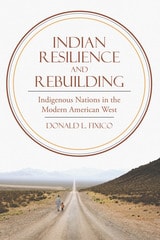
Indian Resilience and Rebuilding
Indigenous Nations in the Modern American WestDonald L. Fixico
University of Arizona Press, 2013
Fixico identifies the tools to this empowerment such as education, navigation within cultural systems, modern Indian leadership, and indigenized political economy. He explains how these tools helped Indian communities to rebuild their nations. Fixico constructs an Indigenous paradigm of Native ethos and reality that drives Indian modern political economies heading into the twenty-first century.
This illuminating and comprehensive analysis of Native nation’s resilience in the twentieth century demonstrates how Native Americans reinvented themselves, rebuilt their nations, and ultimately became major forces in the United States. Indian Resilience and Rebuilding, redefines how modern American history can and should be told.
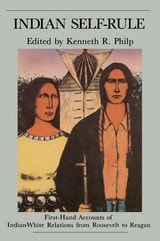
Indian Self Rule
First-Hand Accounts of Indian-White Relations from Roosevelt to Reaganedited by Kenneth R. Philp
Utah State University Press, 1995
Indigenous Movements, Self-Representation, and the State in Latin America
Edited by Kay B. Warren and Jean E. Jackson
University of Texas Press, 2003
Throughout Latin America, indigenous peoples are responding to state violence and pro-democracy social movements by asserting their rights to a greater measure of cultural autonomy and self-determination. This volume's rich case studies of movements in Colombia, Guatemala, and Brazil weigh the degree of success achieved by indigenous leaders in influencing national agendas when governments display highly ambivalent attitudes about strengthening ethnic diversity.
The contributors to this volume are leading anthropologists and indigenous activists from the United States and Latin America. They address the double binds of indigenous organizing and "working within the system" as well as the flexibility of political tactics used to achieve cultural goals outside the scope of state politics. The contributors answer questions about who speaks for indigenous communities, how indigenous movements relate to the popular left, and how conflicts between the national indigenous leadership and local communities play out in specific cultural and political contexts. The volume sheds new light on the realities of asymmetrical power relations and on the ways in which indigenous communities and their representatives employ Western constructions of subjectivity, alterity, and authentic versus counterfeit identity, as well as how they manipulate bureaucratic structures, international organizations, and the mass media to advance goals that involve distinctive visions of an indigenous future.

José de Bustamante and Central American Independence
Colonial Administration in an Age of Imperial CrisisTimothy Hawkins
University of Alabama Press, 2004
The first full-length study of a significant figure of the Spanish Enlightenment
Latin American independence histories of the last 150 years have tended to stereotype Captain General Bustamante, governor of the Spanish colony of Guatemala from 1811 to 1818, as a tyrannical arch-villain who personified colonial oppression. Timothy Hawkins, in contrast, examines Bustamante and his administration within the context of preservation of empire, the effort by colonial officials and partisans to maintain the integrity of the Spanish empire in spite of internal and external unrest.
Based on extensive primary research in the archives of Guatemala, Mexico, and Spain, Hawkins’s approach links the Central American experience to that of areas such as Peru, Venezuela, and Mexico, that also responded equivocally and haphazardly to rebellious uprisings against colonial rule. While conceding that Bustamante’s role in the suppression of unrest turned him into one of the more controversial figures in Latin American history, Hawkins argues that the Bustamante administration should not be seen as an isolated and perverse case of Spanish repression but as an example of a relatively successful, if short lived, campaign by Spain to preserve its empire.
Like the Sound of a Drum
Aboriginal Cultural Politics in Denendeh and NunavutPeter Kulchyski
University of Manitoba Press, 2005
Neoliberalism as Exception
Mutations in Citizenship and SovereigntyAihwa Ong
Duke University Press, 2006
Ong traces how these and other neoliberal exceptions to business as usual are reconfiguring relationships between governing and the governed, power and knowledge, and sovereignty and territoriality. She argues that an interactive mode of citizenship is emerging, one that organizes people—and distributes rights and benefits to them—according to their marketable skills rather than according to their membership within nation-states. Those whose knowledge and skills are not assigned significant market value—such as migrant women working as domestic maids in many Asian cities—are denied citizenship. Nevertheless, Ong suggests that as the seam between sovereignty and citizenship is pried apart, a new space is emerging for NGOs to advocate for the human rights of those excluded by neoliberal measures of human worthiness.
Post-World War One Plebiscites and Their Legacies
Exploring the Right of Self-DeterminationSergiusz Bober
Central European University Press, 2024
Plebiscites, or referendums, are epitomes of direct democracy and the right of self-determination. While direct democracy has always been a key subject in the theory and practice of western liberal democracies, the issue of self-determination has been propelled to the fore by the hegemonistic moves of Russia. By providing a historical analysis of the post-World War One plebiscites, this book deals with enduring, painfully contemporary, and in in any case fundamental, concepts.
The contributors to this edited volume approach the referendums comparatively. After grounding the analysis theoretically, the authors look at detailed aspects of individual cases, with the two plebiscites held in the Danish-German border region of Schleswig in the winter of 1920 as points of departure. They then extend the exploration through the inter-war period and address the effects of border delimitations on everyday life or gender roles in the context of ethnic mobilization. Finally, the book places the post-World War One plebiscites in a long-term perspective. The concluding essays assess, among others, the applicability of plebiscitary solutions to contemporary conflicts, taking into consideration issues of borders, religion, language, identity, and minority rights.
Rebuilding Native Nations
Strategies for Governance and DevelopmentEdited by Miriam Jorgensen; Foreword by Oren Lyons; Afterword by Satsan (Herb George)
University of Arizona Press, 2007
Produced by the Native Nations Institute for Leadership, Management, and Policy at the University of Arizona and the Harvard Project on American Indian Economic Development, this book traces the contours of that revolution as Native nations turn the dream of self-determination into a practical reality. Part report, part analysis, part how-to manual for Native leaders, it discusses strategies for governance and community and economic development being employed by American Indian nations and First Nations in Canada as they move to assert greater control over their own affairs.
Rebuilding Native Nations provides guidelines for creating new governance structures, rewriting constitutions, building justice systems, launching nation-owned enterprises, encouraging citizen entrepreneurs, developing new relationships with non-Native governments, and confronting the crippling legacies of colonialism. For nations that wish to join that revolution or for those who simply want to understand the transformation now underway across Indigenous North America, this book is a critical resource.
CONTENTS
Foreword by Oren Lyons
Editor's Introduction
Part 1
Starting Points
1. Two Approaches to the Development of Native Nations: One Works, the Other Doesn't
Stephen Cornell and Joseph P. Kalt
2. Development, Governance, Culture: What Are They and What Do They Have to Do with Rebuilding Native Nations?
Manley A. Begay, Jr., Stephen Cornell, Miriam Jorgensen, and Joseph P. Kalt
Part 2
Rebuilding the Foundations
3. Remaking the Tools of Governance: Colonial Legacies, Indigenous Solutions
Stephen Cornell
4. The Role of Constitutions in Native Nation Building: Laying a Firm Foundation
Joseph P. Kalt
5 . Native Nation Courts: Key Players in Nation Rebuilding
Joseph Thomas Flies-Away, Carrie Garrow, and Miriam Jorgensen
6. Getting Things Done for the Nation: The Challenge of Tribal Administration
Stephen Cornell and Miriam Jorgensen
Part 3
Reconceiving Key Functions
7. Managing the Boundary between Business and Politics: Strategies for Improving the Chances for Success in Tribally Owned Enterprises
Kenneth Grant and Jonathan Taylor
8. Citizen Entrepreneurship: An Underutilized Development Resource
Stephen Cornell, Miriam Jorgensen, Ian Wilson Record, and Joan Timeche
9. Governmental Services and Programs: Meeting Citizens' Needs
Alyce S. Adams, Andrew J. Lee, and Michael Lipsky
10. Intergovernmental Relationships: Expressions of Tribal Sovereignty
Sarah L. Hicks
Part 4
Making It Happen
11. Rebuilding Native Nations: What Do Leaders Do?
Manley A. Begay, Jr., Stephen Cornell, Miriam Jorgensen, and Nathan Pryor
12. Seizing the Future: Why Some Native Nations Do and Others Don't
Stephen Cornell, Miriam Jorgensen, Joseph P. Kalt, and Katherine Spilde Contreras
Afterword by Satsan (Herb George)
References
About the Contributors
Index
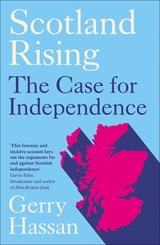
Scotland Rising
The Case for IndependenceGerry
Pluto Press, 2022
A systematic exploration of the arguments for Scottish independence from a sympathetic angle.
The Scottish independence question is one of the pivotal questions facing British politics and the future of the United Kingdom. It is also one of the most contentious and misunderstood.
In Scotland Rising, Gerry Hassan addresses the fundamental questions covering the Scottish independence debate so that people can better understand the case for independence and the nuances, contours, and implications for the whole country. Looking beyond the merits and shortcomings of the SNP and the Conservative government in Westminster, Hassan tackles the larger driving dynamics of 'the Scottish Question' - a growing desire amongst many Scots for an explicit discussion about society, public policy choices, and wider values.
Addressing the constitutional framework, and questions about the role of government and democracy, the nature of the British state, society, and capitalism, Scotland Rising makes an urgent and intelligent contribution to one of the defining political questions of our time.

Self-Determination without Nationalism
A Theory of Postnational SovereigntyOmar Dahbour
Temple University Press, 2014
How do groups—be they religious or ethnic—achieve sovereignty in a postnationalist world? In Self-Determination without Nationalism, noted philosopher Omar Dahbour insists that the existing ethics of international relations, dominated by the rival notions of liberal nationalism and political cosmopolitanism, no longer suffice.
Dahbour notes that political communities are an ethically desirable and historically inevitable feature of collective life. The ethical principles that govern them, however—especially self-determination and sovereignty—require reformulation in light of globalization and the economic and environmental challenges of the twenty-first century.
Arguing that nation-states violate the principle of self-determination, Dahbour then develops a detailed new theory of self-determination that he calls "ecosovereignty.” Ecosovereignty defines political community in a way that can protect and further the rights of indigenous peoples as well as the needs of ecological regions for a sustainable form of development and security from environmental destruction.
In the series Global Ethics and Politics, edited by Carol Gould.

Sovereigns, Quasi Sovereigns, and Africans
Race and Self-Determination in International LawSiba N’Zatioula Grovogui
University of Minnesota Press, 1996
Sovereigns, Quasi Sovereigns, and Africans was first published in 1996. Minnesota Archive Editions uses digital technology to make long-unavailable books once again accessible, and are published unaltered from the original University of Minnesota Press editions.
In this trenchant critique, Siba N'Zatioula Grovogui demonstrates the failure of international law to address adequately the issues surrounding African self-determination during decolonization. Challenging the view that the only requirement for decolonization is the elimination of the legal instruments that provided for direct foreign rule, Sovereigns, Quasi Sovereigns, and Africans probes the universal claims of international law.
Grovogui begins by documenting the creation of the "image of Africa" in European popular culture, examining its construction by conquerors and explorers, scientists and social scientists, and the Catholic Church. Using the case of Namibia to illuminate the general context of Africa, he demonstrates that the principles and rules recognized in international law today are not universal, but instead reflect relations of power and the historical dominance of specific European states.
Grovogui argues that two important factors have undermined the universal applicability of international law: its dependence on Western culture and the way that international law has been structured to preserve Western hegemony in the international order. This dependence on Europeandominated models and legal apparatus has resulted in the paradox that only rights sanctioned by the former colonial powers have been accorded to the colonized, regardless of the latter's needs. In the case of Namibia, Grovogui focuses on the discursive strategies used by the West and their southern African allies to control the legal debate, as well as the tactics used by the colonized to recast the terms of the discussion.
Grovogui blends critical legal theory, historical research, political economy, and cultural studies with profound knowledge of contemporary Africa in general and Namibia in particular. Sovereigns, Quasi Sovereigns, and Africans represents the very best of the new scholarship, moving beyond narrow disciplinary boundaries to illuminate issues of decolonization in Africa.
Siba N'Zatioula Grovogui is assistant professor of political science at Johns Hopkins University. He previously practiced law in his native Guinea.
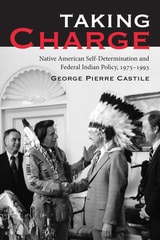
Taking Charge
Native American Self-Determination and Federal Indian Policy, 1975–1993George Pierre Castile
University of Arizona Press, 2006
The Autonomous Animal
Self-Governance and the Modern SubjectClaire E. Rasmussen
University of Minnesota Press, 2011
Autonomy is a vital concept in much of modern theory, defining the Subject as capable of self-governance. Democratic theory relies on the concept of autonomy to provide justification for participatory government and the normative goal of democratic governance, which is to protect the ability of the individual to self-govern.
Offering the first examination of the concept of autonomy from a postfoundationalist perspective, The Autonomous Animal analyzes how the ideal of self-governance has shaped everyday life. Claire E. Rasmussen begins by considering the academic terrain of autonomy, then focusing on specific examples of political behavior that allow her to interrogate these theories. She demonstrates how the adolescent—a not-yet-autonomous subject—highlights how the ideal of self-governance generates practices intended to cultivate autonomy by forming the individual’s relationship to his or her body. She points up how the war on drugs rests on the perception that drug addicts are the antithesis of autonomy and thus must be regulated for their own good. Showing that the animal rights movement may challenge the distinction between human and animal, Rasmussen also examines the place of the endurance athlete in fitness culture, where self-management of the body is the exemplar of autonomous subjectivity.

The Derecognition of States
Gëzim Visoka
University of Michigan Press, 2024
Gëzim Visoka argues that state derecognition is a highly controversial and unstable practice that has less to do with the unfulfillment of the conditions of statehood by the claimant than with the advancement of the self-interest of the former base state and derecognizing state. The derecognition of states is not a rule; rather, it is an exception in international diplomacy, driven by political expediency and is incompatible with original rationales for granting recognition. Yet, the derecognition of states is far more important than previously recognized in shaping the reversal dynamics of secession and state creation and in influencing regional peace, geopolitical rivalries, and the international order. By analyzing the withdrawal of recognition, the book offers a window into the reversal politics of unbecoming a sovereign state and how the arbitrary beginning and the end of diplomatic relations between states take place.
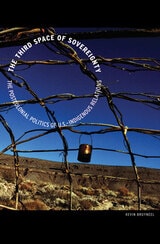
The Third Space of Sovereignty
The Postcolonial Politics of U.S.–Indigenous RelationsKevin Bruyneel
University of Minnesota Press, 2007
The imposition of modern American colonial rule has defined U.S.–indigenous relations since the time of the American Civil War. In resistance, Kevin Bruyneel asserts, indigenous political actors work across American spatial and temporal boundaries, demanding rights and resources from the government while also challenging the imposition of colonial rule over their lives. This resistance engenders what he calls a “third space of sovereignty,” which resides neither inside nor outside the U.S. political system but rather exists on its boundaries, exposing both the practices and limitations of American colonial rule.
The Third Space of Sovereignty offers fresh insights on such topics as the crucial importance of the formal end of treaty-making in 1871, indigenous responses to the prospect of U.S. citizenship in the 1920s, native politics during the tumultuous civil rights era of the 1960s, the question of indigenousness in the special election of California’s governor in 2003, and the current issues surrounding gaming and casinos.
In this engaging and provocative work, Bruyneel shows how native political actors have effectively contested the narrow limits that the United States has imposed on indigenous people’s ability to define their identity and to develop economically and politically on their own terms.
Kevin Bruyneel is assistant professor of politics at Babson College.
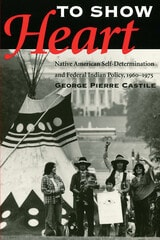
To Show Heart
Native American Self-Determination and Federal Indian Policy, 1960-1975George Pierre Castile
University of Arizona Press, 1998
To Show Heart is a detailed and unbiased account of one of the least understood periods in Indian affairs. It tells how "termination" became a political embarrassment during the civil rights movement, how Lyndon Johnson's War on Poverty prompted politicians to rethink Indian policy, and how championing self-determination presented an opportunity for Presidents Nixon and Ford to "show heart" toward Native Americans. Along the way, Castile assesses the impact of the Indian activism of the 1960s and 1970s and offers an objective view of the American Indian Movement and the standoff at Wounded Knee. He also discusses the recent history of individual tribes, which gives greater meaning to decisions made at the national level. Castile's work greatly enhances our understanding of the formulation of current Indian policy and of the changes that have occurred since 1975. To Show Heart is an important book not only for anthropologists and historians but also for Native Americans themselves, who will benefit from this inside look at how bureaucrats have sought to determine their destinies.
Trusteeship in Change
Toward Tribal Autonomy in Resource ManagementRichmond L. Clow
University Press of Colorado, 2001
This book also includes case studies focused on wildlife management, forest preservation, tribal hunting laws, and other specific concerns in management, preservation and utilization of Native American land. An excellent source for scholars in the fields of Native American and environmental studies, Trusteeship in Change is sure to spark debate and to be an important reference book for years to come.

Undoing Empire
Race And Nation In The Mulatto CaribbeanJose F. Buscaglia-Salgado
University of Minnesota Press, 2003
A revelatory account that places mulatto experience at the center of Caribbean history
This ambitious book brings to light the story of what José F. Buscaglia-Salgado terms mulataje—the ways Caribbean aesthetics offer the possibility of the ultimate erasure of racial difference. Undoing Empire gives a broad panorama stretching from the complex politics of medieval Iberian societies to the beginning of direct U.S. hegemony in the Caribbean at the end of the nineteenth century.
Buscaglia-Salgado begins with an examination of Washington Irving’s “American Columbiad” as an act of historical and territorial plundering. He then traces the roots of mulatto society to the pre-1492 Iberian world, not only finding a connection between the Moors of “Old Spain” and the morenos—the blacks and mulattoes of the New World—but also offering a profound critique of creole and imperial discourses. Buscaglia-Salgado reads the pursuit and contestation of what he terms the European Ideal in colonial texts, architecture, and paintings, then identifies the mulatto movement of “undoing” the Ideal in the wars that shook the nineteenth-century Caribbean from Haiti to Cuba, arguing that certain projects of national liberation have moved contrary to the historical claims to freedom in the mulatto world.
We Will Secure Our Future
Empowering the Navajo NationPeterson Zah and Peter Iverson
University of Arizona Press, 2012
And so began a career that took Zah to the presidency of the Navajo Nation. His life and accomplishments have exemplified the ongoing efforts by American Indian communities to gain greater control over their lives and lands. He has made important contributions in many areas, but education has always been one of his main priorities. Perhaps no one in the Southwest has done more than Peterson Zah to increase the recruitment, retention, and graduation of American Indian students from colleges and universities.
Zah's presentations to Peter Iverson's classes at Arizona State University, employed examples drawn from his own experiences. Students praised his thoughtful, honest and direct observations. He reinforced a central theme in Iverson's classesthat Indian history encompasses triumph as well as tragedy and victory as well as victimization.
This book grew out of Iverson's determination to share Zah's insights with a wider audience. The two met every few months to consider many subjects related to Zah's life. These sessions formed the foundation for this volume.
Part autobiography, part interview, and part conversation, Zah and Iverson's account touches on a wide range of overlapping topics, but two central themes prevail: education and empowerment. We Will Secure Our Future is a fascinating look into the life of a man who became a respected visionary and passionate advocate for his people.

X-Marks
Native Signatures of AssentScott Richard Lyons
University of Minnesota Press, 2010