Results by title
3 books match the query 'Self-mutilation'
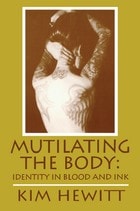
Mutilating The Body
Identity In Blood And InkKim Hewitt
University of Wisconsin Press, 1997
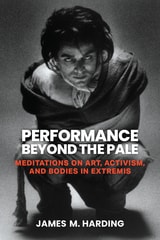
Performance Beyond the Pale
Meditations on Art, Activism, and Bodies in ExtremisJames M. Harding
University of Michigan Press, 2026
The metaphor “beyond the pale” refers to something that’s unacceptable and, as James M. Harding argues in this book, “almost always refers to something—an activity, an action, or an act—that is performed.” In this book, Harding recalls that historically the pale marked contested political boundaries and that what lay beyond the pale was considered to be a dangerous frontier. Siding with seemingly excessive and unreasonable acts and with the artists and activists who produce them, Harding brings together a series of ideas and performances that operate beyond the pale and asks readers to examine them on their own terms.
Drawing on political science, critical theory, and philosophy, Harding investigates instances of self-immolation, life-threatening journeys across deserts and seas, radical political hoaxes, extreme speech acts, and anti-police activism. The book’s five chapters consist of a series of meditations, each with an easily identifiable scholarly logic and clear argument, though the connections between the meditations are left up to the reader. Together these meditations urge readers to understand that “beyond the pale” acts are frequently the product of a sense of urgency that preempts the dictates of accepted reason, conventional logic, and safety.
Women Living With Self-Injury
Jane Wegscheider Hyman
Temple University Press, 1999
In this book, author Jane Wegschneider sheds light on this misunderstood condition. Fifteen women talk about their battle with self-injury and explain how and why they repeatedly and deliberately injure themselves. Most admit they do it because it makes them feel high or safe. They also describe living with ceaseless shame, secrecy, and fear of discovery which could make them unemployable and ostracized. Candidly discussing their attempted and successful recoveries, they reveal the impact living with self-injury has on their day-to-day lives -- where they are competent workers, partners, friends, and mothers.
Hear the voices of these women as they speak to a public that generally sees self-injury as frightening, senseless, and repulsive. Concealing scars or other signs of injury is crucial for them and partly dictates their daily routines, choice of clothes, and the lies they tell to excuse any traces of injury. For these productive women who work outside of the home and often raise children, hiding self-injury is of paramount importance during their workdays and in their relationships with partners, families, and friends.
Hyman's approach is unique in that she not only talked to these women but also really listened to their stories -- something rare in the misunderstood realm of self-injury. Professionals, perplexed by self-injury, have not always tolerated its complexity. As a result those who injure themselves have remained shrouded in secrecy, isolation, and shame -- until now.
This book offers compassion as well as encouragement for recovery by making available the emotional experiences of sufferers in their own words. It is an important book for those who self-injure, their loved ones, anyone who knows of or suspects self-injury in a friend, and mental care professionals.